
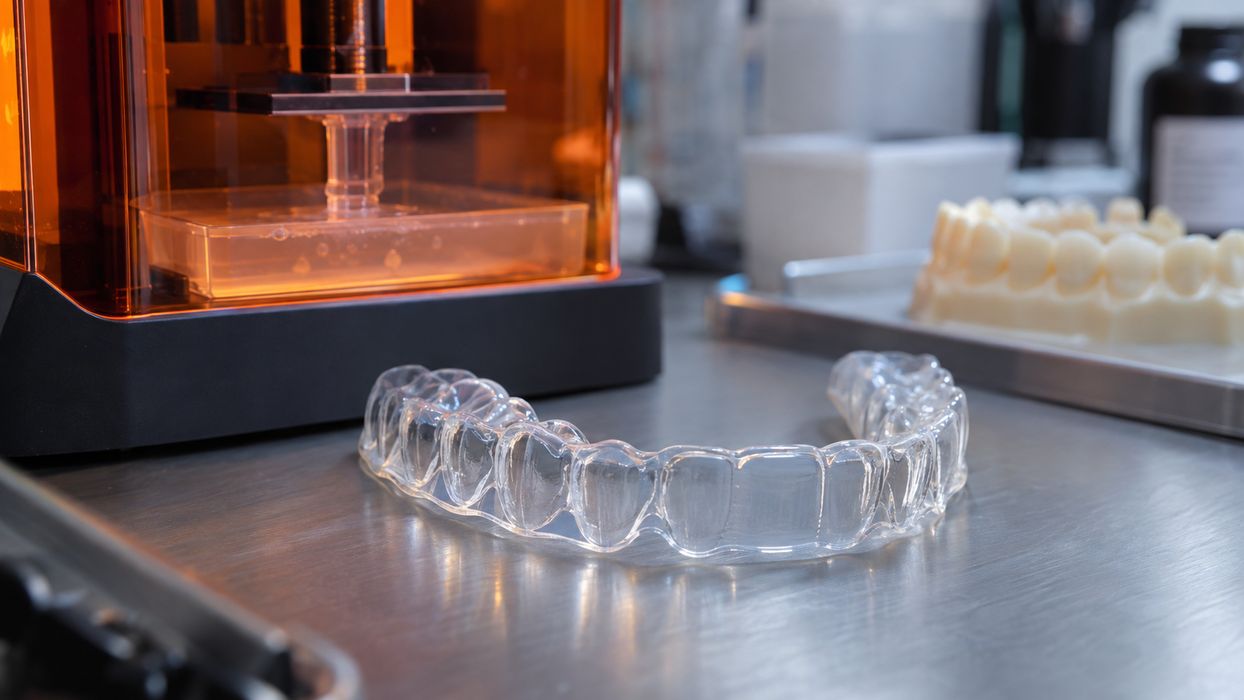
One resin could produce a 3D printed part with both soft and hard regions, according to a patent application from Align Technology.
This could be a really popular approach. Most resin 3D printing processes try to create a single consistent material throughout a part. If you need different mechanical properties, you typically print separate components with different parameters or materials, and then assemble the results.
The Chinese patent application CN123042453A describes another approach: a single photocurable resin that separates its components during curing to form different polymer phases.
Their proposed material contains at least two polymerizable components with different reaction rates. One component reacts more quickly than the other. As the resin cures, the faster component forms one polymer-rich region while the slower component remains available to form another. The result is intended to be a composite with a softer phase and a harder phase, joined within the same printed object.
That separation would not always be visible as two clean chunks of material. The patent describes continuous phases and gradients. The chemistry would determine where the material becomes more flexible and where it becomes more resistant to deformation.
The patent also describes a second way to create this difference: expose portions of the resin to different curing conditions. Those conditions might include different wavelengths of light or different temperatures. One region could therefore be cured under a first set of conditions and another under a second set, causing the two components to polymerize differently.
So a resin 3D printer would not need two resin tanks or a complicated material-switching system, which several companies have attempted to make. Instead, the material itself would act as two materials, while the curing process would determine which one is active.
The proposed resin systems include methacrylate and acrylate chemistry, along with combinations involving free-radical and ionic polymerization. Some versions use a faster-reacting component to form the soft phase and a slower-reacting component to form the hard phase. The document gives example hardness ranges of 60 to 85 Shore D for the two regions.
Their intended application is orthodontic equipment, including aligners, retainers, expanders and other appliances used to reposition teeth. A dental appliance could contain a flexible section that fits around a tooth and a stiffer section that applies force.
A clear aligner’s function depends on how it deforms and where it delivers force. A printed composite could, in theory, put those behaviours into the geometry and material at the same time.
If their chemistry works as described, we have a way to make material properties part of the print job itself, at least in two ways.
Via Espacenet