
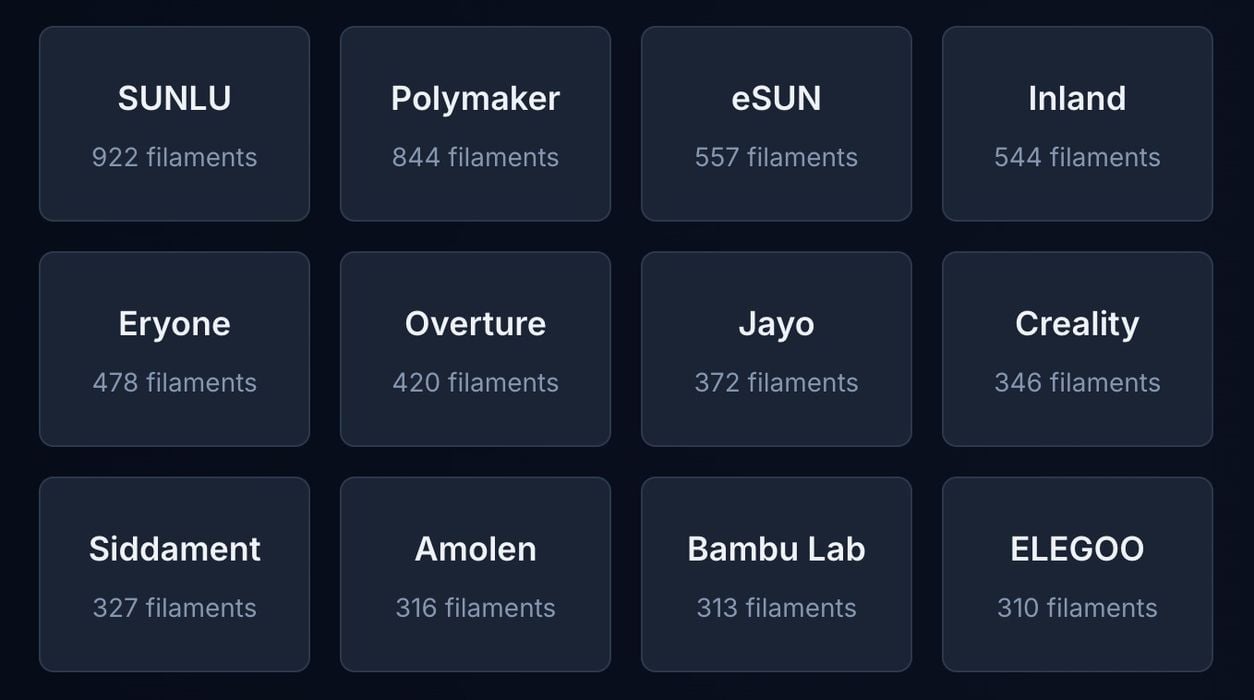
3D Filament Profiles attempts to standardize and track 3D printer filament inventories, and that could simplify FFF 3D printing.
The site is essentially a gigantic library of filament options from dozens of providers. As of this writing, it looks like there are almost 24,000 different filament options in their database, from over 900 providers. That is almost certainly the largest single collection of filament options on the planet.
Why do you need such a database? It’s simply because of the sheer number of options these days. In days gone by, a “red” filament was just “red”, and you bought from whoever provided “red” filament. You didn’t care much about colors because there really weren’t that many available.
Nowadays things are vastly different. Polymaker alone provides hundreds of different options, and it is becoming a science to select the right filament from these ever-larger providers.
That’s where 3D Filament Profiles comes in. The site allows you to “add” specific types of filament to your portfolio so that you don’t have to go chasing through provider sites to figure out what you ordered four months ago. You can also find similar filament products through the site’s search facilities.
On the site, you can browse and compare filament entries rather than relying on scattered PDFs, store listings, or forum posts that may be years out of date. That could speed up things, especially for anyone running multiple printers or switching between brands due to availability or pricing. You can even search by RGB hex code to identify the filament with the closest color match.
There is also a subtler benefit: tracking. If you can quickly look back at what worked for a specific spool or material family, you reduce the institutional memory problem that shows up in schools, makerspaces, and print farms. When staff changes, or when the “person who knows the filaments” is not around, print quality can suffer. A shared reference point, your portfolio in 3D Filament Profiles can keep operations running as they have been.
The site also has a really interesting feature to provide labeling for filaments. If you’re like me, you have mountains of filaments lying around that each have differently formatted labeling. Do you find yourself picking up spools and looking around for the labels? Are you frustrated that every vendor has a different way of laying out the information fields?
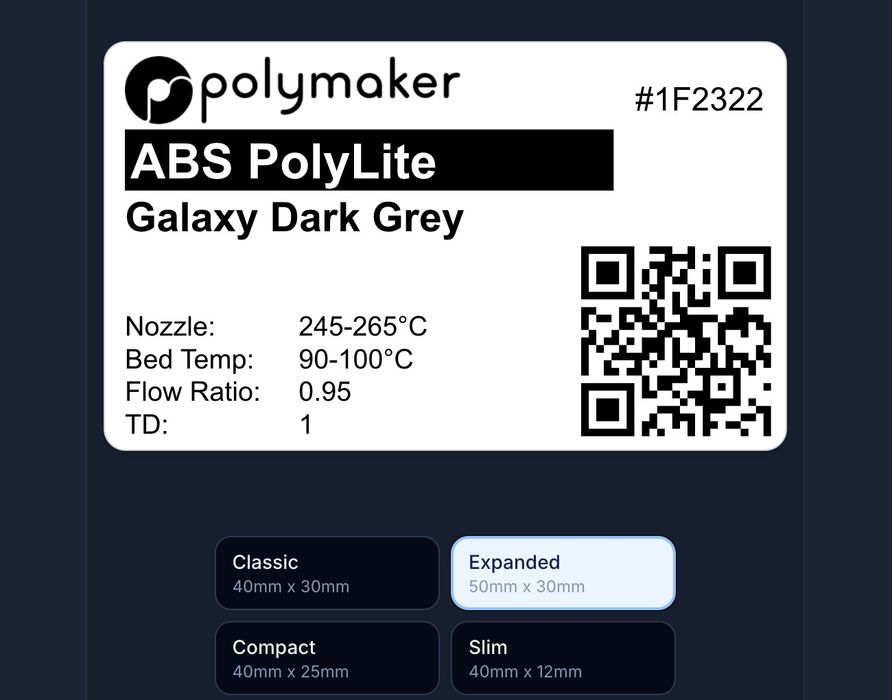
3D Filament Profiles can quickly generate a standard label that you can slap on your spools for easy reference. They even provide a way to generate different format labels: choose the style that you like best. These need only be printed on a label printer for immediate use.
What’s missing from 3D Filament Profiles is, well, profiles.
The site allows you to track your filament spools, and even hardware, providing tons of information about each. But when you want to actually use one of the spools, you will need a profile.
A profile is a set of data that associates a specific material to a specific 3D printer configuration. For example, you might want to print Polymaker Terra Blue PLA on an Anycubic Kobra X with a 0.6mm nozzle and BIQU Glacier print plate. What exactly would the temperatures, speeds and other settings for this configuration?
I was hoping that 3D Filament Profiles would provide an independent sharable resource for filament profiles that could be used, for example, when you get a new spool of material for which you don’t have a profile.
While the site doesn’t seem to have that functionality, it would seem to be a natural next step.
After all, they already have the right name.
