
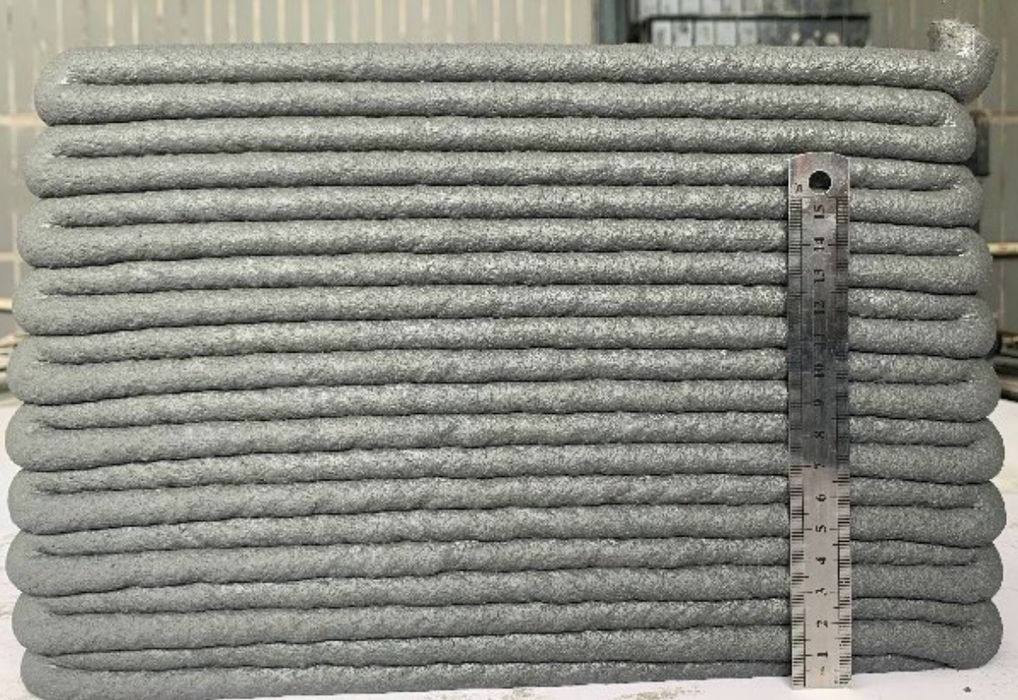
Researchers evaluated barium chloride, tartaric acid, sucrose, and sodium tripolyphosphate to tune the printability and mechanical performance of geopolymer concrete for extrusion 3D printing.
Geopolymer concrete has become a compelling candidate for additive construction because it replaces a portion of Portland cement with alkali activated aluminosilicates such as fly ash, slag, or metakaolin. That change can lower carbon while offering strength gain, but it also changes the mix chemistry and rheology in ways that standard concrete admixtures do not always predict. For 3D printing, the balance is especially delicate: the material must both pump and extrude smoothly, stand up without slumping as soon as it exits the nozzle, and still fuse layers well over an open time measured in minutes.
The new study focuses on that printability window. The researchers investigated how four common additives alter static and dynamic yield stress, thixotropic rebuild, setting behavior, and the resulting green and hardened properties. While many construction printers today rely on cement rich recipes, the market is steadily exploring geopolymers to cut CO2 and expand curing options. Tuning these mixes for pumpability, buildability, and interlayer adhesion is now a big task for system providers from startup sites to large vendors.
Dialing In The Printability Window
In extrusion based 3DCP, the working envelope is defined by three constraints: extrudability through a hose and nozzle, shape stability of freshly deposited filaments, and bond strength across interfaces as delay time grows. Chemical admixtures are the fastest lever to move these constraints without redesigning hardware. Sodium tripolyphosphate (STPP) is often used as a dispersant in alkali activated systems, helping to reduce flocculation and lower initial viscosity, which boosts pumpability and lowers required pressure. Organic acids such as tartaric acid and sugars like sucrose commonly act as set retarders in cementitious mixes, and can slow geopolymer gelation as well, extending open time at the cost of slower early strength.
Barium chloride is less common in mainstream concrete practice but can modify early reactions by complexing with anions or shifting ion equilibria in highly alkaline environments. In a layer wise build, such early stage tuning changes how fast static yield stress rebuilds after shear, which determines how tall a wall can grow before slumping. The paper reports that the selected additives meaningfully shift this balance, producing mixes that pump more easily, carry higher early green strength, or maintain workable times long enough to complete a course.
Strength, Trade Offs, And Practical Constraints
Printability is only half the story. The authors also assess compressive and likely interlayer bond strength, highlighting the familiar trade off between rapid buildability and interlayer adhesion. Faster stiffening can create a cold joint effect that weakens layer interfaces, while prolonged open time improves bonding but risks sag and geometric drift. The study indicates that certain dosage windows preserve mechanical properties while improving rheology, although precise percentages, curing regime, and absolute strengths are not provided in the summary.
There are things to be concerned about, however. Chloride bearing salts can accelerate corrosion in reinforced elements, and while many printed walls today use limited steel, anchorage and lintels still rely on embedded metal. Barium compounds also introduce handling and disposal considerations that would need mitigation on a jobsite. STPP, acids, and sugars are easier to source and dose, but on site batching must manage temperature swings, water variability, and pump shear that can erase lab gains if control systems are not in place.
For equipment makers and material suppliers, this work suggests a path forward: pair rheology modifiers with sensing and control. Closed loop extruders that monitor pressure and flow, coupled with inline mixers that can tweak admixture dosing on demand, could hold the process inside a narrow target band as weather events and print pauses take place. Service providers would benefit from a validated mix envelope and clear guidance on delay times between courses to preserve interlayer bond.
The 3DCP industry is still dialing in the optimal material mixes for extrusion, and this research shows some of that work.
