
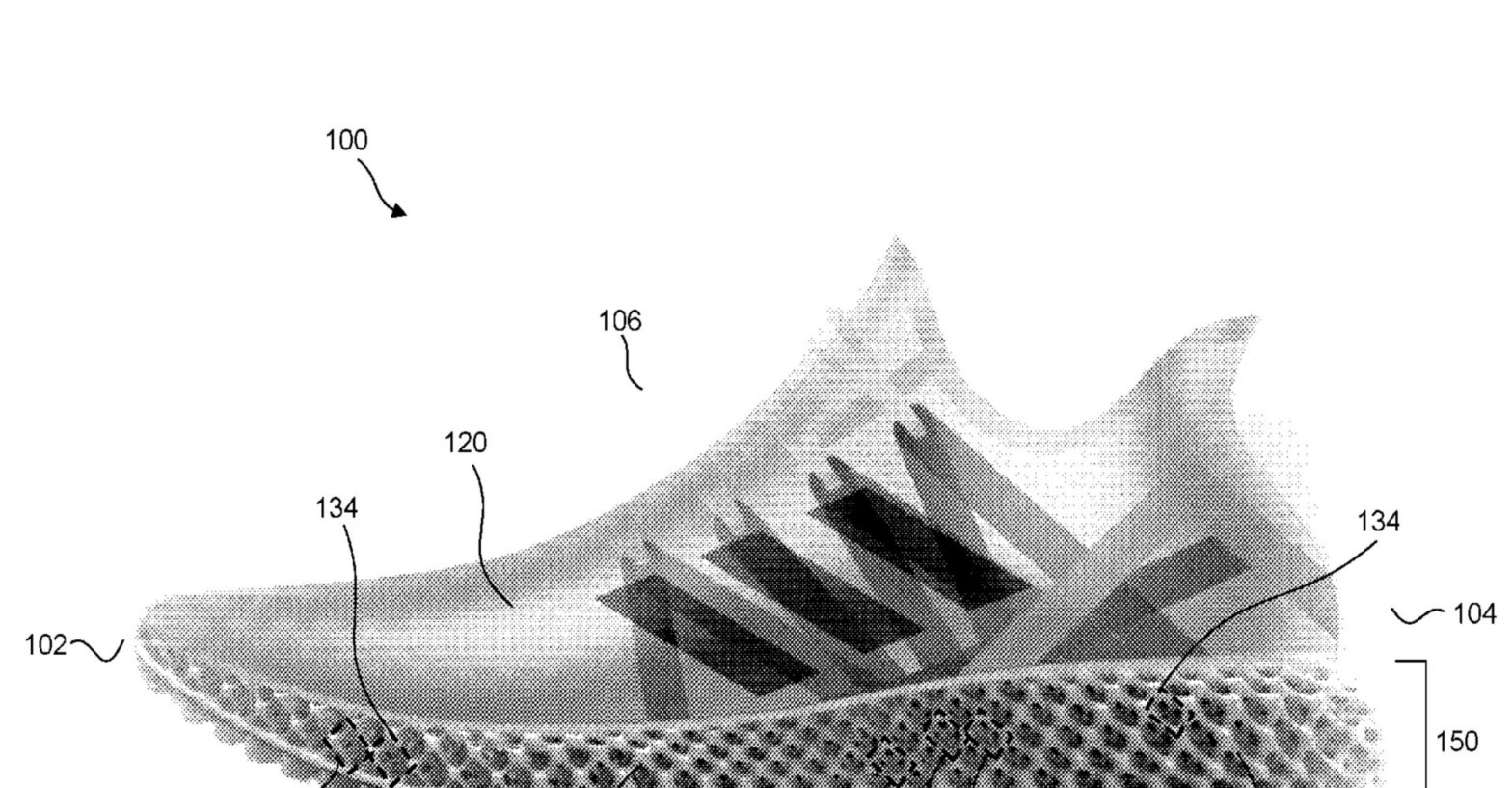
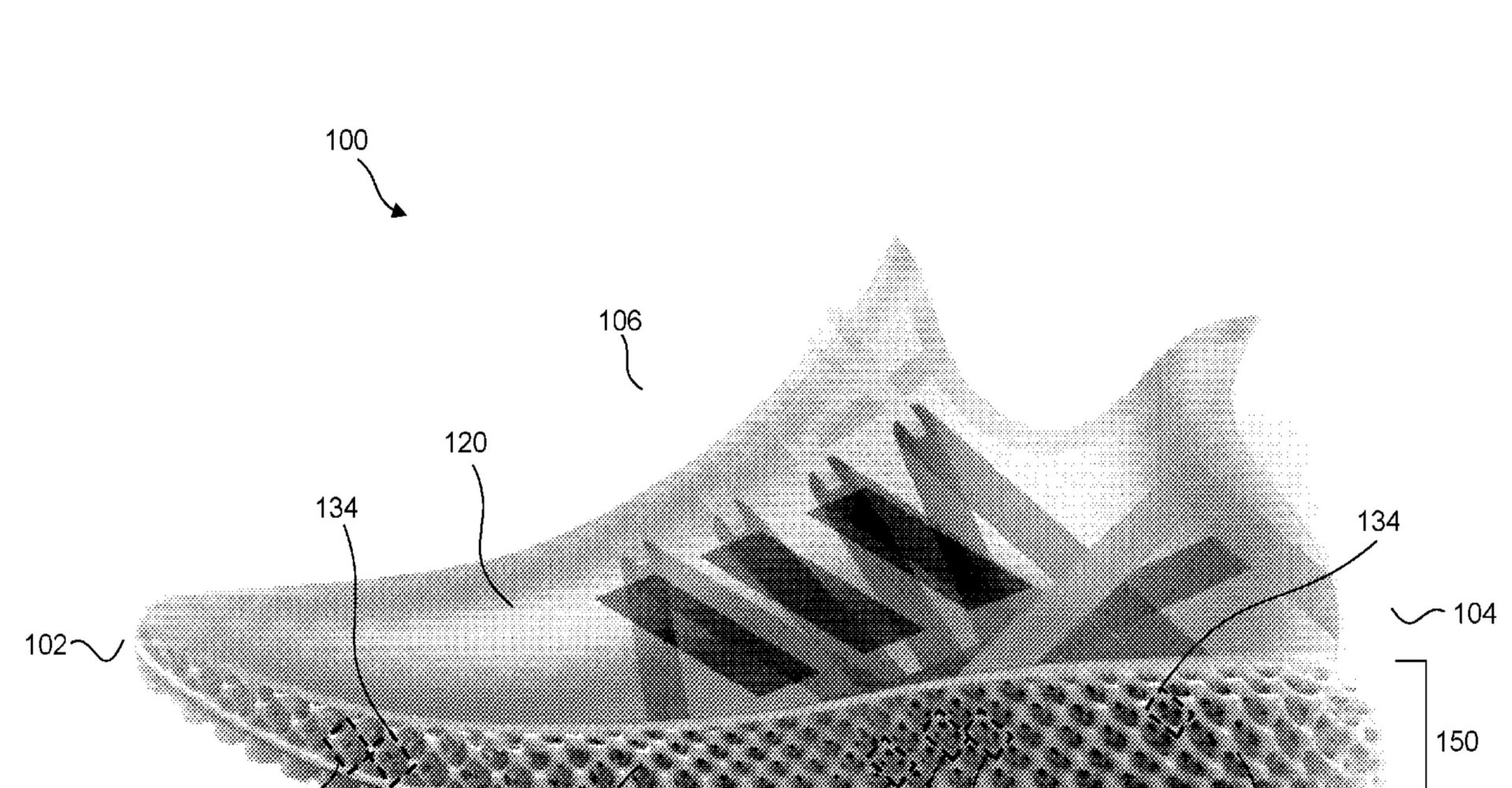
Adidas has patented a way to 3D print the bottom of a running shoe.
That is the idea in Adidas patent application US20260344837. The filing describes a 3D printed midsole built as a lattice, but with parts of its bottom surface deliberately separated so they can move relative to one another.
In a regular shoe sole, the foam or rubber structure and its tread tend to spread forces across the whole surface. Adidas is proposing something closer to a collection of cooperating zones.
The basic object here is a 3D mesh made from struts and nodes. At the bottom of that mesh, the patent places flat platforms at selected nodes. These platforms provide enough surface area for the part to sit on a build plate during printing, and later provide places where an outsole can be attached.
Here is the unusual part of their idea: adjacent platforms do not always touch at the bottom. Some are separated by a gap. Others can gradually grow larger until neighboring platforms merge into a continuous surface. The result is a sole whose bottom can change from rigidly connected to locally independent across its length.
Why design it this way? The patent links the geometry to flexibility, traction and print reliability. Separate bottom features can move as the shoe bends and may conform more readily to uneven ground. They can also reduce the amount of material at the bottom while preserving specific attachment areas.
There is a manufacturing reason as well. The application discusses continuous liquid interface production, a resin process in which the part is pulled upward from a liquid reservoir. A poorly designed lattice can detach from the build surface during printing. Larger shaped platforms give the mesh something more dependable to hold onto.
So the same geometry is doing two jobs here. It helps the midsole survive through printing, then becomes part of the shoe’s mechanical behavior.
Claim one describes two bottom skins separated by a void, with the midfoot region shorter than the forefoot and heel regions. The void can sit between two outsole pieces, allowing those pieces to move independently. Other claims add a third skin and a third outsole section.
The drawings show several possible configurations. One version uses separate forefoot and heel regions with a flexible or open midfoot between them. Another places different skins in high-wear zones. Outsole pieces can be bonded separately, or in some embodiments formed integrally with the printed structure.
That separation could let Adidas tune a shoe by region. The heel could be designed for impact, the forefoot for propulsion, and the midfoot for bending. A traditional molded sole can obviously use different densities and shapes, but a printed lattice allows those functions to be embedded directly into the geometry.
This is an interesting move by Adidas. As the 3D printed footwear market continues to grow rapidly, we should begin to see a slew of patents emerging that describe various 3D print-enabled functions. This seems to be one of them.
Via Espacenet