
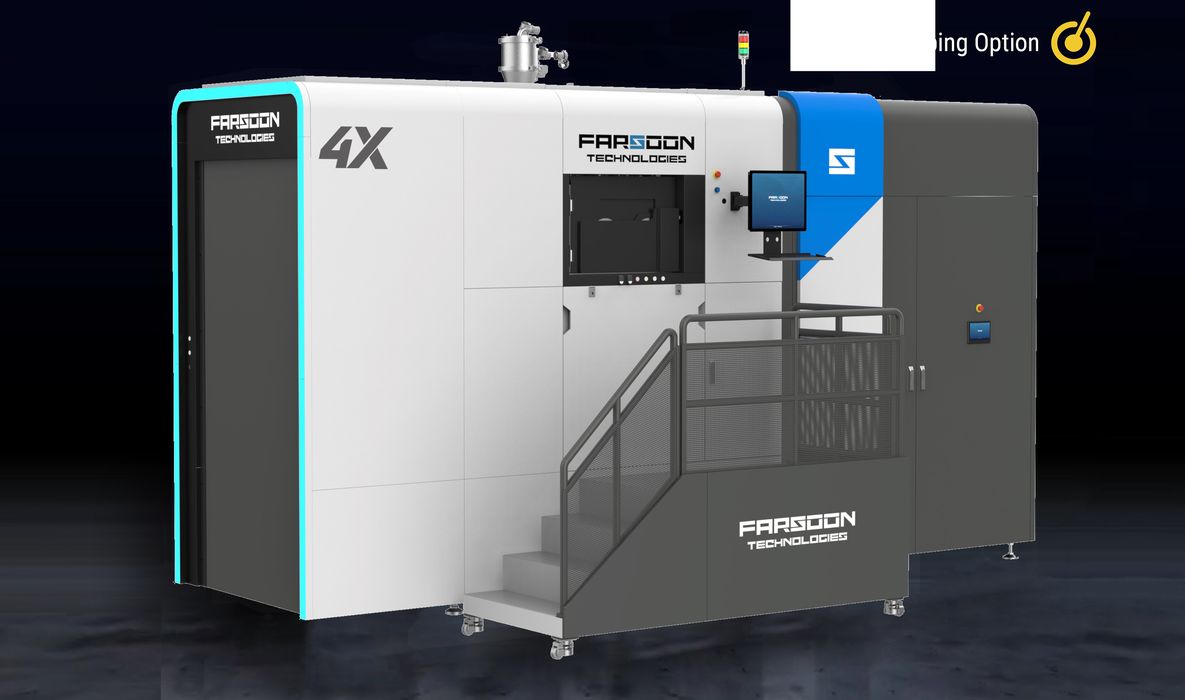
Farsoon is betting that industrial 3D printing will be won by increasing active print time.
The company’s latest announcements include three large-format production platforms. Two use the metal LPBF process: the FS722M and FS4X. The third, the Flight HT1002P, is a polymer PBF system. All three are designed around the same question: how do you keep a very large, expensive printer producing qualified parts instead of waiting for operators, cooling, powder handling or maintenance?
The FS722M is the biggest of the two metal systems, with a rather large 720 × 420 × 650 mm build volume and eight 1,000 W lasers. Farsoon lists a build rate of up to 1,000 cm³/h, depending on the material, process parameters and build conditions, of course.
That large capacity targets automotive components, tooling inserts and large machinery parts. The more interesting feature, however, is the machine’s CAMS workflow. “Continuous Additive Manufacturing Solution” uses exchangeable build cartridges, allowing a completed build to come out of the printer for processing while another cartridge is set up. This means you can, more or less, print continuously. And that’s a good thing when a production system’s goal is to keep the machine running 24/7.
Farsoon also describes a closed-loop powder system for the FS722M-CAMS. Powder recycling, sieving, storage and fresh-powder feeding take place inside a protected inert environment. That reduces the number of operator manual handling steps.
The FS4X takes a somewhat different approach. Its 425 × 425 × 550 mm build envelope is a bit smaller, at approximately 99 litres, but it can be configured with four 2,000 W lasers or six 1,000 W lasers. Its open platform is intended to let manufacturers develop material parameters and processes for their own parts.
Much of the FS4X description is about preventing production interruptions. Automated scanner calibration, multi-laser alignment, chamber pressure control, recirculating filtration and cooling are intended to keep conditions stable. A one-piece machined build cylinder reduces potential powder-leak paths, while linear-encoder feedback provides closed-loop control of the Z axis.
A low-drag recoater, a dedicated tool airlock and zero-point cylinder positioning are not each revolutionary, but together they can reduce the opportunity for interruptions.
The Flight HT1002P applies the same continuous production strategy to polymer powder bed fusion. Its 1,000 × 500 × 650 mm build volume reaches 325 litres, with four 300 W fiber lasers and scanning speeds of up to 20 m/s.
It offers a Production Mode using overlapping laser fields for output, and a Premium Mode that assigns a single laser to a 335 × 550 mm working zone for applications requiring greater process control. The machine also has a 220 C maximum chamber temperature with multi-zone heating and infrared monitoring.
Again, the machine’s workflow is as important as the lasers. Preheating, cooling and breakout stations can be arranged independently, with conveyors, automated guided vehicles or robotic arms moving build cartridges through the factory.
Farsoon’s machines now look like components in configurable production cells. That may be important, as the world is shifting to additive manufacturing, and this type of automation would fit right in.
Via Farsoon