
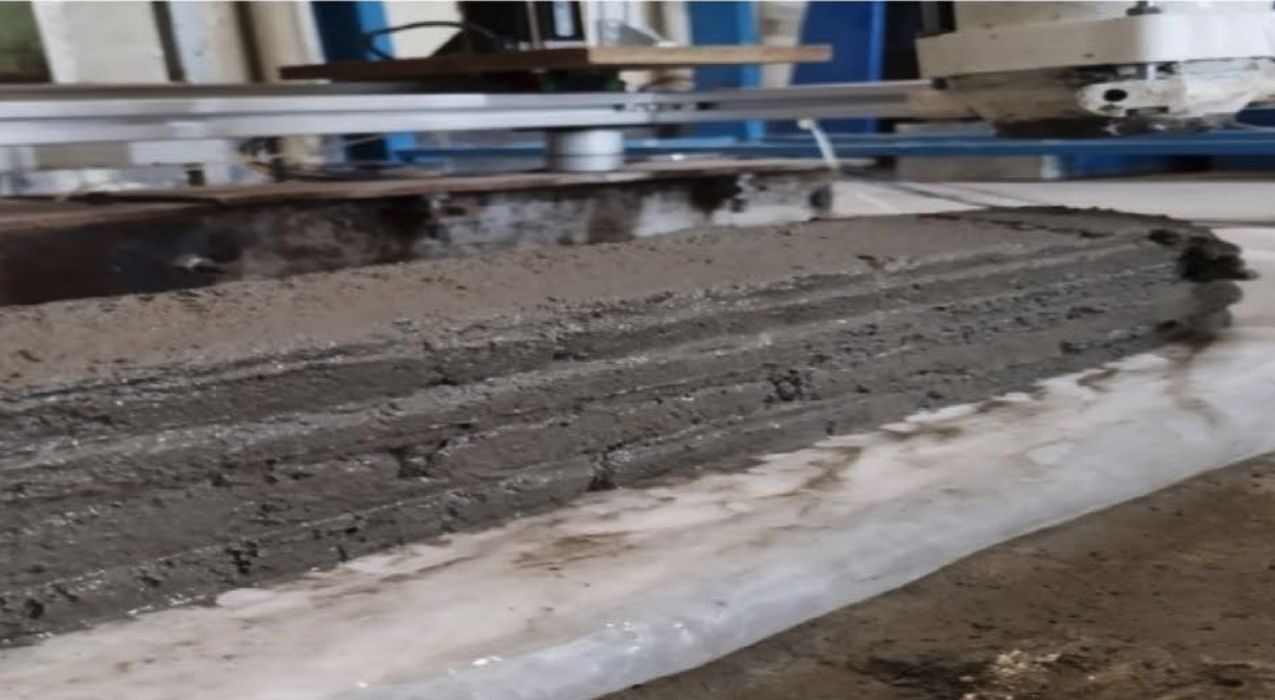
A new study explores how agricultural waste fibers can strengthen and stabilize 3D printed concrete while cutting the environmental cost of construction materials.
The results suggest that small additions of plant fibers from date palm, banana, pineapple, coconut, and corn cob waste can make printable concrete both greener and stronger — a potential leap for sustainable additive manufacturing in architecture.
Balancing Printability and Strength
3D concrete printing (3DCP) has long promised lower labor costs and design freedom, but material sustainability remains an obstacle. Concrete is one of the world’s largest sources of CO2 due to the chemistry and thermal requirements of its manufacture.
The Babol team reinforced printable concrete with bio-waste fibers instead of synthetic or steel alternatives. They tested four volume fractions, from 0.1% to 0.25%, and measured effects on flowability, extrudability, and mechanical strength.
An optimal mix was found at 0.2% fiber content, where the concrete maintained workable extrusion properties while gaining notable strength increases: 26% higher compressive strength, 40% higher tensile strength, and 20% greater flexural strength than unreinforced mixes. This is the eternal 3DCP struggle: strength of extrusion versus extrudability.
The fibers were processed from agricultural by-products — cleaned, dried, and cut without chemical treatment — to align with low-impact goals. While untreated fibers absorb more water, potentially reducing long-term durability, they remain biodegradable and easy to source locally. This approach could help developing regions utilize agricultural waste as construction reinforcement instead of relying on energy-intensive materials.
Experimental Approach
The team ran a two-phase program combining small-scale material tests and full-scale printed beam evaluations. Using a Cartesian-type printer with a 1 × 0.8 × 0.8 m build volume, the researchers extruded 35 mm-wide filaments through a 40 mm nozzle under software-controlled deposition. They monitored flow, layer stability, and inter-layer adhesion through ASTM-aligned procedures.
Key performance indicators—flow table spread, extrusion distance, and buildability—revealed how fibers interact with mix rheology. Flowability dropped by about 10% at the optimum 0.2% fiber level, a trade-off for improved shape retention and fewer deformations between printed layers.
Buildability improved markedly, allowing the printed mortar to sustain nearly double its own weight before collapse, an important capability for multi-story printing.
Mechanical Outcomes
Mechanical tests confirmed that plant fibers help mitigate cracking and enhance ductility. Direct tension and pull-out tests showed that date palm and coconut fibers achieved the highest bond strengths thanks to their rough, lignocellulosic surfaces, which improve frictional anchoring in the cement matrix. These same fibers also provided the best overall mechanical performance.
Flexural tests on printed beams showed that fiber reinforcement significantly delayed crack propagation. Printed beams generally exhibited higher ductility and energy absorption than mold-cast equivalents due to fiber alignment along the print path.
The best result came from 0.2% corn-cob fiber, which increased ultimate bending force by over 40% compared to other fiber types. However, beyond 0.25% fiber, print quality degraded as voids formed in the matrix.
Using Waste Fibers
The study concludes that low percentages of agricultural waste fibers can enhance the performance of 3D printed concrete without compromising printability — a critical step toward sustainable large-scale additive construction.
Future work is expected to focus on hybrid fiber blends, chemical surface treatments to improve durability, and the integration of supplementary cementitious materials like slag and bentonite to further reduce clinker demand.
If validated at construction scale, this approach could turn common waste — from pineapple leaves to coconut husks — into functional reinforcement for printable structures, closing the loop between agriculture and construction.
Via Nature
