
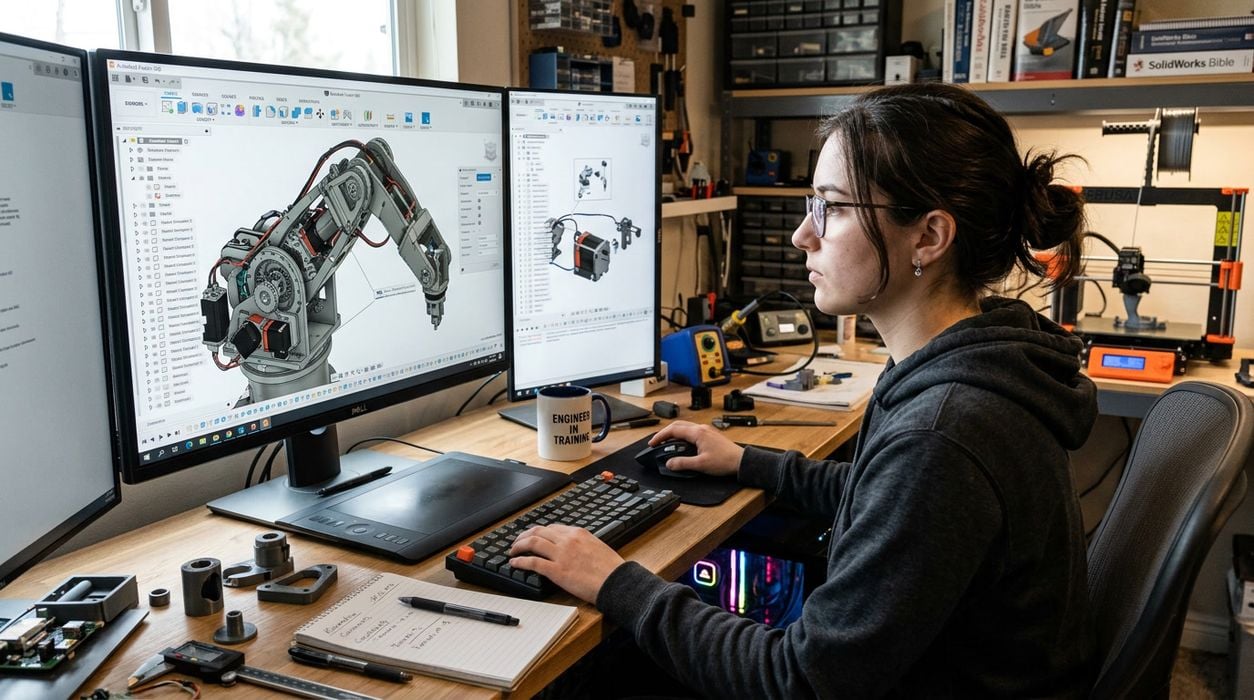
Anthropic’s latest strategy to position Claude as a tool for creative work points toward a future where describing an object could become as important as learning difficult CAD software.
This week Anthropic announced a series of “connectors” to link their AI system, Claude, to a variety of creative tools. These include systems like Adobe, Affinity, Splice, Abelton, and more. The list also include:
- Autodesk Fusion
- Blender
- SketchUp
All three of those are well-known 3D model creation tools, frequently used by Fabbaloo readers. It now appears that you can drive them using Claude by creating text prompts to describe what you want to design. This is effectively a text-to-3D system.
Anthropic is making an important statement with this announcement: its AI model can help people think visually, iterate creatively, and turn rough ideas into more structured outputs. For the 3D printing world, that’s a really important signal because design software has been one of the biggest barriers to wider adoption.
If you’ve spent any time around desktop 3D printing, you’ve seen this happen. Printing itself has become far easier with modern hardware and operational software. Slicing software is far more polished than it was a decade ago. Hardware is cheaper and much more reliable. But creating a new object from scratch still usually means learning a serious CAD workflow, and that is an immovable barrier for many creators.
From prompting to printable geometry
That’s where tools like Claude could change the game. The idea is not that a chatbot will instantly replace professional CAD packages such as SolidWorks, Fusion, Onshape, or Rhino. It’s that natural-language systems may increasingly sit in front of them. A user describes an enclosure, fixture, bracket, organizer, lamp shade, cosplay part, or educational model, and the system translates that intent into dimensions, features, constraints, and possibly code-based geometry definitions. With follow up prompts to tweak these generated designs, almost anyone should be able to create CAD models.
We’ve already seen parts of this appear through text-to-OpenSCAD experiments, generative design assistants, and AI-enhanced modeling plugins. Anthropic’s announcement adds another puzzle piece: it suggests the major AI labs now see structured creative output as a serious use case, not just chat, search, or coding assistance. In other words, the market is drifting toward “describe what you want” interfaces, and 3D design is an obvious candidate due to the difficulty many people encounter.
For 3D printing, that could be more important than many hardware launches. Why? Because the real bottleneck for a lot of potential users is not the hardware. It’s getting from an idea to a printable model. If AI can help users specify shape, fit, pattern, wall thickness, tolerances, and even printer-aware constraints in plain language, then many more people can actually make use of the machines they already have. And more people will be encouraged to buy their own.
The opportunity is real, but so are the gaps
That said, there’s a big difference between helping with creative ideation and producing reliable printable geometry. Mechanical designs are pretty complicated. A pretty concept image is easy. A parametric part that mates correctly, prints without ridiculous support structures, respects material limitations, and survives real use is another matter. Claude may help with the front end of the workflow, but it’s unclear how far that assistance goes without dedicated CAD integrations and geometry validation.
There’s also the issue of trust. If an AI-generated script creates non-manifold geometry, weak joints, impossible overhangs, or wrong dimensions, the user still needs enough knowledge to detect and fix the problem. So this doesn’t eliminate expertise. It may shift where expertise is needed: less time drawing every feature manually, more time checking intent, constraints, and manufacturability.
Another open question is workflow ownership. Will AI companies build direct 3D design front end tools themselves, or will established CAD tool makers include these capabilities first? It seems more likely that we will first see a layer of AI assistance wrapped around existing tools rather than a total replacement. That would still be quite important, even though the resulting models may not be perfect.
But consider this move as a first step into a different world of 3D design. As AI tools improve and become more integrated with CAD functions, we will gradually see the barriers get lower and lower. That will enable far more people to get into 3D printing.
So while Anthropic’s announcement is not specifically targeting at 3D printing, it reinforces the trend of design tool simplification.
Via Anthropic
