
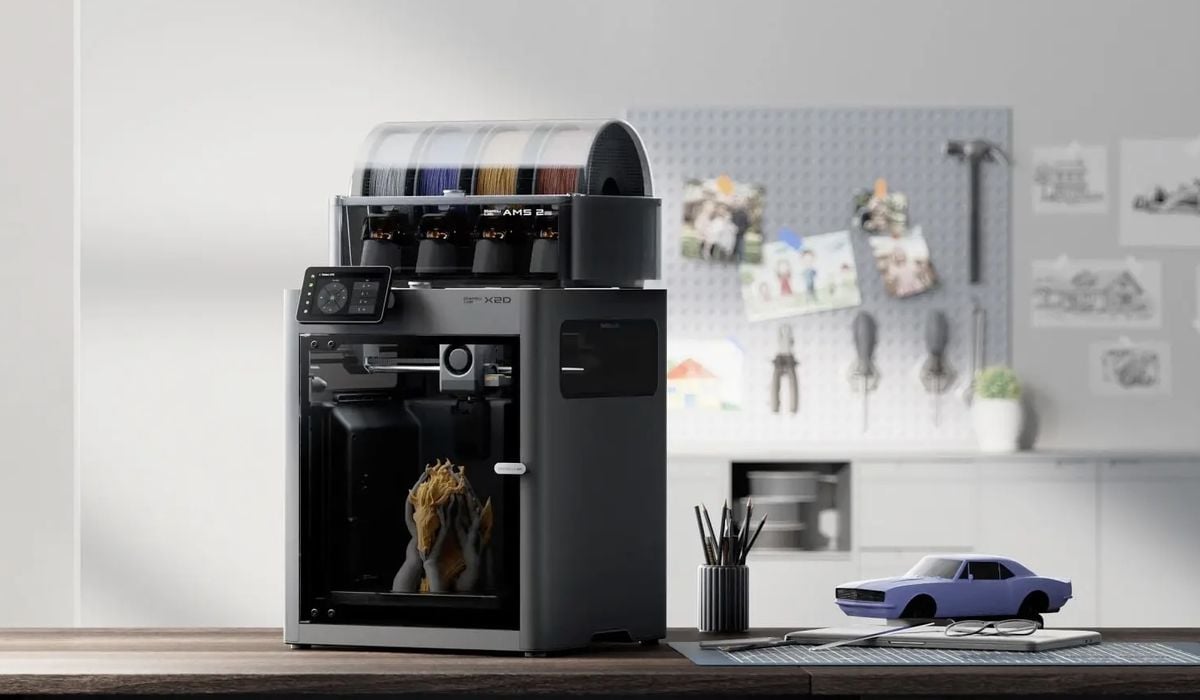
I’ve been thinking about the X2D announcement from Bambu Lab, and I believe it could be a turning point for the industry.
If you missed it earlier this week, Bambu Lab announced what at first seems to be a routine machine upgrade: it’s an “X2” instead of the now-retired “X1” series. It includes a range of features that have been introduced in other models, as well as a couple of new innovations.
A typical new machine announcement.
The X2D looks to be a very interesting machine, particularly because its dual nozzle will allow operators to very easily print highly complex 3D models with relative ease.
What struck me as being very, very different in this case was how they positioned the X2D for the market.
The features in the X2D were, by all measures, things you’d have found in professional 3D printers of only a year or two ago. These were features you’d pay extra for, as they made the machines capable of printing dimensionally accurate parts on a reliable basis.
So did Bambu Lab say this is a new, terrific professional machine (and it probably is one)?
Nope.
They instead spent most of the web page space touting the machine as being ideal for home use. It is quiet. It has filtering. It is easy to use. It connects with a database of ready-to-print models. It prints accurately. Etc.
There were many images of gaming pieces, sculptures, home parts, suggesting that Bambu Lab has very different intentions for the X2D. It seems that their target market for this system is, in fact, regular consumers.
That is quite something. That’s because the 3D print industry attempted to court consumers directly about ten years ago. Those attempts failed miserably because the machines were: constantly breaking; hard to use; missing printable content; expensive.
Since then, virtually the entire industry pivoted to other markets, such as professional, education, industrial, etc. That’s where the money was, because it certainly wasn’t in the consumer space.
Since then, there have been some mild attempts at the consumer market by various parties, but all have failed to pick up any substantial momentum.
So why is Bambu Lab doing this now, seemingly against a decade of wisdom in the industry?
I believe this goes back to the overall strategy of Bambu Lab, and we can guess some of it based on history.
You might not know this, but the founders of Bambu Lab originally came from DJI, the leading provider of drones. DJI entered the drone industry when it was far less mature. There were plenty of products, but they tended to be hard to use, expensive, and with few applications.
DJI’s strategy was to sort out those problems. They developed inexpensive products that were very easy to use and encouraged new applications by adding features to make them a natural thing to do. Eventually, they slurped up 75% of the drone market, where they are today. They were able to make a product that was easy enough for consumers to use, allowing them to sell gear to the absolutely massive consumer market. Previously, consumers would never have considered buying tricky drone products from earlier vendors.
Bambu Lab’s founders came from there.
Now, you might have seen a bit of a similarity: the current state of the 3D print industry is somewhat like the early drone industry: plenty of players, hard to use, etc. Bambu Lab’s first few products broke some of that by making it easy and reliable to print objects.
This is part of their success today: many people buy Bambu Lab equipment “because it works”. That’s another way of saying it’s easy to use, as well.
In other words, with their first several products, they may have figured out how to make machines easy enough for consumers. Or at least they believe so.
That’s why I believe the X2D is targeted at consumers: Bambu Lab is doing a big test to see whether their tech is truly ready for consumer acceptance.
If so, it then opens up the massive consumer market for Bambu Lab. Instead of selling hundreds of thousands of machines per year, they would be selling tens of millions.
It’s definitely worth a test. I’ve seen many people that are entirely non-technical successfully use Bambu Lab systems, and that’s even without positioning them for consumers. 3D print technology may now be “ripe” for consumers.
I’ve always thought this was the end game for Bambu Lab, and we just might be seeing the beginning of it unfolding before us with the X2D.
Via Bambu Lab
