
Could we soon see a “real” 3D printer priced less than US$100?
Today’s lower cost 3D printers tend to be priced in the US$200-300 range, with more competent options priced a bit higher in the US$400-800 range. While pricing has continually dropped, we still haven’t quite gotten to the magic US$100 barrier.
The march towards this goal has been quite uneven.
Many years ago desktop FFF devices were priced in the US$2000-3000 range, something hard to believe today. The idea of a US$100 printer was considered “science fiction” at that time.
However, there were several attempts to get to that milestone.
The most notable of which is certainly the notorious Peachy Printer. The device used an unusual audio method in its 3D printing process to reduce costs, but this printer never was released to the public. That’s because the company’s Kickstarter funds were stolen by the company’s CFO to build a house. If you haven’t heard that story, it’s still perhaps the most incredible 3D print saga to date.
In 2017 iMakr introduced a US$99 3D printer, the STARTT. This machine was indeed a barely functional 3D printer, but was so degraded in features that few purchased them. The product’s tagline was “Not the best 3D printer you can buy, but the first 3D printer you will buy.” The device soon disappeared.
Also in 2017 a mysterious company named Kodama introduced a US$49 desktop 3D printer, the Obsidian. Launched on Kickstarter, it collected six figures in pledges. Unfortunately, it failed miserably and basically no one received a printer. Today their website seems to be for casino promotion.
If we look at all these prior attempts to crash through the US$99 barrier, there are a couple of common characteristics:
- Fraud or other types of financial failures
- Semi-functional with far too many features removed
The latter is where I’m focused: these machines achieved their low cost simply by stripping out stuff. This approach made the machines cheaper, but at the same time rendered them effectively useless for the majority of buyers.
Remember, at that time desktop 3D printers were incredibly unreliable. You really had to be a hardware whiz to properly operate them, as they constantly broke or required significant tuning. The market was already narrow for these machines, and stripping them down made the market even smaller.
That was not a winning approach.
What really was required was a way to lower the costs of a true, nearly-full featured 3D printer. None of the earlier attempts were even slightly close.
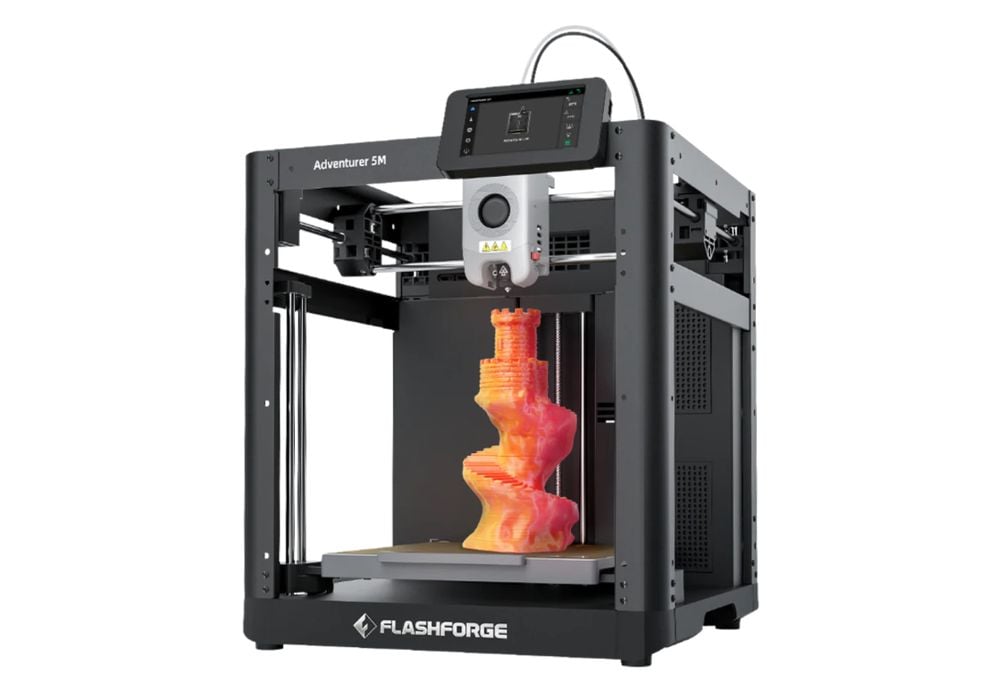
Now, however, things may be changing. Today’s standard desktop 3D printer is an enclosed, CoreXY, high speed, auto calibrating system that is relatively easy to operate. Prices have been dropping consistently, particularly on slightly older models that are being cleared from inventory.
A good example of this is the recent pricing of Flashforge’s Adventurer 5M. This is a competent machine with the above characteristics, and there have been coupon-sales of this machine recently for only US$162.
US$162 is dangerously close to US$99. It seems to me that inevitably within the next year or two we will see a proper 3D printer on sale for under US$100 for the very first time.
Will that cause a breakthrough in sales to general consumers? Perhaps, but my thought is that the ease of use problem is more than just the hardware — the software, interface and general ecosystem also has to be present and easy to use in order to fully attract consumers.
