
A newly filed Creality patent describes a modular FFF printhead that treats filament changes like tool changes.
Multi material FFF has been “solved” many times, but rarely in a way that satisfies everyone at once. Single nozzle systems that splice or merge filaments keep the motion system light, yet they pay in contamination, long purge cycles, wasted material and tricky melt zone management. Multi nozzle systems reduce color bleed, but they add mass, calibration complexity, cost and the ever present risk of one idle nozzle nicking a print as it zooms by.
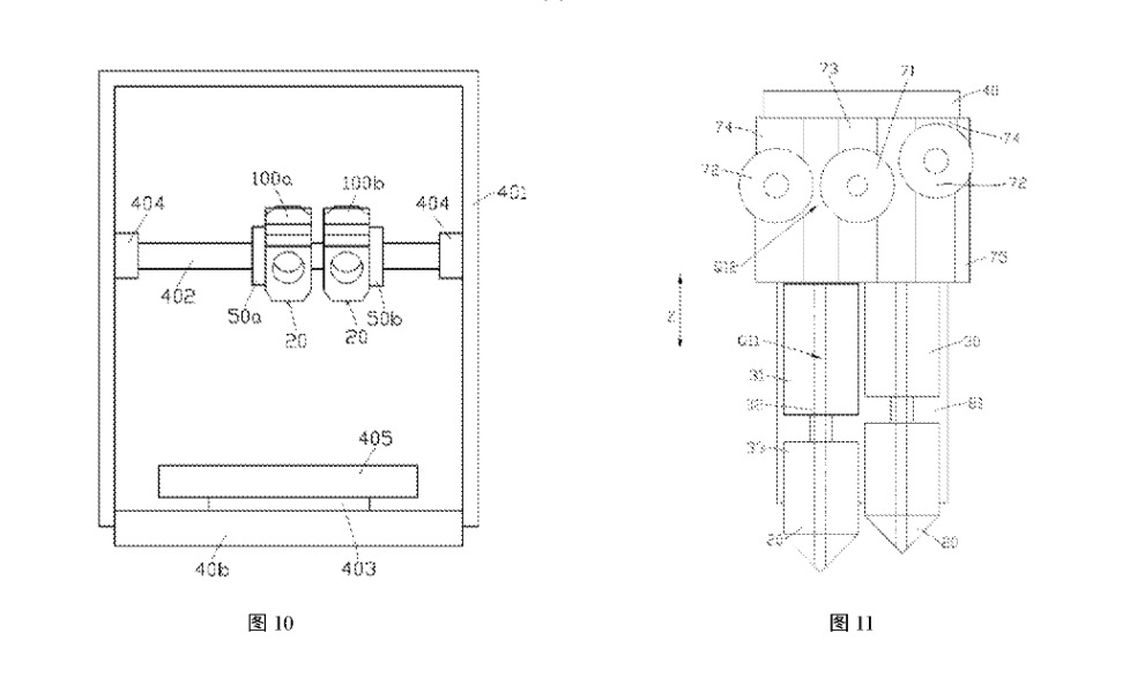
The patent, titled “Printing Module, 3D Printer, and 3D Printing Equipment,” takes a blunt mechanical approach: switching should happen by swapping which melt path is physically in the print position. The application describes a printing module with multiple transport channels, multiple hot melt assemblies, and at least one nozzle, all arranged so only one nozzle sits at the lowest “printing position” at a time.
A Printhead That Moves The Melt Zones, Not The Whole Toolhead
The core concept is a printhead with several hot melt components, each with its own hot melt channel, nozzle, and associated extrusion path. A switching assembly selectively places one hot melt component down in the printing position while lifting the others into a standby position. The patent explains that the nozzle in the printing position is the one lower than the nozzles in standby, reducing the chance of dragging an inactive nozzle through the print.
Two implementation flavors show up. One uses a switching drive and transmission member to push a selected hot melt component down. The other leans on “mechanical collision” triggering, where the printhead approaches a frame column, and that contact mechanically causes the transmission element to shift and select the next hot melt component. It is a very manufacturing minded idea: trade a motor, wiring, and control loops for a very predictable bump stop and a linkage.
The patent also proposes a buffer mechanism between the cartridge and the print module, with a spring like buffer section that provides resistance and absorbs stress when feeding starts and stops. That matters because retracting filament far enough to cleanly switch materials can create tension spikes and snaps, especially with brittle polymers.
Cutting, Retracting, And Scaling Past Two Colors
A notable detail is the integrated cutting component that can enter the transport channel and shear filament before a swap. The patent places the cutter between the extrusion assembly and the hot melt assembly, which is sensible: cut close to the melt zone, retract the upstream filament cleanly, then push a new filament into the same channel with less wasted length. Some versions use two cutters on opposite sides, enabling multiple channels to be cut efficiently, and others pair cutters with multiple module bodies to scale the concept.
The application also describes two larger architectures. One uses a “printing module” that itself contains multiple hot melt assemblies. Another uses multiple printheads, each tied to a consumable storage device, where one head prints while another head performs filament replacement in a standby location. That second approach should substantially reduce swap time, letting a non printing head do filament pulling and pushing while the active head lays down material.
What is new here is not the idea of multi nozzles, buffers, or cutters in isolation. It is the insistence that the selection mechanism can be simplified into vertical position switching, potentially triggered mechanically, while maintaining a low mass moving system.
The patent even explores a single nozzle variant with multiple hot melt channels arranged around a center, where a rotating nozzle mount selects which channel feeds the nozzle. That hybrid tries to keep nozzle count low while avoiding full material purges.
There are plenty of unknowns. No throughput numbers are stated, and the patent does not commit to how many materials can be supported before the module becomes too heavy. It also leaves open how nozzle offset calibration is handled after repeated switching, and whether the collision triggered switching is gentle enough for consumer grade frames over time.
Still, if Creality is really behind this concept, it could be an attempt to compete with other multi material systems by promising faster switching and less contamination, without huge purge towers and mountains of poop.
Via PATENTSCOPE
