
A Chinese patent proposes folding three messy resin workflows into one machine.
Desktop vat photopolymerization systems still have a slight problem. A resin 3D printer might produce the part, but operators usually still need a separate wash station and a separate cure unit to finish the job properly. That’s not news. What is interesting here is the attempt to simplify that whole workflow mechanically.
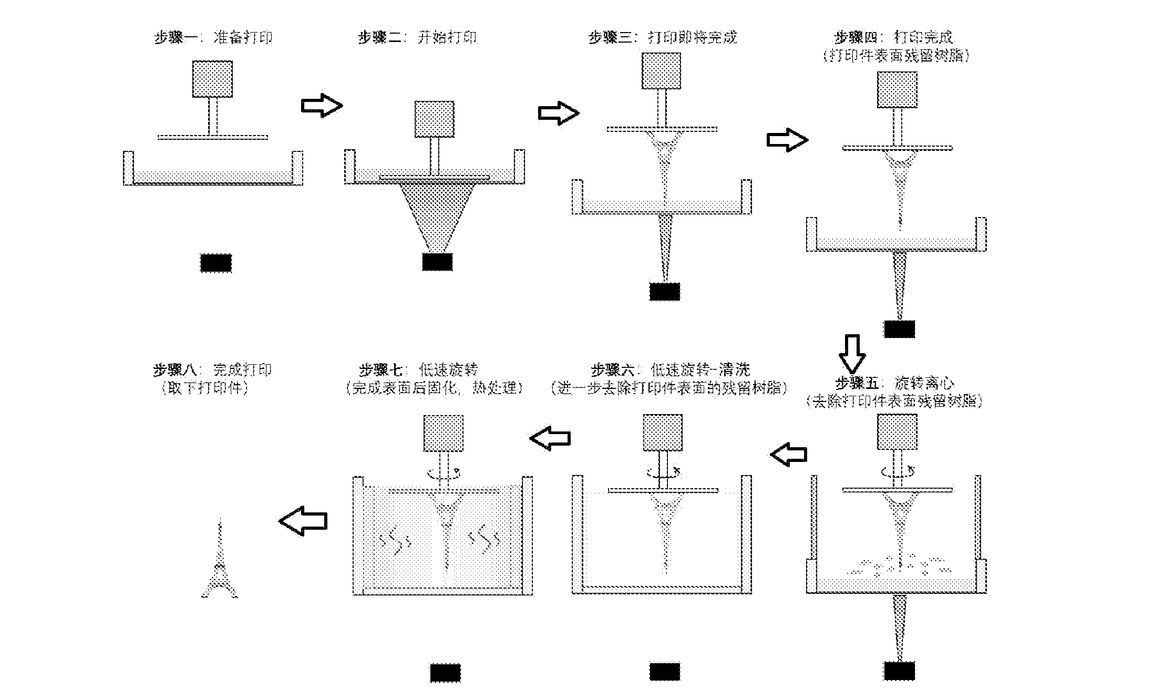
The patent describes a single material photopolymer 3D printer that adds a rotating motor above the build platform. After printing, the platform and attached part spin at high speed to centrifuge uncured resin off the surface and back into the resin vat, which is fitted with an added splash guard. The resin vat is then removed and replaced with a cleaning tank, allowing the same platform to dip and rotate in cleaning fluid. After that, the cleaning tank is swapped for a post cure heat treatment tank with curing lamps on the side walls and electric heating elements at the bottom.
This is not a new print engine. It is a machine architecture patent aimed at reducing the number of boxes on your workbench. The document explicitly says the concept can work with DLP, SLA, and LCD systems, so the news is in how the printer handles those messy steps after printing.
Why Spin the Part Instead?
The idea is simple enough that it seems reasonable. Resin parts emerge coated in uncured photopolymer, and some of that resin can and should be recovered. Spinning the build platform inside an enlarged vat area could remove a meaningful amount before the part ever reaches the wash solvent. That has two potential benefits: reduced resin waste and lower contamination of the cleaning bath, which normally gets progressively dirtier. If this approach works well, operators could stretch solvent life and reduce one of the more annoying parts of desktop resin workflows.
The patent also changes the usual wash and cure sequence. Instead of moving the part to a machine where the wash liquid or UV light field does the work, the part itself rotates inside stationary tanks. That could trim component count, reduce footprint, and lower bill of materials cost. For schools, labs, clinics, and small design shops where desktop space is at a premium, that could be quite important.
But there’s going to be some challenges, and perhaps that’s why we haven’t seen this previously. High viscosity resins, intricate internal channels, and tightly packed support structures do not magically clean themselves just because the platform spins. The patent acknowledges this indirectly by still requring an alcohol or other organic solvent wash after centrifuging. That is important to understand: this is NOT a solvent free resin workflow. It is a “solvent reduced” workflow at best.
A Cleaner Desktop Stack
There are other open questions. The patent text provided does not identify the pricing, throughput, build size, target resin classes, or actual rotational speeds. It also does not explain how the machine manages vapor containment, solvent compatibility, balancing of asymmetrical parts during rotation, or maintenance of the interchangeable tanks. Those are not things you can ignore, they will show up in a real implementation. A spinning build platform loaded with a lopsided part can introduce vibration, and a heated post cure chamber inside the same overall machine envelope raises contamination and safety questions.
Even so, the idea could be commercially useful because it eliminates some labor and clutter. That is often where desktop resin 3D printer manufacturers still have room to improve, as they all market separate wash & cure devices.
Hopefully someone turns this patent into a shipping product so we can see real experiences of resin recovery, solvent life, cycle time, and part quality. Until then, this concept will remain a reminder that when resin printing, the worst part is the clean up.
Via Patentscope
