
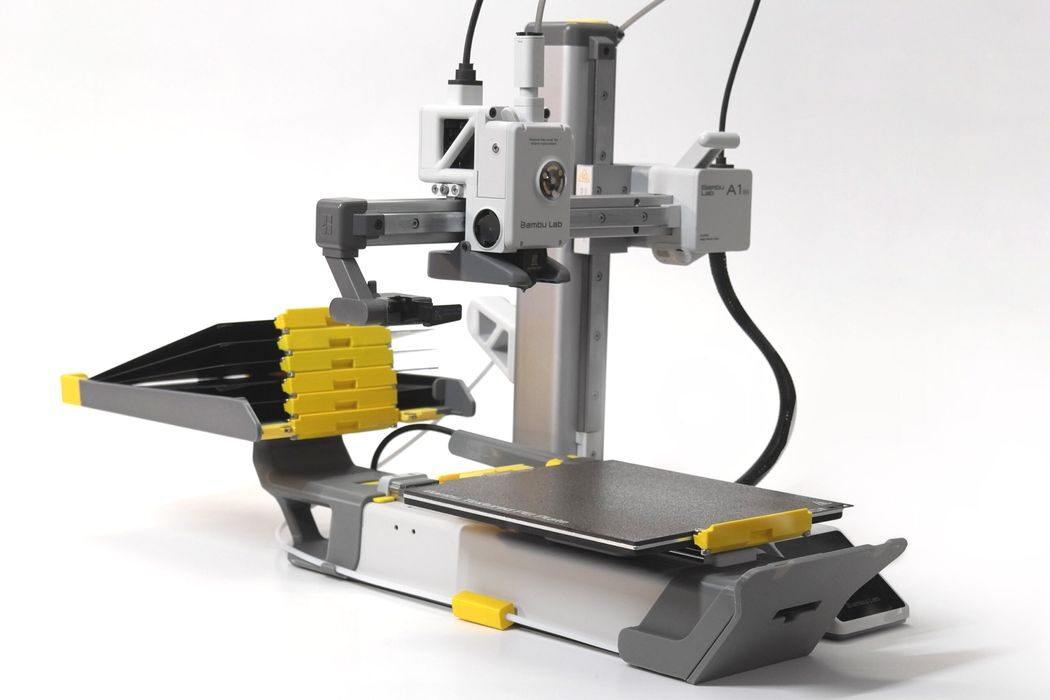
Since our last post on the PlateCycler, we’ve learned of significant controversies about this technology.
Readers may recall our hands on test of Chitu Systems’ PlateCycler from the other week. The system is a “clip on” set of parts that, with some ingenious GCODE, can automatically swap print plates when a job completes. The system allows for up to ten plates to be printed in a completely unattended manner.
I found the PlateCycler to be a pretty cool concept that actually worked. With it, your Bambu Lab A1 mini 3D printer becomes a kind of “factory” that churns out parts while you do other things.
Then I was contacted by Andre Bar of Novibar GmbH, which develops the “swapmod”. It’s a “clip on” set of parts that, with some ingenious GCODE, can automatically swap print plates when a job completes. Sound familiar?
The swapmod was originally launched as a Kickstarter campaign in 2024, and if you look at the designs of the two systems, they are functionally identical.
Not only is the hardware similar, but the software workflow is the same. In both cases you must post-process your GCODE before running it on the modified 3D printer using a website (although Chitu also provides a Windows app for this). These are the two websites:
What’s the difference between these two? Chitu Systems sells the parts as an entire kit, composed of injection molded parts, and is targeting operators not interested in printing the parts themselves. The swapmod is a small set of parts that you combine with self-printed components, at a lower price.
We’ve learned that Novibar was approached by Chitu Systems, who apparently sought a deal with the company to market the concept. Bar explains:
“In short, Chitu offered me a “co-branding” cooperation, believing that the injection-moulded version would open up a bigger market. I said that I was not interested and gave a detailed explanation as to why. Despite my refusal, they told me that they still wanted to ‘move on’ and offered to pay me a ‘moderate’ licence fee, as well as asking me if I had any patents. After receiving this response, I stopped the email conversation.”
From Chitu Systems’ side, they write this:
”PlateCycler was inspired by community prototypes like Swapmod, and by the strong interest we’ve seen in ‘continuous printing without supervision.’ That motivated us to bring this vision to the commercial market. Rather than simply recreating a prototype, we aimed to deliver a stable, ready-to-use product for everyday users.”
So we have two companies with very similar products, apparently targeting different markets. However, one seems to be based on the other.
The plot thickens. Evidently Swapmod is not sold in the US, apparently because someone has a patent on the concept. I did some investigation and found that R3 Systems has patented the concept in the US.
US Patent 12337539 and several similar entries describe a plate changing system. Here’s the abstract:
“A system and method for autonomously creating subsequent physical objects using a 3-dimensional printer. The system includes a build platform which is ejected with a printed object adhered to it, with a replenishing mechanism to place a blank build platform into the expected build area such that printing a subsequent object may occur autonomously. The replenishing mechanism may draw from a plurality of stored blank build platforms which may be reusable in some embodiments and disposable in others.”
And that is precisely what is done by Swapmod and PlateCycler.
What is R3 Printing? I hadn’t heard of them, and took a deeper look. It turns out they are a Los Angeles-based 3D printer manufacturer that’s been around for quite a few years. Today they sell the R3 Printer, which is designed for manufacturing. It offers high temperature compatibility and other 24/7 production features.
It does not offer a plate cycling feature.
Digging further, I found this in the archives:
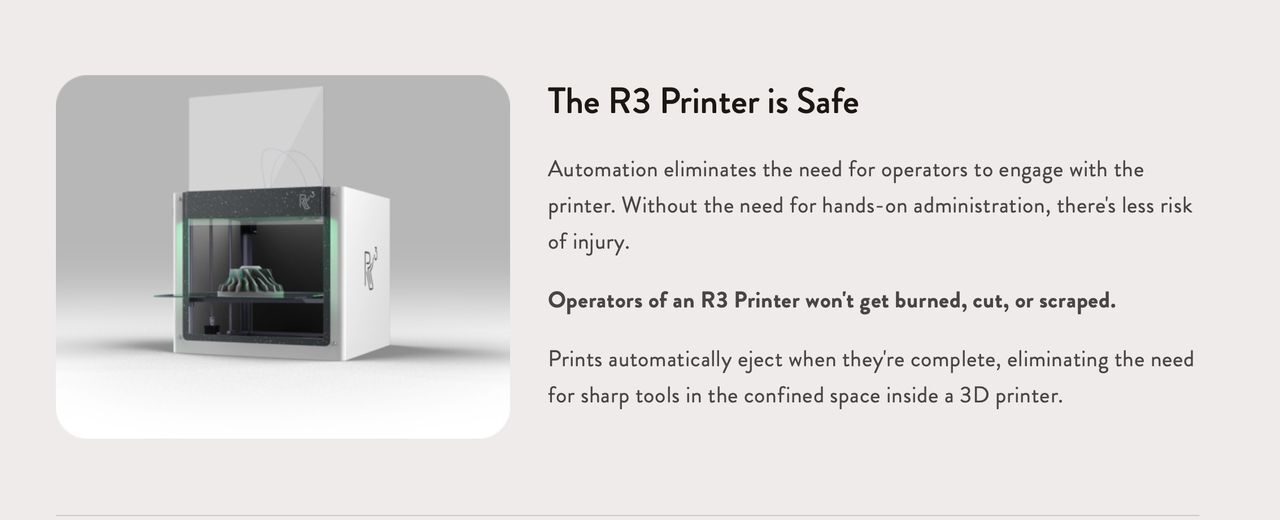
It seems that R3 Printing DID offer a plate cycling system some years ago in 2018, but subsequently abandoned it. They must have patented the process at the time, and still hold those patents.
If Chitu Systems does sell the PlateCycler in the US, it is possible they may become the accused in a patent infringement case, should R3 Printing want to protect their patent.
The plate cycling functionality situation right now seems so muddled it is unclear where it is going. That’s a shame because it is such a useful feature it should really be a default feature on every 3D printer.
