
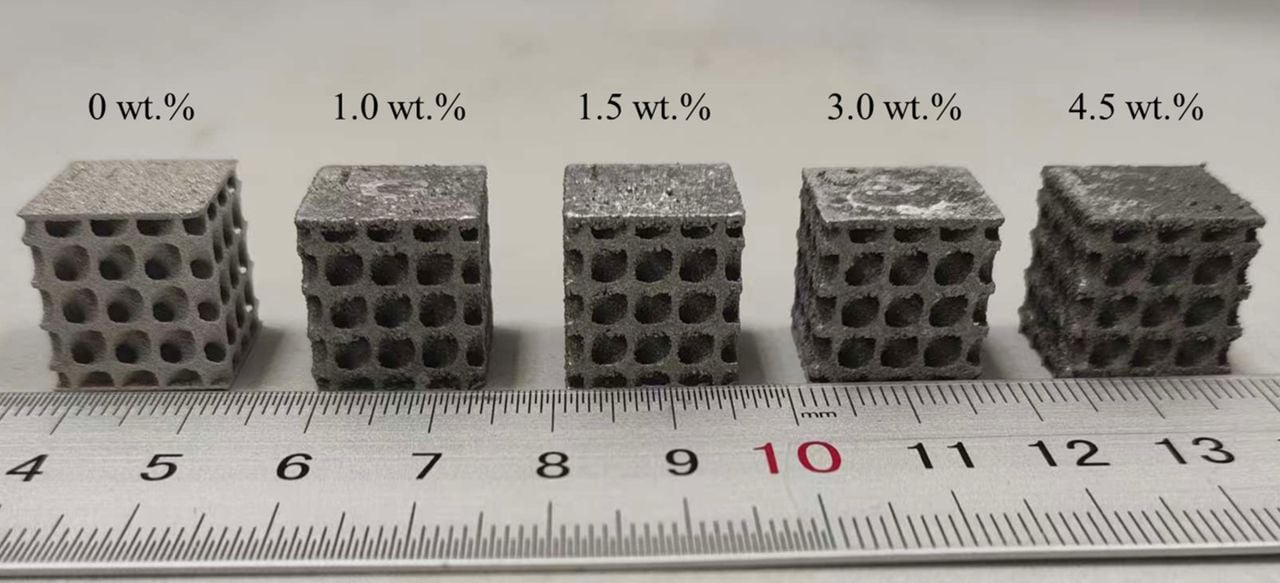
Researchers report crack-free LPBF builds of Ti-modified 6063 aluminum TPMS lattices.
Most aluminum parts made with the LPBF process today use AlSi10Mg for its forgiving solidification behavior, with premium options like Scalmalloy providing strength at a pretty steep price. Alternatively, 6xxx series alloys such as 6063 dominate extrusions in conventional manufacturing, but are notoriously prone to hot cracking with LPBF due to their solidification range and coarse grain structures.
In a new study published in Materials, the researchers engineered a Ti-modified 6063 composition and successfully fabricated crack-free triply periodic minimal surface (TPMS) porous structures with LPBF. TPMS architectures are desirable for high stiffness and tunable energy absorption, making aluminum variants attractive for aerospace, automotive and protective equipment where weight, strength and thermal management are all important.
Microalloying with titanium can introduce potent nucleants for alpha-aluminum, promoting grain refinement and mitigating hot tearing. While the paper’s details are all about metallography, the claim of crack-free builds implies a transition from columnar to more equiaxed grains and reduced solidification stress concentrations. This is similar to industry experience with other mixes, such as zirconium and scandium, but would have potentially lower material cost and simpler supply chains.
TPMS geometries complicate a print job in ways conventional designs most often do not: thin struts, high surface area and complex thermal paths can amplify residual stress and thermal gradients. Demonstrating crack-free behavior in these lattices is therefore an important proof. It suggests the modified alloy and parameter window together provided adequate melt pool stability, wetting and solidification control across intricate features.
A printable 6xxx-path alloy could align AM lattice parts with well-understood post-processing, joining and corrosion behavior in mainstream, non-printed aluminum systems. That alignment could simplify qualification challenges and could reduce reliance on specialty powders. Cost per part is also a factor, since titanium microalloying is typically less expensive than scandium additions and may be implemented via master alloys or custom powder blends.
Compatibility with existing LPBF platforms appears highly likely, since the work used standard laser powder bed fusion rather than an exotic custom process. But success at the lab does not guarantee practical production across many diverse geometries and build volumes.
If commercialized eventually, early adopters may include automotive crash structures, drone frames and heat exchanger cores where TPMS porosity can control stiffness and flow. Aerospace could follow with careful certification, especially if tensile, fracture and fatigue properties meet or beat AlSi10Mg at comparable density.
Via Materials (MDPI)
