
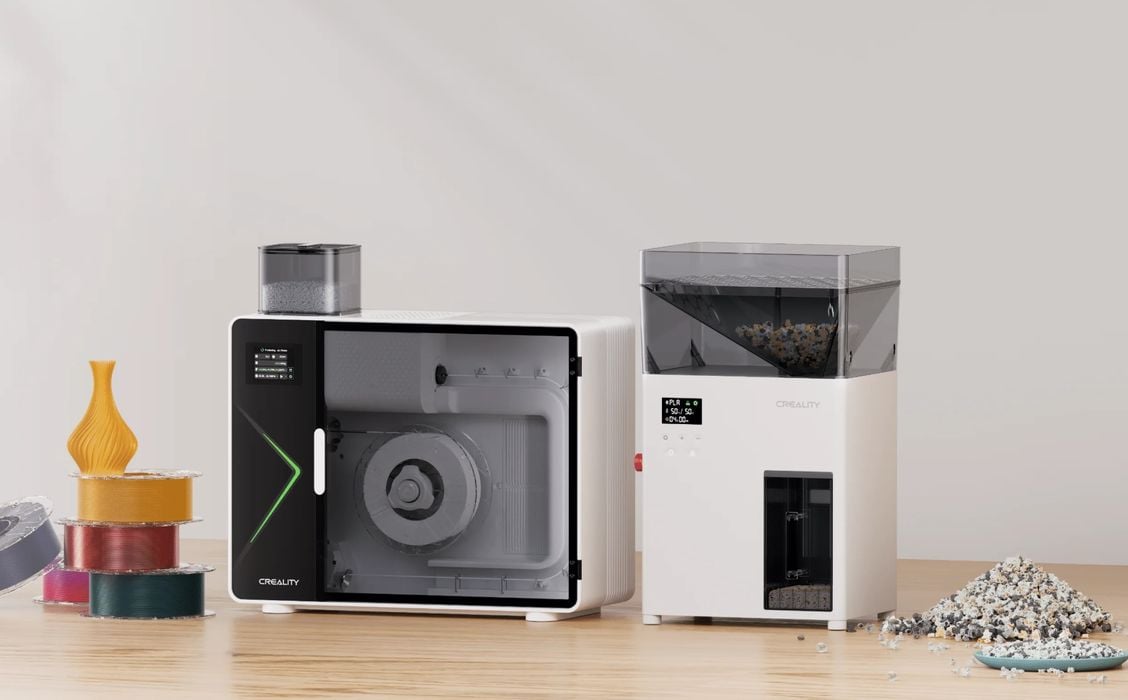
Creality is to launch a filament recycling system, the M1 / R1.
There are two pieces to this system: the R1 Filament Shredder is a device that accepts 3D print scraps or pellets, and grinds them into small pieces only a few mm across. This is to ensure a uniform flow of material into the second part of the system, the M1.
The M1 is the extruder. It accepts the ground-up scraps and feeds them into an extruder. This is essentially the same process as FFF 3D printing, since the material is heated and reformed into a new shape. Here it’s a filament.
The M1 Filament Maker also includes a take-up spool to accept freshly made filament, which presumably you can then 3D print.
The announcement of the machine appears on Creality’s crowdfunding page, which is basically an in-house Kickstarter-style setup. However, the campaign hasn’t officially launched yet. Creality seems to be teasing the audience with flashy images and animations for the system.
There is no indication of price or availability dates for the filament recycling system, but from the comprehensive nature of the page it would seem that Creality should open it up soon. They are accepting email signups for immediate notification when the system is available.
Desktop Filament Recycling?
The concept of desktop filament production has been around literally for decades, but it has largely flopped. Numerous projects have attempted to do this, but have been foiled by several significant barriers:
- The cost of the system makes recycled filament more expensive than just buying new.
- The systems are quite fiddly and require considerable care to operate successfully.
- The quality of the output filament is usually far less than any purchasable filament from proper manufacturers.
Could Creality overcome these barriers? We can’t know until the system’s full details are published, but let’s take a look at the information provided so far.
Currently, the only feasible commercially available desktop recycling system is made by 3DEVO, and it’s priced well into the five digits. This places it not as a casual accessory to clean up scraps, but instead as a lab tool to make small quantities of experimental filament. Note: there are some open-source, DIY-style options that are low cost, but they suffer from the other two barriers mentioned above.
Creality has the advantage of low-cost manufacturing capability and potentially a huge audience. No other major 3D printer manufacturer has attempted to release a filament recycling system to their large ecosystem previously, so Creality might gain a lot of buyers for the M1/R1.
A large product volume could reduce the price of the system, but I can’t see it being less than US$1,000 in any case. My guess is that this system might end up in the US$2,000+ range. Is that cheap enough for people to buy it? Would they actually save enough to warrant a purchase? It all depends on how much you recycle. For that guesstimated price, you could buy hundreds of spools of filament — and get guaranteed quality.
What about the second problem, ease of use? Here, Creality might be able to provide a significant value. Good filament production depends utterly on very precise management of feed speeds, temperatures, humidity, and more. All of those could be managed by software if sufficient sensors are provided.
Creality is accustomed to building machine management systems of this type: they’ve built that capability into their desktop 3D printers for years. Building something similar for a recycling system should be straightforward for the company.
One feature I noticed in their animation is a grabber that is able to automatically catch the extrusion and take it right to the take-up spool. This is quite different from other systems where the operator has to thread the fresh filament by hand.
Finally, there is the question of quality. Could this system deliver filament that is good enough to use?
That’s a very key question because today’s desktop FFF 3D printers are so powerful that even the slightest variation in filament quality can mess up part quality. Years ago, the machines were so bad that machine errors exceeded the filament errors, but that’s no longer the case. You absolutely need great filament quality to get good parts.
The good news is that most filament providers now provide quality filament — they have to, otherwise they couldn’t sell product. Typically, quality is measured in the average divergence of diameter throughout a spool. These days, less than plus or minus 0.05mm is the standard, with some exceptional providers even as low as 0.02mm. I would not use any filament exceeding 0.05mm.
Here, the M1 is said to produce filament with less quality:
“Achieve up to 1kg/h output within ±0.05mm diameter tolerance with our precision extrusion technology. Diameter Tolerance: Virgin Pellets ±0.05mm | Recycled Pellets ±0.1mm.”
This means that at best, the system might reach 0.05mm: it is ALWAYS going to be worse than purchased filament.
Note that “recycled” pellets — meaning those poops that have been generated by your multicolor filament swapping 3D printer — will be even worse at 0.1mm.
Then there’s the question of polymer quality. Each time a polymer is reheated, some of the molecules are damaged. This gradually makes the material less strong and causes printing quality drift. Recycled filament cannot physically be as good as fresh filament.
Finally, there’s one other problem: sorting. If you want to make a spool of pink PLA, you must feed the M1/R1 pink PLA scraps. In fact, those scraps should probably be all from the same source to ensure the polymer chemistry is the same. If not, the generated filament would have varying printing properties along its length, leading to poor quality output.
The problem is that most people really don’t have a uniform pile of 3D printer scraps. If I look through my growing sack of 3D printer poop, I see not only many different colours, but also different types of material: PLA, PLA+, PLA Tough, some other PLA Tough, PAHT-CF, ASA, PHA, HIPS, PCTG, PETG, PET, etc.
You cannot mix these in a filament recycling system.
Do you sort your 3D printer poop? I didn’t think so.
Who is the Creality M1 for?
My conclusion here is that for all these reasons, the M1/R1 really won’t be for the general FFF 3D printer operator that hopes to cash in on those scraps they’ve been collecting.
Who is it for then? My suspicion is that it could be useful in larger 3D print operations, mainly medium-sized print farms. These would typically be using the same material, over and over, and thus would have access to large amounts of uniform scrap. They would also profit from print profiles they tune for using the recycled filament. These are aspects that a single 3D printer operator may not be able to achieve.
I’m interested to see the pricing of the M1/R1 when it is announced.
Via Creality
