
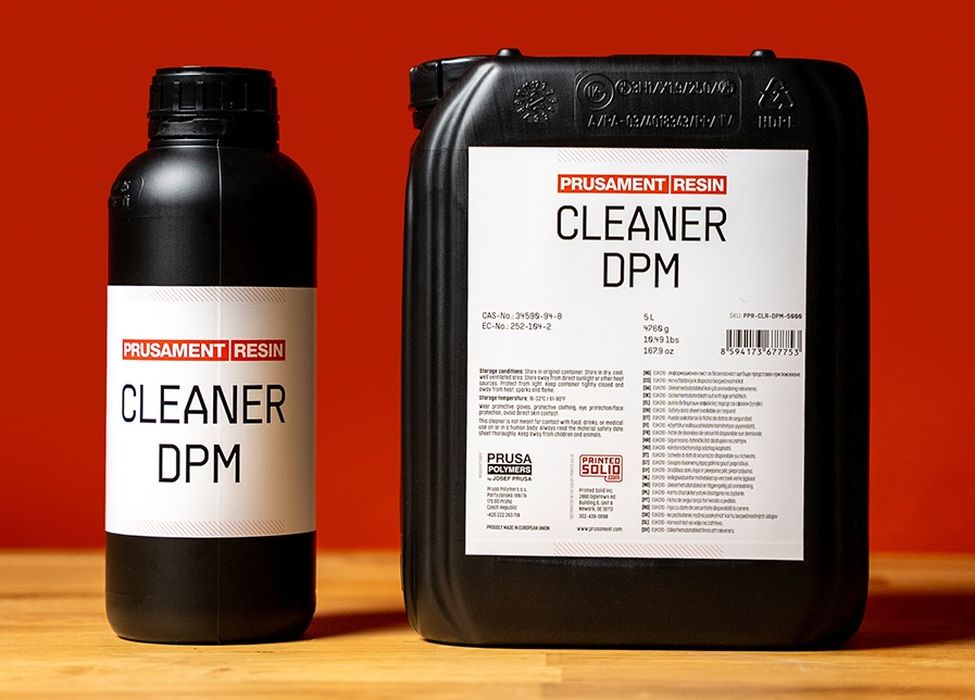
Prusa Research is now selling “Prusament Resin Cleaner DPM”, a lower-flammability alternative to isopropyl alcohol (IPA) for washing SLA prints.
If you do resin printing at home or in a small shop, you already know the routine: print on an MSLA machine, then wash in IPA, then post-cure. IPA has become the default mostly because it is easy to find, fairly inexpensive, and it works. But it also brings along a set of hazards that many users tolerate rather than solve.
Resin workflows consume a lot of washing liquid, and that means you end up storing liters of a highly flammable solvent, usually mixed in with a dose of toxic resin. Prusa Research also points out that IPA volatility leads to higher vapor levels in the workspace and faster evaporation when a container is left open. Remember that smell when you enter your resin 3D printing workshop?
With Prusament Resin Cleaner DPM, Prusa is essentially productizing a “safer wash station solvent” concept for its own ecosystem, particularly users of the SL1S resin printer and the CW1S wash and cure unit. The key difference is that DPM (dipropylene glycol methyl ether) is positioned as a solvent with a much higher safety profile than IPA, while aiming to keep washing performance comparable.
What Prusa Is Selling And How It’s Used
Prusament Resin Cleaner DPM is an organic solvent that Prusa claims has low flammability, low volatility, and “the lowest possible toxicity” for the job. The company goes as far as saying it is safer than IPA “in every way” and does not require hazard warnings in the way IPA typically does.
It is meant to be used in the same workflow most resin users already follow. Prusa describes filling the CW1S vat, running a wash cycle of about five to fifteen minutes depending on part complexity, and then rinsing the part in a second container of water. For easier removal of leftover cleaner, Prusa suggests water with dish soap, followed by drying and then curing.
On longevity, Prusa says it tested the cleaner with Prusament Resin in the CW1S and found that two liters of cleaner stayed “perfectly” effective until saturated with about 100 ml of liquid resin, after which performance gradually declines. That is a useful metric because resin washing costs are usually driven less by the initial purchase and more by how fast the solvent becomes contaminated.
Pricing is set at US$18 for a one liter canister and US$65 for five liters (Prusa notes import duties included), with EU pricing listed as €16.99. This is a fair bit more expensive than IPA, but you gain the advantages above. Prusa also notes it has not sold IPA in its own shop because flammability made worldwide shipping difficult, whereas the new cleaner’s safety profile enables global distribution without special paperwork.
Why This Matters For Resin Printing Workflows
This launch is less about inventing a new chemistry and more about shifting expectations for the “messy parts” of resin printing. Hardware keeps improving, but many resin setups still rely on an open tub of IPA on a bench, which is a poor match for growing household adoption and small-business production.
Prusa highlights four safety concerns with IPA that are worth taking seriously at scale: high flammability, volatility and vapor exposure, general toxicity and skin irritation risks, and a lesser-known issue of peroxide formation over long storage or exposure conditions. Prusa warns that visible crystals in old IPA can indicate dangerous peroxide concentration, and advises users not to handle such containers and to contact local authorities for disposal.
Assuming DPM performs as claimed across a wider range of third-party resins, the biggest benefit may be operational: fewer fire-safety constraints, fewer fumes to manage, and less solvent loss to evaporation. In other words, less “shop chemistry” for people who want the quality benefits of resin without turning their workspace into a hazmat scene.
Prusa did not publish comparative wash-quality data versus IPA across multiple resin brands, nor did they discuss how the cleaner behaves in ultrasonic cleaners or non-Prusa wash stations. Users will also want to see how quickly water rinses become contaminated, and whether the overall waste stream is easier or harder to manage than an IPA-based process.
Even if the cleaner is meaningfully safer, it does not change the core rule: anything contaminated with uncured resin should be treated as hazardous waste. Better solvents can reduce risk, but they do not eliminate the need for gloves, eye protection, and disciplined cleanup. Print safe, everyone!
Via Prusa Research
