
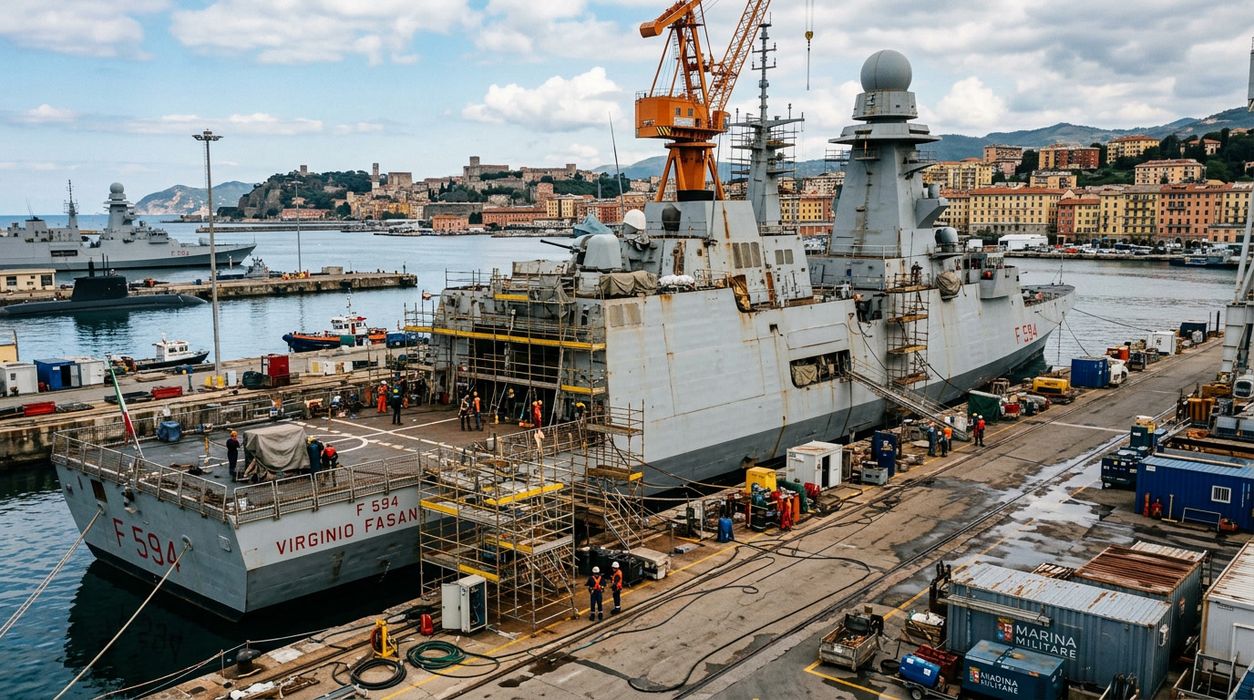
ROBOZE announced an unusual arrangement with the Italian military.
The Italian company produces industrial-grade high-temperature 3D printers. They are designed to print strong materials that are heat-resistant, using materials like ULTEM, PEEK, and PEKK.
Because of the combined strength and heat resistance, some applications can swap in these lightweight 3D-printed plastic parts for heavier metal original parts. It has been a successful strategy for the company, and they’ve been expanding for several years now.
The announcement has ROBOZE leading a new initiative called “DIANA”, which stands for “Digitales partes Ad Necessitatem Armatorum”. That’s Italian for ”Digital parts for the needs of the armed forces”. ROBOZE explains:
“The project is designed to develop new technological infrastructures to support the Italian Armed Forces and the Navy, improving the operational availability of naval units through advanced digitalization and distributed manufacturing models.”
Other participants in the ROBOZE-led project include Isotta Fraschini Motori S.p.A., NESST S.r.l., and Politecnico di Bari. The project appears to be first focusing on naval manufacturing.
At this point, I should mention that this is definitely not your usual “printer company sells stuff to military” story. This is a project to develop a continuous, end-to-end system for the use of 3D print technology to enable rapid production of parts where they are needed.
- The project intends to integrate these functions:
- Identification of damaged components on board naval units
- Digital reconstruction through reverse engineering of unavailable parts
- Technical validation of models and production data
- Decentralized production in operational hubs or containerized units
- Secure management of data and production files
To me, that sounds an awful lot like a complete system for additive production.
They say it will provide a means for both local and on-demand production near the point of use, and therefore avoid the traditional spare parts warehouse paradigms of the past. In other words, this seems to be a digital inventory initiative for the Italian Navy.
This work, if completed, could open up a huge range of potential applications for 3D print technology in the military. For ROBOZE, it could be the key to a reliable, long-term source of revenue.
But the project likely would also enable other additive providers that ROBOZE does not compete with, so it should be good for the industry as a whole.
Going further, if other militaries see value in the approach, they in turn may initiate their own digital inventory projects. This could be a really big thing.
Via ROBOZE
