
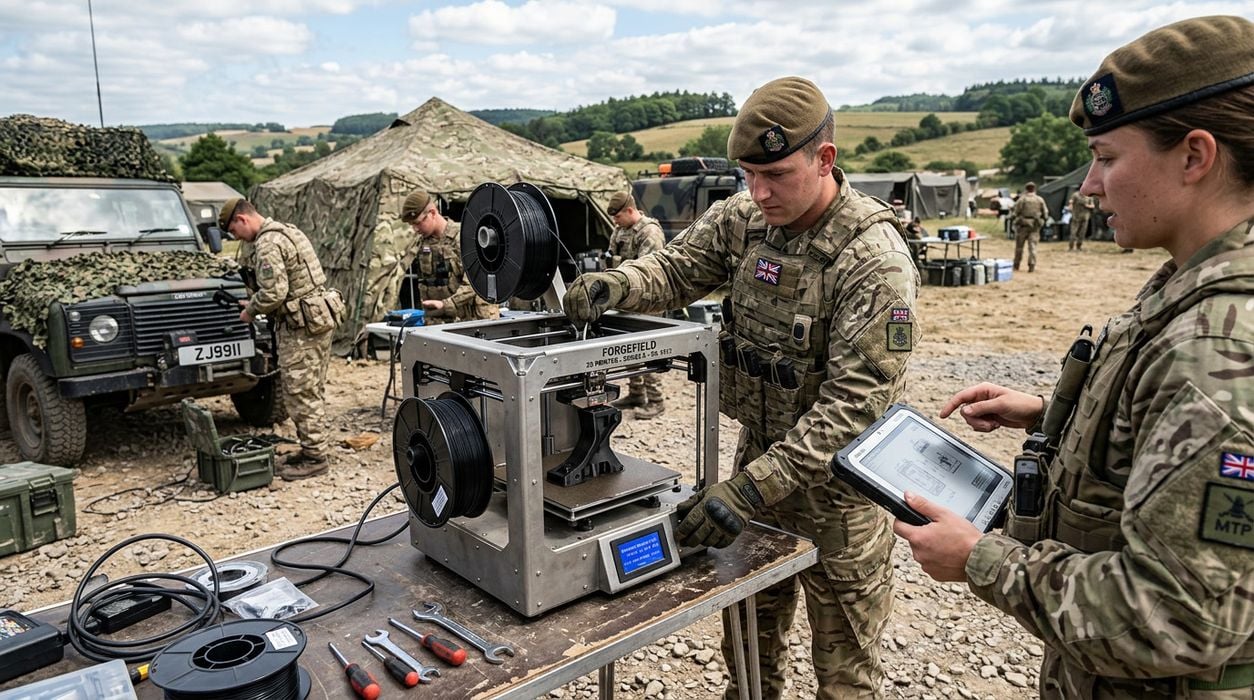
It seems every other story we write these days involves a military application.
That is indeed a sign of the times. Enormous resources are now pouring into military programs in many countries to prepare for potential future conflicts. This spending is a priority for many governments.
As you might expect, there is a migration happening in the 3D print industry because of this spending shift. An increasing number of technology manufacturers are signing contracts with military buyers, or are setting up new sub-organizations specifically to handle military applications.
Why is this happening? The answer is as plain as it was for 20th-century bank robber Willie Sutton, who, when asked why he robbed banks, apparently answered:
“Because that’s where the money is.”
And that is the same story today: the money is in military applications.
3D print companies will adjust and cater to that sector, and many will succeed. But this is not the first time the industry made a big shift.
Another shift happened about a dozen years ago, one many have forgotten.
Five years before that, the patents had expired for the very first 3D printers, opening the way for a large number of startup companies to launch inexpensive 3D printers — desktop-sized for the first time.
The common thought at the time was that these small devices could become a massive consumer product. Huge sums were poured into the industry to develop not only consumer-style 3D printers, but also the content and materials. For example, licensing deals with major brands were signed, with 3D models of your favourite characters being created.
That all collapsed a few years later when it became clear that these early machines were highly unreliable and required an on-site tech to look after them. The parts produced were of poor quality, even if you could find the 3D model you wanted (you couldn’t).
This left a lot of companies in the lurch as they suddenly found their expected consumer market to evaporate. What to do now?
They shifted.
They shifted into two places: the education and professional markets.
Some companies added learning portfolios and examples, made safety changes to their products, making them suitable for educational settings. An example of that shift was MakerBot, which even today still holds a good portion of the educational market.
Other companies pursued the professional market, adding features to their equipment to make better parts, print more types of materials, and provide better management. These were bought by engineers, design firms, and similar operations.
Both markets proved effective, and those companies that shifted tended to survive, some of which are still going today.
The companies that did not shift mostly evaporated. A great example would be Printrbot, which at one point was a leading 3D printer manufacturer. They tried to remain in the evaporating consumer space and eventually closed down.
Today, we find ourselves in the midst of another application shift in 3D printing. I’m now wondering what happens to the companies that do not make the shift to military applications. Will they disappear just like those companies from a decade ago?
Managing Director of Meltio José Luis Sánchez explains his view of the future of 3D printing in the military sector:
“The future lies in its integration as a structural capability into operations. It is not just about manufacturing parts, but about transforming the logistics model into a more decentralized, digital, and resilient model. We will see its increasing application in outposts, maritime environments and in remote operations, where autonomy is crucial. It will also play a central role in the maintenance, repair, and extension of equipment lifespans. Across industry as a whole, additive manufacturing is evolving from a production tool into a cross-functional capability that is redefining how organizations operate. The defense sector is currently the most demanding environment for testing these technologies, and what proves successful there will later be transferred to the rest of industry.”
Things could look quite a bit different in a couple of years.
