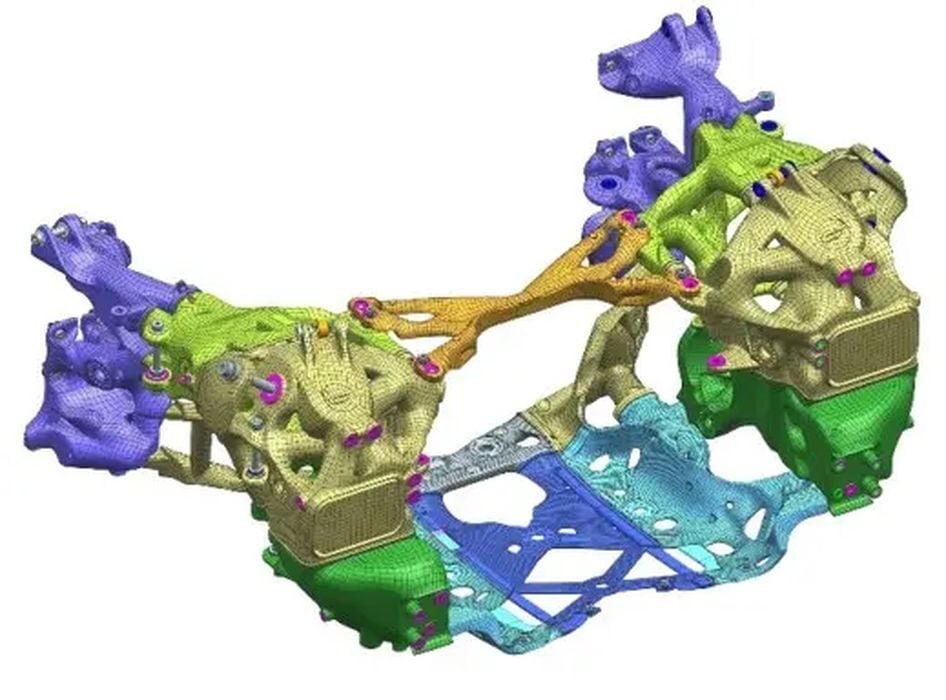
Charles R. Goulding and Preeti spotlight Divergent’s success and recent focus in the Wall Street Journal (WSJ).
It’s rare for a 3D printing startup to land in the Wall Street Journal for reshoring U.S. manufacturing, but that’s exactly what happened on September 24, 2025. Liz Young’s piece, “Why a Defense Startup Built a U.S. Supply Chain for Its 3-D Printer,” spotlights Divergent Technologies — a California-based additive manufacturing company that is attempting something extraordinary: building not only 3D printed products but also its own onshore supply chain for the machines that make them.
For years, additive manufacturing has struggled to break free from its image as a prototyping tool. Divergent’s trajectory — and the attention it’s getting from WSJ — is proof that things are shifting. By betting heavily on U.S.-based suppliers, Divergent is positioning 3D printing as a backbone for national manufacturing security, not just a niche tool for lightweight brackets or show cars.
The Story in WSJ
Young’s article explains why Divergent is making this pivot. The company’s CEO, Lukas Czinger, acknowledges that 3D printers are its biggest bottleneck. If Divergent remained dependent on outside vendors — many of them overseas — its growth and reliability would always be at risk. So the company began designing and building its own printers, with the majority of parts sourced domestically.
That choice isn’t cheap. According to Young’s reporting, domestic parts can run 25–30% more expensive than Chinese equivalents. But Divergent sees the premium as worthwhile when balanced against tariff risk, shipping delays, and geopolitical uncertainty. The idea is simple: better to own a stable supply chain than to gamble on volatile imports.
The article also notes how difficult it is to find U.S. suppliers with the precision and scale required. Divergent often signs long-term agreements or helps vendors upgrade capacity. In some cases — like laser subsystems — the domestic supplier pool is so thin that Divergent relies on just one qualified source.
Meanwhile, the company is growing fast. Its headquarters spans 150,000 square feet in Torrance, California, with a new factory planned in Oklahoma and ambitions for more than ten sites by the end of the decade. Divergent has already raised over US$1 billion, including a US$290 million Series E earlier this year that valued it at US$2.3 billion. Its customers include luxury automakers, aerospace firms, and defense primes like Raytheon and Lockheed Martin.
What WSJ captures well is the scale of Divergent’s ambition: it doesn’t just want to sell parts or printers. It wants to be a new kind of industrial backbone, capable of serving both commercial clients and the U.S. defense establishment.
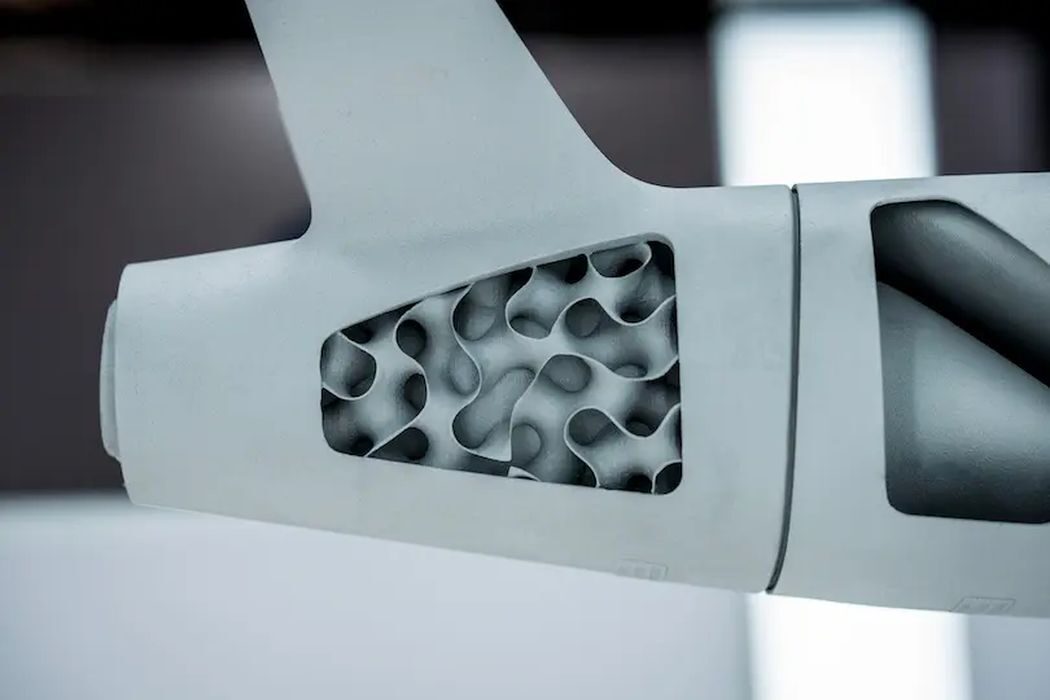
Divergent’s Current Projects
The WSJ article offers the frame, but Divergent’s projects show how that vision is being realized.
Automotive and Hypercars
Divergent is closely tied to Czinger Vehicles, the hypercar company founded by Lukas and his father, Kevin Czinger. The company’s 21C supercar, famously designed with AI and built using 3D printing, demonstrates Divergent’s end-to-end digital production model. Fabbaloo has previously covered Divergent’s automotive work in this feature.
Beyond its own cars, Divergent supplies advanced structural parts to high-end brands including McLaren, Mercedes-AMG, Aston Martin, and Bugatti. McLaren, for instance, is using Divergent-printed suspension components on new performance models. These collaborations prove that Divergent’s adaptive production system can meet the standards of world-class automakers.
Aerospace and Defense
In aerospace, Divergent has partnered with General Atomics Aeronautical Systems (GA-ASI) to apply its workflow to unmanned aircraft systems. It has also teamed with Raytheon to speed naval hardware production, while supplying parts and design support to primes like Lockheed and Triumph Group. The defense angle is more than a revenue stream — it’s integral to Divergent’s positioning as a national manufacturing asset.
Software and Integration
Divergent has also entered software collaborations that expand its reach. Its partnership with Palantir integrates Divergent’s DAPS (Divergent Adaptive Production System) into Palantir’s Foundry platform, giving defense and industrial clients the ability to tap into on-demand additive production. A similar partnership with webAI brings distributed AI tools into Divergent’s digital workflow, making its factories more autonomous and resilient.
The Ecosystem Around Divergent
While Nikon SLM Solutions is the most prominent 3D printing firm tied directly to Divergent — they previously partnered on machine development — the broader additive ecosystem matters here. Companies like EOS, Velo3D, Desktop Metal, GE Additive, Stratasys, and Markforged all play roles in pushing metal and polymer additive technologies forward. Divergent, however, is distinctive in its decision to vertically integrate: it’s not just a user of these machines but increasingly a designer and builder of its own.
This integrated approach sets Divergent apart. Most automotive and aerospace firms remain equipment agnostic, sourcing machines from whichever OEM fits the job. Divergent is building the machines, the parts, the software, and the manufacturing plants. That level of control is unusual — and costly — but it may also prove necessary for the scale of manufacturing independence they envision.

The Czinger Connection
The Czinger family’s role is central to the Divergent story. Kevin Czinger, Lukas’s father, has a long history in automotive ventures and is known for his vision of AI-assisted, 3D printed vehicles. Together, Kevin and Lukas launched Czinger Vehicles and built the 21C supercar as a proof point. We have previously written on Fabbaloo about the Czingers’ ventures, tariffs, and the role of additive in reshaping manufacturing — themes that resonate directly with Divergent’s current strategy.
By linking the Czingers’ automotive experimentation with Divergent’s broader industrial vision, we can see a through-line: using additive manufacturing not for showpieces, but as a foundation for how industries — and even national defense — might operate in the future.
Why This Matters
For additive manufacturing, Divergent represents both promise and risk.
Promise:
- Full-stack integration of software, AI, robotics, and printing.
- Expansion beyond niche markets into mainstream automotive and defense supply chains.
- A credible case for additive as a national security tool.
Risk:
- U.S.-based supply chains are expensive and fragile, especially when supplier pools are thin.
- Scaling from luxury and defense contracts to mass-market viability remains unproven.
- Heavy capital requirements mean Divergent must keep raising money or securing government backing to hit its ambitious goals.
Still, the Wall Street Journal coverage underscores that Divergent is no longer just a curiosity in the additive world. It’s being treated as a serious industrial player, one whose model could influence how manufacturing evolves over the next decade.
The Research and Development Tax Credit
The now permanent Research and Development (R&D) Tax Credit is available for companies developing new or improved products, processes, and/or software. 3D printing can help boost a company’s R&D Tax Credits. Wages for technical employees creating, testing, and revising 3D-printed prototypes can be included as a percentage of the eligible time spent on the R&D Tax Credit. Similarly, when used as a method of improving a process, time spent integrating 3D printing hardware and software counts as an eligible activity. Lastly, when used for modeling and preproduction, the costs of filaments consumed during the development process may also be recovered.
Whether it is used for creating and testing prototypes or for final production, 3D printing is a great indicator that R&D Credit-eligible activities are taking place. Companies implementing this technology at any point should consider taking advantage of R&D Tax Credits.
Conclusion
For Fabbaloo readers, Divergent’s appearance in the Wall Street Journal is a milestone. It shows that additive manufacturing is entering the mainstream conversation about industrial policy, defense readiness, and economic competitiveness. Divergent’s decision to onshore its supply chain may seem risky, but it’s also visionary: it treats 3D printing not just as a tool, but as the seed of a new industrial framework.
We’ve covered Divergent before, and we have connected tariffs to additive’s growth potential. With the Czingers at the helm, a billion dollars in funding, and the WSJ spotlight, Divergent now stands at the center of the reshoring conversation. Whether it can deliver on that promise will shape not only the future of 3D printing, but perhaps the future of American manufacturing itself.