
Technical University of Denmark has patented a resin 3D printing concept that moves the optics instead of exposing a whole layer at once.
Most vat photopolymerization systems fall into a few standard patterns. Stereolithography (SLA) typically scans a laser across the resin surface, while Digital Light Processing (DLP) projects an entire image through the vat or onto the resin. Masked stereolithography (MSLA) uses an LCD mask to do something similar at a lower cost.
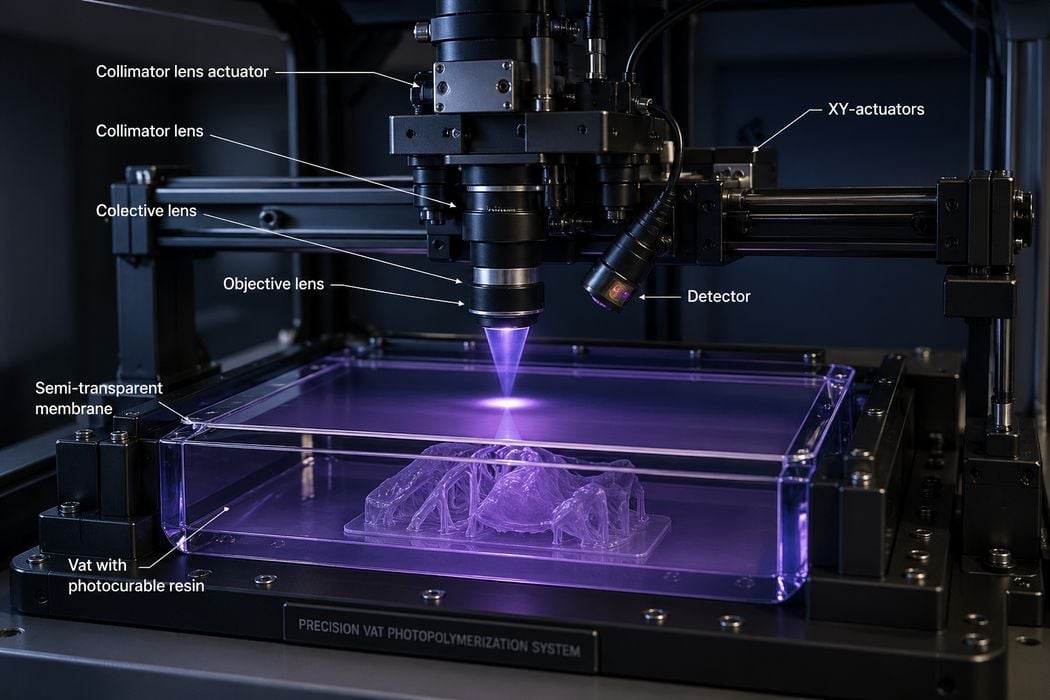
The DTU approach described in patent application US-20260116006-A1 sits somewhere between these ideas. It uses a vat of photocurable resin, a semi-transparent membrane, and an optical unit that can be positioned in the XY axis. The optical unit includes light sources, a collimator lens, an objective lens, and a detector for monitoring properties of the object and substrate.
That combination of components suggests a scanning resin system with more active control than a basic desktop SLA machine. Rather than simply sweeping a beam across a surface at a fixed focus, the system can move the optical unit and adjust the focal point along the optical path. The goal is to cure resin at specific positions with high resolution and accuracy.
Moving the Cure Point
The most interesting detail is the adjustable focal point. A collimator lens actuator changes where the light is focused, allowing the system to cure resin at targeted locations as the optical unit moves. In other words, the printer is not merely deciding where to shine light in the XY plane; it is also changing the optical conditions used to create the cure.
That could be important in several ways. Resin systems are already highly sensitive to exposure energy, optical distortion, oxygen inhibition, resin depth, peel mechanics, and the interface between the part, vat, and build substrate. Adding focal control could help improve feature definition, compensate for geometry, or manage cure behaviour near a membrane or substrate.
The detector is also interesting. The patent abstract says it monitors properties of the object and substrate, although it does not say exactly which properties. That leaves open several possibilities, including optical feedback, height sensing, cure verification, surface inspection, alignment monitoring, or substrate condition checking.
Remember, this is just a patent, not a product announcement. There is a ton of information we don’t yet know about this concept. Those details would determine whether this concept is practical for actual applications.
Precision Instead of Projection
DLP and MSLA systems work well because they expose large areas at once, making prints speedy. A scanned optical unit as proposed might provide finer localized control, but it also risks slowing the print speed unless it can move very quickly to cure multiple zones.
Where this could possibly become most useful is when making parts that require higher precision instead of print speed. Research labs, optics work, microstructured parts, and high-value engineering components might benefit from controlled exposure and sensing.
Implementations of this patent would be in the Formlabs, 3D Systems, and microfabrication spaces. If DTU can show superior accuracy, feedback control, and reliable curing with a moving platform, this might become a licensable technology, rather than a standalone printer line.
One question: How much slower is the scanning process, and could it still compete with projection-based vat photopolymerization?
Until that is answered, this patent appears to be an interesting resin printing architecture, but not necessarily one that’s commercially viable.
