
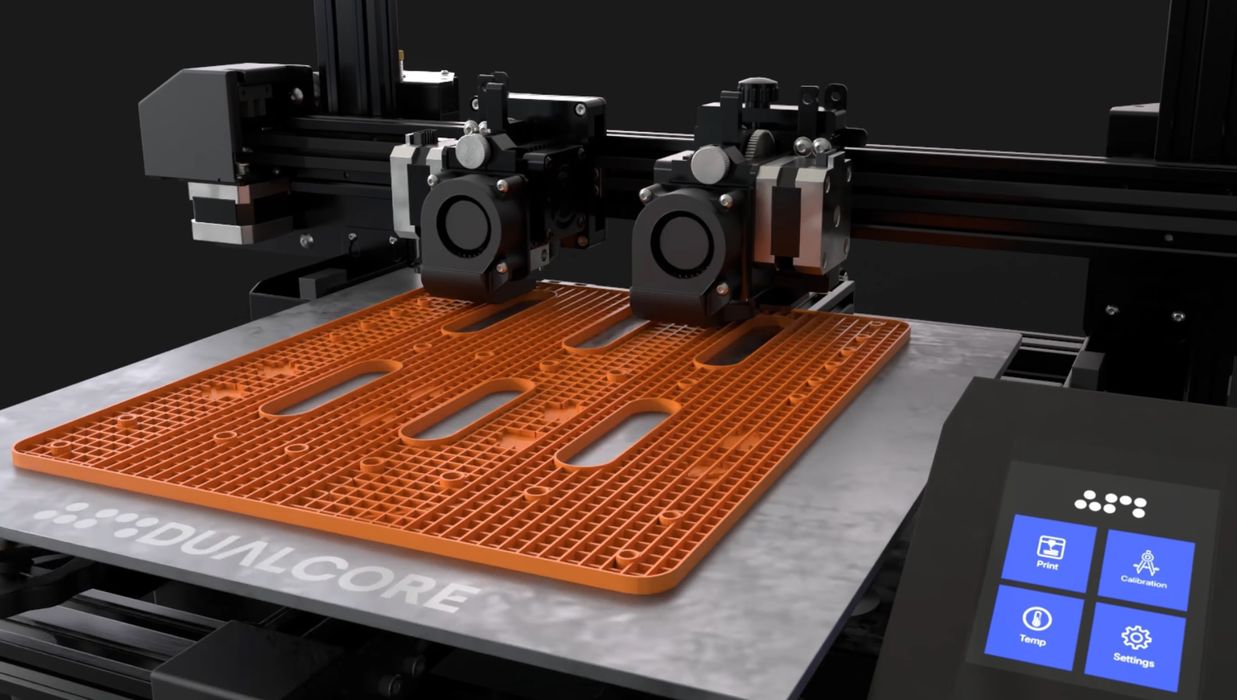
A new Kickstarter launch has a 3D printer with several never-seen-before innovations.
Now, I know what you are thinking: yet another Kickstarter 3D printer launch, the same as the rest, doomed to failure. While we don’t know if Anabolic Mechanic’s campaign will succeed, we can see that their new DualCore system does things other 3D printers have never done.
One clue is in the product name: DualCore. This is, as you can tell from the images, a dual extrusion system, and they are independent: it’s an IDEX system. That is something that’s been around for at least ten years.
DualCore Innovations
What’s different here is that somehow Anabolic Mechanics has figured out something no other IDEX provider has done: use two toolheads on one model.
Previous IDEX implementations typically offered several modes of printing:
- Single, like a regular one-extruder system
- Dual, printing two identical but separate objects
- Mirror, printing two identical objects but mirrored left/right
Note that you don’t see any option to have both toolheads work on one 3D model.
Why? Because it’s complicated. When printing separate objects, there is little chance of collisions and misalignment. It seems that Anabolic Mechanics has figured out that software problem and implemented it in the DualCore.
This means that the DualCore can print objects faster because two toolheads work on the same object. Of course, it’s not twice the throughput, because the two toolheads will have to avoid each other during the print job: imagine trying to print a very small object. But it’s still going to be faster to receive your completed print.
I’ve wanted this feature for a dozen years, and no one I’ve spoken to had any thought to build it. Now Anabolic Mechanics appears to have done it.
This makes for some complex measurement. How fast can this device print? It’s not a simple answer anymore because it depends on the object’s geometry. Anabolic Mechanics provides some math to do so, but while correct, it’s going to be beyond many buyers. For marketing purposes, they cite “1,850mm/s speed”, but that’s going to vary depending on what you’re printing.
The dual technology is not the only innovation in the DualCore system. They’ve made a couple of other very interesting software changes, both of which strengthen parts, implemented in their own slicing software tool.
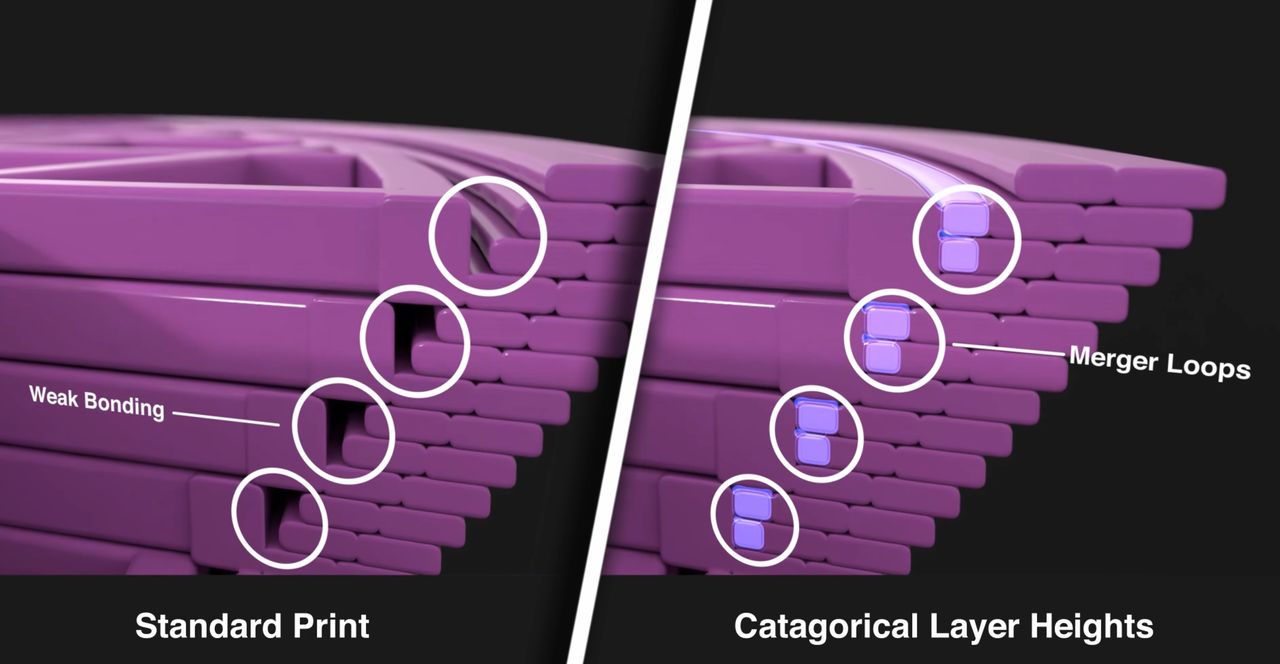
One is something they call “Categorical Layer Heights”. Basically, it’s a way to strengthen the bonding between the perimeter layers and the infill. Because the perimeters can often be curvy, they don’t match the vertical orientation of the infill. This can create gaps, which are obviously a weak point. The new approach is to detect these gaps and fill them in with different layer heights. They explain:
“Categorical Layer Heights lets DualCore use different layer heights for different parts of the same print, based on what each region actually needs. Visible surfaces like contours, perimeters, and outer skins are printed at finer layer heights for better surface quality, while internal regions like infill can be printed at larger layer heights to save time. This means the printer stays beautiful where it counts, and fast where it matters.”
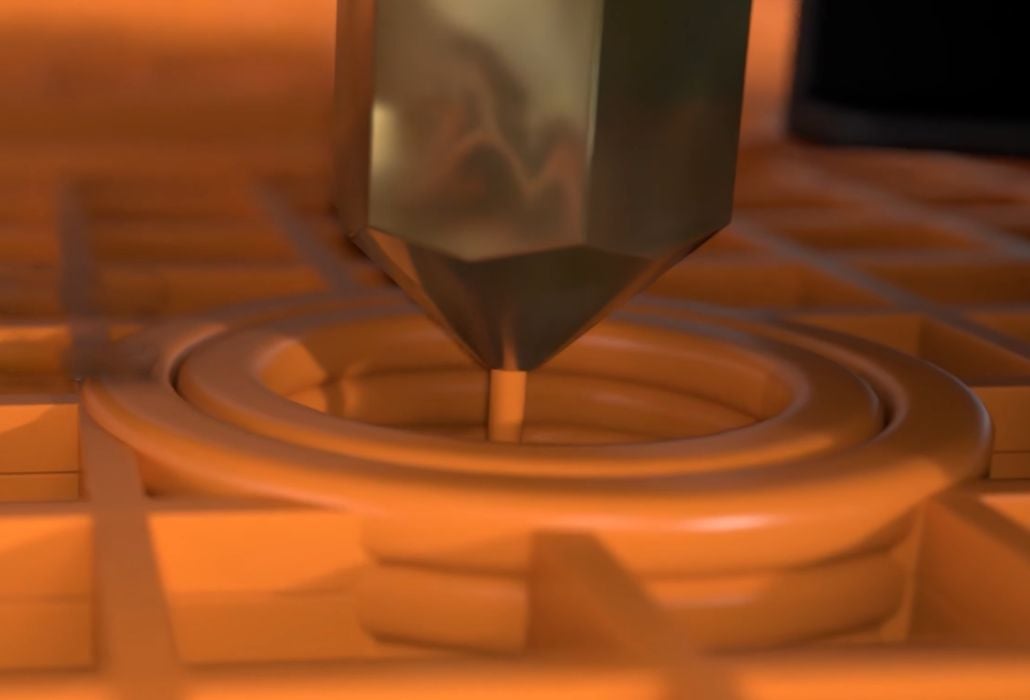
The other interesting innovation is “Overflow Anchor Seeding”, intended to strengthen layer interfaces. The layer boundaries are always the weakest part of any FFF print, because that’s where the least amount of bonding occurs. While Anabolic Mechanics isn’t directly working on the layers, their innovation is quite ingenious.
Inside the print, they create small circular voids at various locations. Several layers up, they position the nozzle directly above the void and pump it full of material. This solidifies into a solid mass that traverses layer boundaries, creating a very strong bond between several layers. That is a terrific idea that should have been in slicers years ago.
DualCore Challenges
While these innovations are wonderful additions to the state of FFF 3D printing, Anabolic Mechanics faces stiff competition from the big players, who now offer incredibly slick systems at low price points.
One big challenge is that the DualCore system is an open gantry machine, a style of machine that is rapidly fading away in the market. Most new systems now are fully enclosed with a variety of features, such as filtration, active heating, etc., all of which enable printing of a wide range of materials.
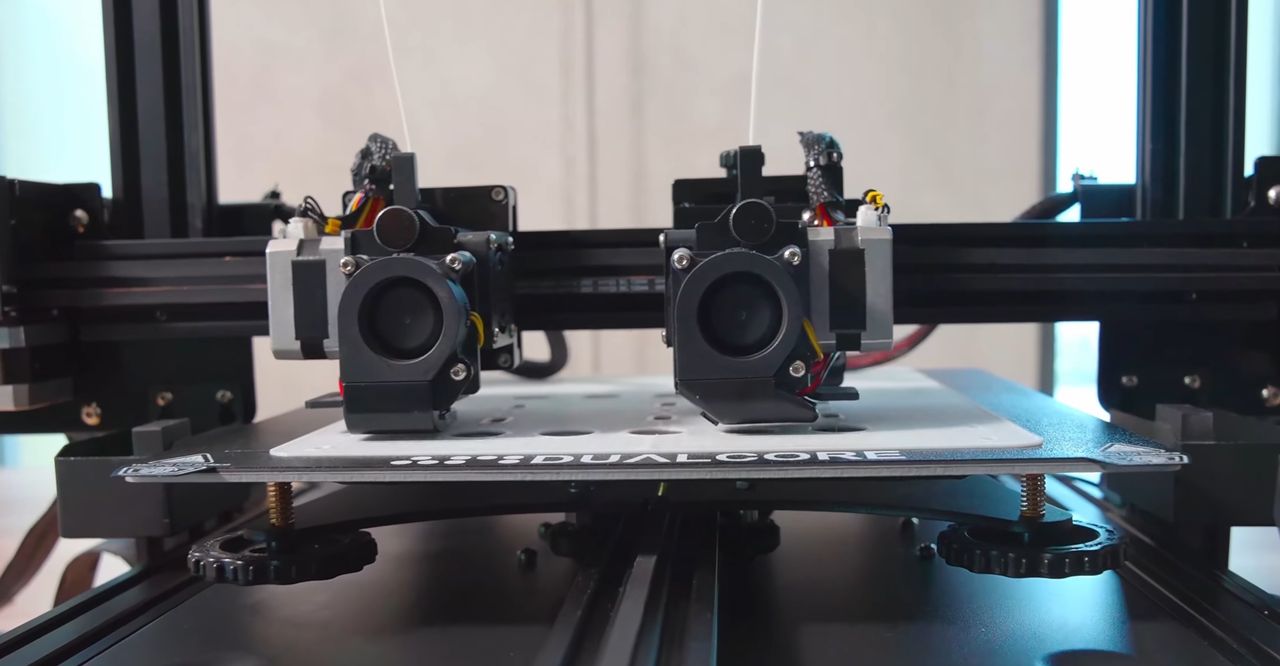
In the images, it appears that the DualCore includes knobby wheels for manually adjusting the plate level, while most of today’s modern systems don’t even have them anymore.
That said, the DualCore is the company’s first system, and if successful, they will no doubt move into more complex offerings in the future.
DualCore Pricing
For now, you can order a DualCore system from their Kickstarter campaign for US$1680, which is a discount from their target price of US$2400.
I am a bit hesitant about their pricing, as it is quite a bit higher than competing systems. For example, one could buy a Bambu Lab X2D (dual nozzle but not independent) for US$899. You could almost buy three X2Ds instead of one MSRP DualCore system, and the X2Ds would generate more part throughput than the DualCore. Speed is only valuable if it comes at the same or better price.
That price challenge may limit DualCore orders. So far, about halfway through their campaign, the DualCore as of this writing has commitments from only 24 buyers.
Via Kickstarter and Anabolic Mechanics
