
A new study shows inkjet-printed electrodes built directly on 3D printed parts, pointing to faster, cheaper custom electrochemical devices.
Printed electronics has steadily grown from flat foils and PCBs toward curved, custom geometries, and additive manufacturing (AM) is a natural way to accomplish this. Providers already blend direct-write traces or embedded wiring into jigs and fixtures, but those methods often require dedicated pastes, masks, or tooling. Inkjet printing (IJP) of conductive inks adds a digital, maskless process that can place high resolution electrical features where needed, on demand.
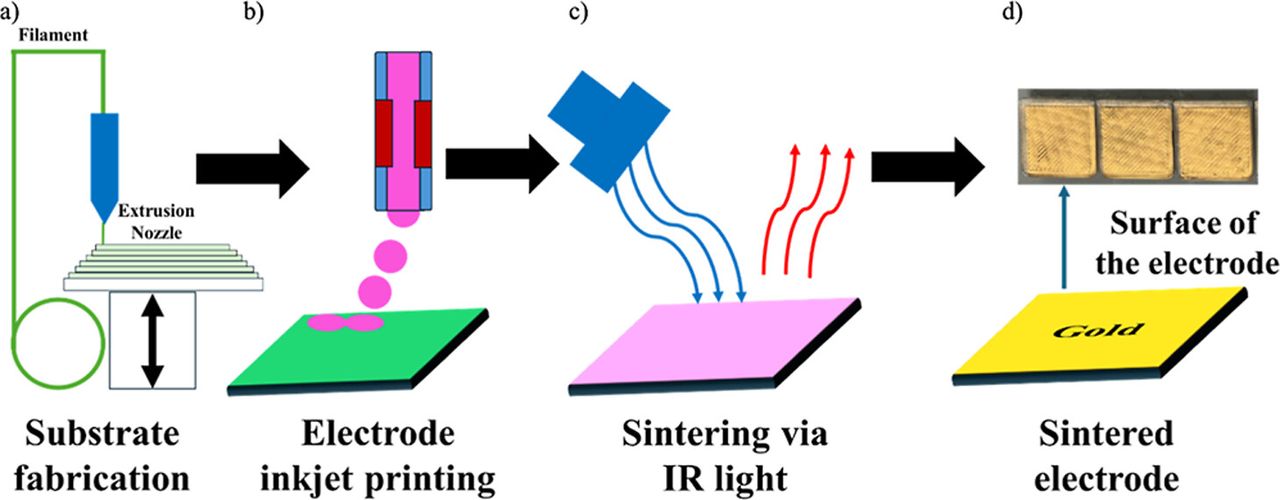
The paper, entitled “Hybrid Fabrication of an Electrochemical Electrode via Inkjet Printing on 3D-Printed Substrates,” does exactly that: they combine polymer 3D printing for rapid, form-factor freedom with inkjet-deposited conductive features for function. This could be a way to rapidly turn a plastic print into a working electrochemical sensor or embedded contact with far less effort.
Why Pair Inkjet With 3D Printing?
Inkjet printing deposits microliter-scale droplets with precise placement, enabling traces, pads and electrode geometries that are difficult to stencil or otherwise produce on non-planar parts. Because it is a digital process, changes are immediate: swap a CAD-driven toolpath for a different electrode pattern and print the next version on the same substrate. Compared with aerosol jet or screen printing, IJP can reduce material waste and avoid mesh tooling, though it is more sensitive to surface energy and roughness.
That is where 3D printing processes complicate things. FFF leaves ridges and pores, for example. The hybrid method addresses this by preparing the printed substrate first, then later jetting conductive ink in registered passes to build the electrode features. A curing or sintering step is apparently required to reach the target conductivity; depending on polymer glass transition, that curing step could be thermal, photonic, or chemical.
This new approach would be welcomed by labs and startups building one-off or low-volume electrochemical devices. Custom flow cells, microfluidic lids, wearable housings and benchtop fixtures can move from idea to reality in less than a day. Eliminating the previously required fixtures and masks reduces human labor, and a single operator could iterate several electrode designs by simply swapping print files, not hardware as would normally be required.
The Inkjet process can minimize waste and turn geometry changes into software, not tooling. For production, however, the bottlenecks will be ink cost, nozzle reliability, curing time and any post-processing required. This could become an offering from 3D print service bureaus to complement their existing 3D printing processes.
This is clearly a niche technology for 3D printing, but it is an interesting one that could be quite valuable for any organization that is trying to rapidly iterate on an electrical product design.
Via ACS Omega
