
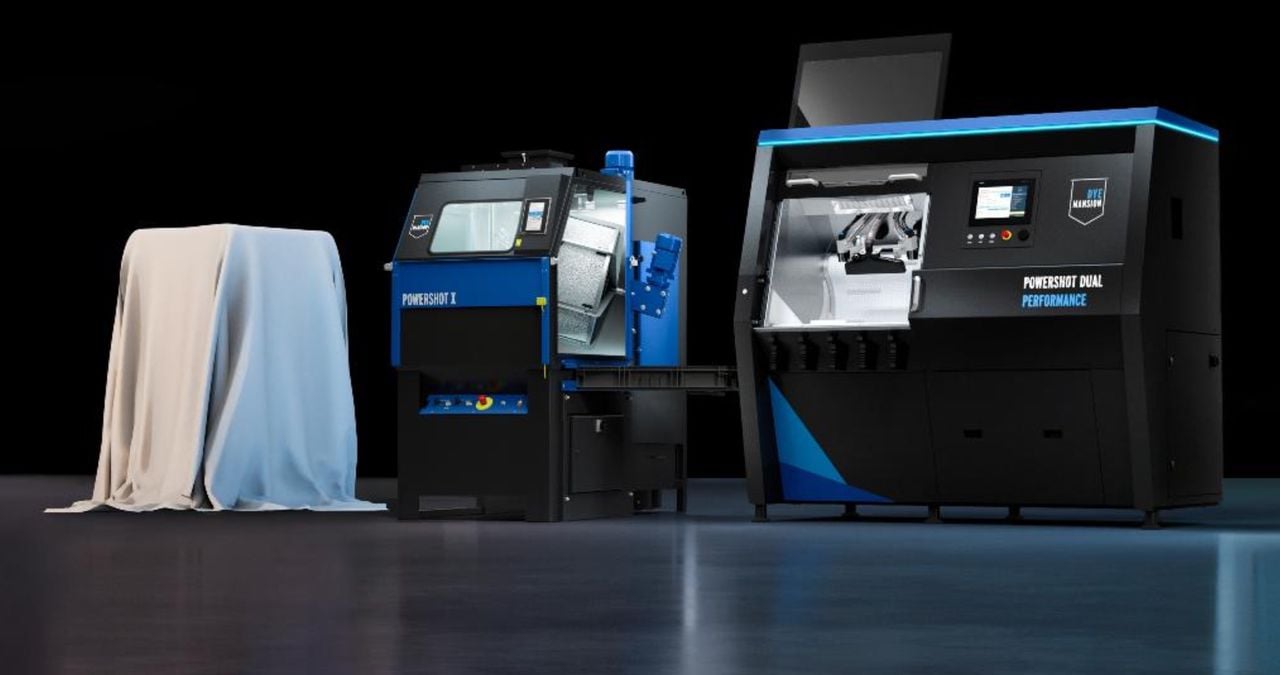
DyeMansion says it is developing a compact Powershot system that could bring industrial depowdering and surface finishing to smaller polymer 3D printing operations.
The Munich-area company is best known for building end-to-end post-processing equipment for powder-based polymer parts, particularly those produced on Selective Laser Sintering (SLS) and HP’s Multi Jet Fusion (MJF). In most production lines, post-processing is where the real bottlenecks appear: removing trapped powder, cleaning parts consistently, and achieving predictable surface quality before coloring or vapor smoothing.
Until now, DyeMansion’s higher-capacity depowdering and blasting-style solutions have tended to map to industrial-scale operations. The company positions its Powershot X and Powershot DUAL Performance systems for more automated, higher-throughput environments. That leaves a gap for users with compact powder bed systems, or for organizations with a larger industrial printer that do not yet need a big automated finishing cell.
Last week DyeMansion said the new compact Powershot is planned for full launch at Formnext 2026. The goal is to make the company’s PolyShot Cleaning and PolyShot Surfacing technologies accessible to a “broader user base” that wants to integrate industrial depowdering and surface treatment into production, but at a smaller scale.
What DyeMansion Is Building
Details are intentionally limited at this stage. DyeMansion describes the upcoming unit as a compact Powershot system for both depowdering and surface treatment, designed for industrial applications. It is also described as a complement to the company’s VX1 vapor smoothing system, suggesting DyeMansion is thinking in terms of a modular “Print-to-Product” workflow rather than a standalone machine.
CEO and co-founder Felix Ewald termed the move as an availability and segmentation play: professional post-processing “is not only reserved for large-format, high-volume operations.” In other words, DyeMansion wants the same finishing outcomes customers associate with its larger systems, but packaged for teams that have less space, less volume, or less appetite for automation complexity. Or less budget.
The company says the system is being developed “in close alignment” with requirements of this market segment and will integrate with VX1 and compatible compact printers as part of its workflow. What it did not provide yet are the specifics buyers will immediately ask for: footprint, throughput, compressed air requirements, filtration approach, media type, noise levels, consumables, or pricing.
Why A Compact Powershot Matters
If you have ever watched a powder bed polymer operation scale, you know that printing capacity is only half the story. As part volumes rise, manual depowdering and ad-hoc bead blasting become difficult to standardize. Results vary by operator, and the labor required can kill the benefits of adding another printer.
A compact, industrially oriented unit could be attractive to service bureaus, product innovation groups inside larger companies, and OEMs making small batches. These organizations often need consistent surface feel and appearance for customer-facing parts, but they may not have the volume to justify a large automated cell. If DyeMansion can preserve repeatability while lowering the entry barrier, that could pull more users into its ecosystem a lot earlier in their growth curve. As they grow, they may then become buyers of Dyemansion’s larger products.
The timing also looks coordinated with printer vendors pushing smaller-footprint powder systems. DyeMansion specifically references HP’s new compact MJF printer announcement, and HP product manager Marc Garcia is quoted saying the new compact Powershot “will be a great addition” to the HP MJF 1200. That kind of cross-vendor alignment is important because depowdering and surface preparation are where end-to-end workflows either become efficient or fall apart.
DyeMansion says more details will arrive in the coming months, with the complete reveal at Formnext 2026.
Via DyeMansion
