
EOS has filed a patent application that could make polymer powder reuse in SLS more efficient.
The European patent application was published on 20 May 2026, and it describes the use of amorphous silicon dioxide in polymer build material to improve the reusability of aged powder in additive manufacturing.
It’s all about a very practical issue in powder bed fusion: material refresh rate.
In SLS, only part of the powder in a build is actually fused into parts. The rest is recovered after the job. That unsintered powder has been put through a heated build environment, so it is no longer the same as virgin material.
For polyamide powders, especially PA12, thermal exposure can change the polymer. The patent mentions chain lengthening as one aging mechanism. In production terms, that means recovered powder can eventually flow poorly, process inconsistently, or produce parts with defects.
The usual fix is to blend used powder with fresh powder. But there is a limit. According to the patent, conventional material refresh ratios have typically been capped at 60:40 by weight, meaning no more than 60 percent aged powder and 40 percent fresh powder. Above that, EOS says conventional materials can lead to process defects or part defects.
EOS is trying to push past that ratio.
More Used Powder, Less Waste
The patent proposes mixing aged polymer powder with fresh polymer powder, where at least the fresh material contains amorphous silicon dioxide. The result is a refreshed build material with an aged to fresh powder ratio greater than 60:40.
The preferred range is 65:35 to 80:20. That is a small shift, but that could still be important for an operation printing large amounts of powder.
In other words, a service bureau or production user could potentially consume less new powder per build cycle while keeping parts within acceptable quality limits. That would reduce material cost, waste powder, and the logistics for powder handling.
Amorphous silicon dioxide can act as a flow aid, and powder flow is central to successful SLS recoating. But EOS is claiming more than simple flow improvement. The patent describes the material as improving powder reusability over multiple cycles while preserving part quality.
The examples are interesting. EOS tested PA12 powder mixed with several types of amorphous silicon dioxide, including hydrophobic grades surface modified with dimethyldichlorosilane. The additive amounts were small, around 0.05 to 0.10 percent by weight in the examples.
The patent describes repeated refresh cycles using a 70:30 aged-to-fresh powder ratio. Test parts included warpage frames and tensile specimens. A comparative PA12 material without the claimed amorphous silicon dioxide showed strong surface defects after the first refresh. Two of the silicon dioxide materials showed no surface defects after five refresh cycles.
The Sinter Window Question
There is a catch, of course. SLS powders are not just about flow. They depend on a workable thermal window between melting and recrystallization. A flow aid that changes crystallization behavior too much could create new processing problems.
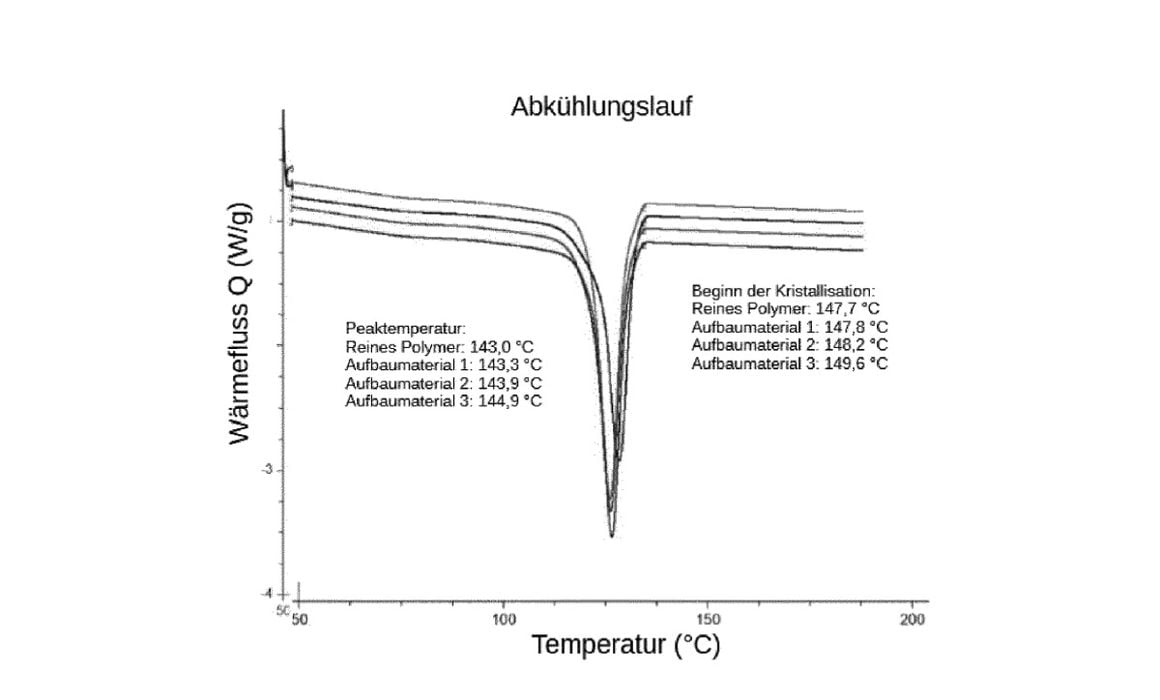
EOS appears aware of that issue. The patent states that the amorphous silicon dioxide should increase the recrystallization temperature by no more than 4°C, preferably less. In one example, pure PA12 began recrystallization at 147.7°C, while tested materials showed only modest shifts.
That is important because maintaining the sinter window is what keeps parts from curling, warping, or failing during the build.
My suspicion is that the real attraction here is the economics. Polymer powder bed fusion success is often measured not only by machine price or part quality, but by the cost of powder consumption across repeated builds. A higher safe reuse ratio could improve the operating model for SLS customers, especially those running PA12 continuously.
This is a smart direction for EOS. It is not as visible as a new machine launch, but powder lifecycle improvements can matter just as much in real production.
Via Espacenet
