Charles R. Goulding and Nimra Shakoor connect federal investment, breakthrough additive manufacturing, and valuable R&D tax incentives to show how gallium is becoming a strategic material with outsized impact.
The United States has intensified investment in defense manufacturing and critical materials to reduce reliance on foreign supply chains. This effort accelerated after China’s 2025 ban on gallium exports, exposing vulnerabilities in advanced technology and defense industries. Federal funding has flowed to contractors such as L3Harris and Intel, as well as domestic producers of critical minerals. Notably, the Pentagon committed US$150 million to Atlantic Alumina Co., a U.S.-based gallium producer, to help secure domestic supply (Financial Times). The U.S. Department of War also awarded US$29.9 million to ElementUS Minerals, LLC to develop a demonstration facility in Gramercy, Louisiana for separating and purifying gallium and scandium from existing industrial waste (U.S. Department of War). Even more recently, the federal government has made moves to invest $1.6 billion into a rare-earth metal producer, USA Rare Earth, to build and operate a U.S. magnet facility (The Wall Street Journal).
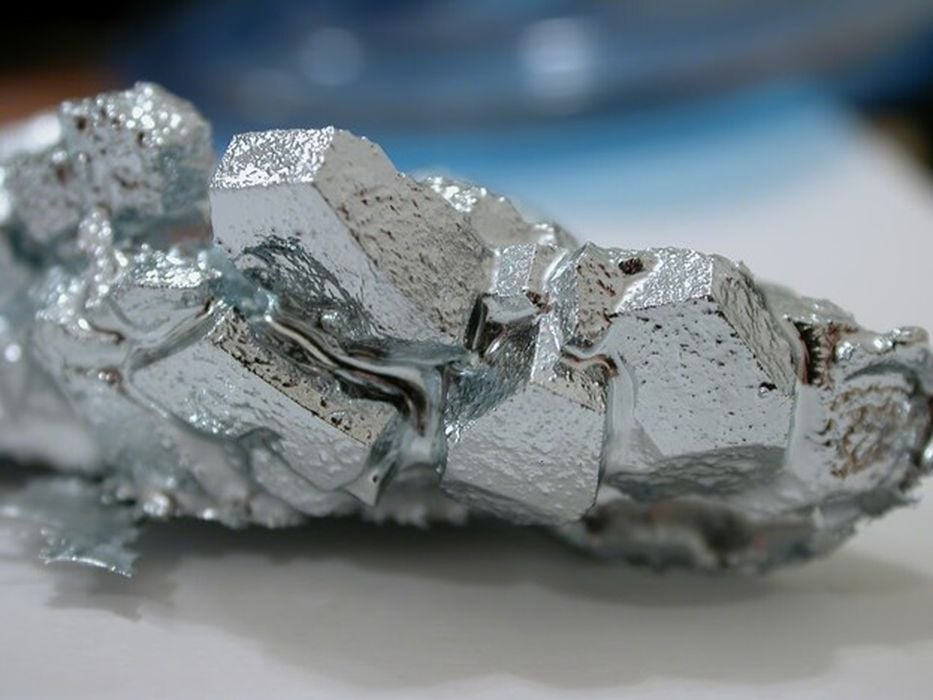
Gallium is often grouped with “rare earths” in policy discussions, though technically it is classified as a critical mineral rather than a lanthanide. Its strategic importance is clear: gallium is essential for semiconductor wafers, high-performance computing, LEDs, solar cells, aerospace systems, medical devices, and telecommunications infrastructure (USGS). As of 2025, China accounted for roughly 98 percent of global primary gallium supply, creating a single-point dependency for industries critical to national security and economic competitiveness (CSIS).
Beyond semiconductors, gallium’s rise in 3D printing shows that securing supply is crucial not just for defense readiness, but also for enabling next-generation innovation in electronics, sensing, and adaptive systems.
Gallium’s 3D Printing Advantage
Gallium stands apart from conventional 3D printing metals due to its unique physical and chemical properties. It melts just above room temperature, exhibits high surface tension, and demonstrates distinctive phase-change and supercooling behavior. Combined with strong electrical and thermal conductivity, these properties make gallium ideal for functional, adaptive components rather than load-bearing structures (Parvini et al., 2014).
Eutectic alloys of gallium with metals such as indium and tin further expand its versatility. These alloys offer controlled flow and stability, enabling printing approaches that conventional metals cannot support. Gallium-based materials thus produce components emphasizing flexibility, conductivity, and reconfigurability, rather than structural strength (Patil et al., 2025).
Gallium enables capabilities rarely possible with standard 3D printing metals. It supports self-healing conductive pathways, shape reconfiguration via phase-change actuation, and direct printing onto soft or temperature-sensitive substrates. Its chemical compatibility with polymers and elastomers allows multi-material integration, embedding functional circuits within flexible matrices. These characteristics make gallium well-suited for exploratory prototyping and functional testing, where components can be printed and evaluated without high-temperature sintering or extensive post-processing (Liu et al., 2023).
Preparing & Handling Gallium
Successfully printing with gallium requires careful control of materials and process conditions. Applications may use pure gallium or eutectic alloys, depending on performance requirements. Because gallium’s high surface tension can impede flow, controlling rheology and viscosity is essential for consistent deposition.
Oxide layer formation presents an additional challenge. Gallium readily forms a thin oxide skin that can disrupt extrusion and bonding if left unmanaged. Printing systems must incorporate strategies to mitigate oxidation, along with careful selection of nozzle materials to reduce clogging and chemical interaction. Environmental controls—particularly temperature regulation and, in some cases, atmospheric management—are often required to maintain stable printing conditions.
Printing Techniques
Advances in liquid metal printing have expanded the range of gallium-enabled methods. Direct Ink Writing (DIW), the most widely used approach, relies on liquid metal alloys such as eutectic gallium-indium (EGaIn). These materials can be extruded at room temperature to create flexible, conductive, and stretchable electronics.
Due to gallium’s surface tension, specialized techniques—such as micro-vibration, high-viscosity emulsions, and controlled surface oxidation—stabilize printed features and improve resolution. Research demonstrates that, with sufficient control, gallium structures can be printed at micron-scale precision.
Beyond DIW, hybrid printing combines gallium with structural or flexible materials in a single build. Embedded printing injects gallium into a supporting matrix to form enclosed conductive networks, while sacrificial printing enables fabrication of complex hollow channels, particularly for biomedical and microfluidic applications. These approaches highlight gallium’s role as an enabling material within multi-material systems, rather than a standalone structural solution.
Key Applications
Gallium-enabled additive manufacturing excels where functionality outweighs mechanical strength. Key applications include:
- Flexible electronics: Wearable sensors, antennas, and stretchable circuits
- Soft robotics: Components that benefit from adaptability and self-repair
- Energy storage: Experimental 3D-printed batteries with enhanced durability
- Reconfigurable circuits and antennas: Designs that can be modified post-fabrication
- Thermal management: Printed thermal interfaces and heat-spreading components
- Microfluidics and embedded sensing: Precision conductive pathways for advanced devices
Most uses remain in research, prototyping, and specialized applications rather than mass production. Their strategic importance is disproportionate to their volume, particularly in defense, aerospace, and advanced electronics.
Challenges & Innovations
Despite its promise, gallium presents clear limitations. High surface tension complicates printing, mechanical strength is limited, and long-term stability and fatigue behavior remain under study. Precision and repeatability are challenging at scale, and integrating gallium components with load-bearing structures adds complexity.
Health, safety, and environmental considerations further shape adoption. Gallium has a non-trivial toxicity profile, and its extraction carries environmental costs. Recycling gallium from electronics and manufacturing waste is technically difficult, though ongoing research aims to address this. Overall, gallium-enabled 3D printing is best positioned as a targeted, high-value capability rather than a general-purpose solution.
Despite these challenges, gallium’s unique properties continue to drive experimental work, providing opportunities for innovation in advanced electronics and adaptive systems.
The Research & Development Tax Credit
The now permanent Research & Development Tax Credit (R&D) is available for companies developing new or improved products, processes and/or software.
3D printing can help boost a company’s R&D Tax Credits. Wages for technical employees creating, testing and revising 3D printed prototypes can be included as a percentage of eligible time spent for the R&D Tax Credit. Similarly, when used as a method of improving a process, time spent integrating 3D printing hardware and software counts as an eligible activity. Lastly, when used for modeling and preproduction, the costs of filaments consumed during the development process may also be recovered.
Whether it is used for creating and testing prototypes or for final production, 3D printing is a strong indicator that R&D-eligible activities are taking place. Companies implementing this technology at any point should consider claiming R&D Tax Credits.
Strategic Outlook
Gallium’s importance lies in capability rather than volume. Securing domestic supply supports not only semiconductor stability but also continued experimentation in advanced manufacturing, including additive electronics and adaptive systems.
Domestic sourcing, paired with advances in recycling and process efficiency, could improve availability and price stability. This, in turn, lowers barriers to experimentation, supporting sustained innovation. As technical and regulatory constraints are addressed, gallium-based 3D printing is likely to remain a high-impact, specialized technology, closely aligned with national security priorities and the development of next-generation electronic and functional systems.