
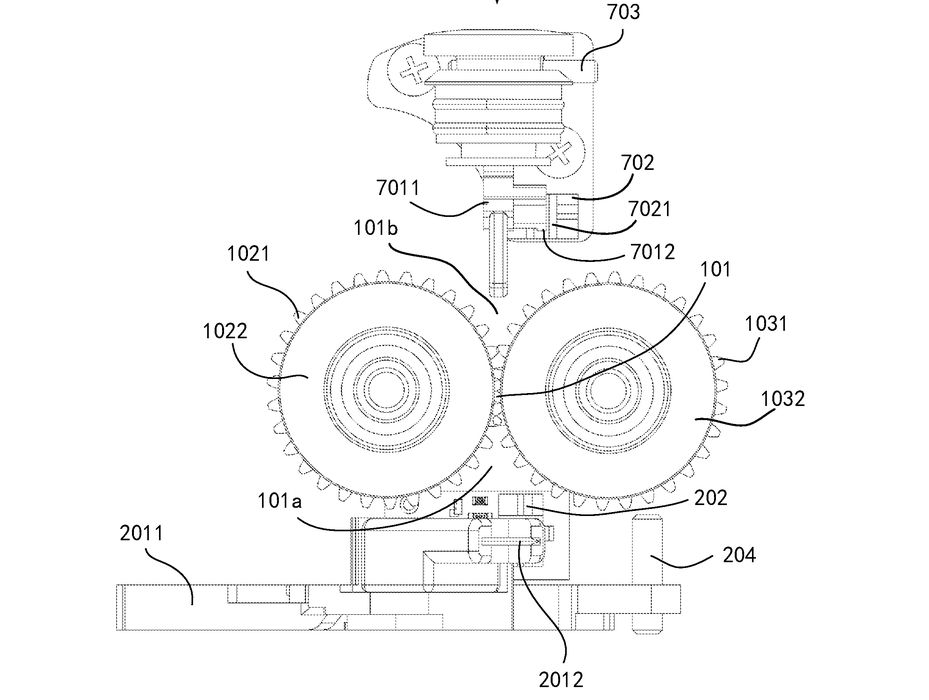
A new patent filing sketches a compact way to cut filament inside the printhead before a tool change, and that matters because cleaner swaps can make multi material FFF systems faster and less troublesome.
The application describes a printhead assembly for a 3D printer that combines two familiar functions: filament drive and filament cutting. The twist is in how the cutter is arranged. Instead of a separate, bulky mechanism, the blade rotates around a shaft whose axis runs parallel to the filament path. That sounds minor, but it changes the packaging problem inside the toolhead. The cutter sits at the end of the conveying passage, swings in with a short motion, snips the filament, then springs back out of the way.
The problem it addresses is real enough. During filament changes, partially molten material near the hot end can smear backward into nearby components if the machine simply retracts it. That contamination can hurt reliability, especially in compact systems that try to pack sensors, drive gears, and switching hardware into a small carriage. The patent’s answer is to cut the filament first, then retract only the solid section. In principle, that reduces ooze related mess inside the printhead and could improve changeover consistency.
This is not a new category of idea. Several multi material systems already rely on cutting, parking, wiping, or otherwise managing filament ends before retraction and reload. What is notable here is the emphasis on miniaturization and low part count. The cutter is shaped as a lever, with the force applied farther from the pivot than the blade edge, which gives mechanical advantage. The design also proposes using the printer’s own motion system and an internal housing feature to actuate the cut. In other words, the printhead can move until the cutter contacts a protrusion in the enclosure, which then pushes the blade into the filament. That could eliminate the need for a dedicated cutting motor or solenoid.
Why Packaging Matters
That last point is probably the most interesting part of the filing. A separate actuator adds cost, mass, wiring, control logic, and failure points. By borrowing motion from the existing gantry and reacting against a fixed environmental feature, the mechanism becomes simpler on paper. For desktop FFF vendors, especially those chasing multi color and multi material throughput, every gram and cubic millimeter in the toolhead matters. Lower moving mass can help speed and vibration control, while a smaller assembly leaves more room for cooling, sensing, and nozzle hardware.
The filing goes beyond the blade itself. It also includes optical sensing to confirm when the cutter reaches its cut position, then trigger filament retraction. A second sensing arrangement monitors whether filament remains in the feed path, and only then signals that a material swap should continue. That sequencing matters. In many filament systems, the ugly failures happen not during normal extrusion, but during edge cases: incomplete retracts, soft filament deformation, half cut strands, and reload attempts before the path is actually clear. This patent tries to lock those steps into a defined order.
Even so, this remains a patent idea, not a shipped product. The filing does not state cycle life for the blade, cut force across different materials, speed penalties, nozzle temperature implications, or how well it handles brittle, abrasive, or flexible filaments. Those unknowns matter. Cutting standard PLA is one thing; repeatedly cutting carbon fiber filled nylon or a gummy TPU is another. Blade wear, debris generation, and calibration drift could all become practical issues.
A Practical Path, If The Details Hold
If the mechanism works as intended, the main beneficiaries would be vendors building enclosed, automated desktop systems where frequent material changes are part of the value proposition. It could also matter for machines that want cleaner color changes without making the printhead much larger. The competitive impact would therefore be less about raw print quality and more about reliability, serviceability, and how elegantly a vendor can integrate multi material workflows into a compact carriage.
The best proof would be simple: show thousands of cut and retract cycles across multiple filament classes, with low jam rates and predictable maintenance intervals. Until then, this looks like a smart packaging patent with practical intent, but not yet proof of a better printer. In desktop FFF, small mechanical ideas often decide whether automation feels magical or maddening.
Via Patentscope
