
Hong Kong University of Science and Technology has filed a patent for a DLP 3D printer that uses multi-directional coating to handle more difficult photopolymer materials.
The patent is CN 122125900 A, published on June 2, 2026. It describes “a multi-directional scraping and coating sinking DLP photocuring 3D printing device.” That sounds awkward in English, but the concept is actually quite straightforward.
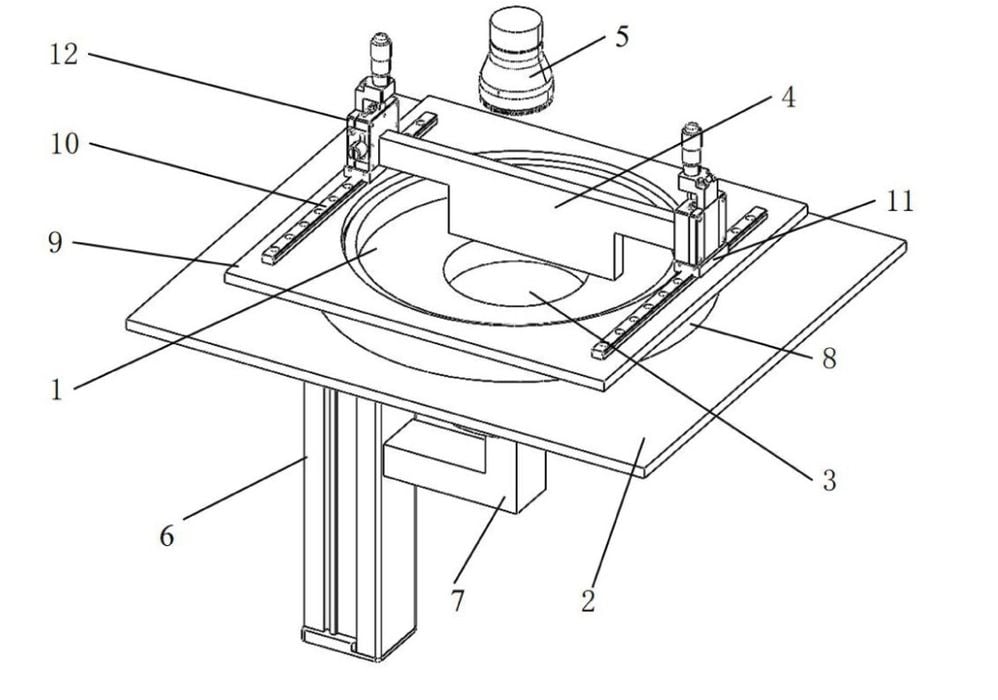
It is a top-down DLP resin printer with a build platform that sinks downward into a sleeve-like vat. A UV DLP projector sits above the print area and exposes each layer on the liquid resin surface. That part is not unusual; we’ve seen this approach before.
The interesting part is the coating mechanism. Normally, top-down systems simply dip the plate and allow resin to flow over the top. But that works only on less viscous resins.
Instead of relying only on resin flow, settling, or a recoater moving in one fixed direction, the proposed machine places a scraper blade on a motion system that can move linearly across the print (resin) surface and also rotate around it. In other words, the blade can sweep resin across the build area from different directions.
That could be quite useful because not all photopolymer resins behave like ordinary desktop SLA or DLP resin.
The patent specifically mentions high-viscosity materials and photocurable materials containing anisotropic fillers. That could include fibre-reinforced materials, carbon nanotube-filled resins, sheet-like filler materials, liquid crystal materials, or combinations of these. These materials can be useful, but they are also more difficult to spread consistently.
A filled resin may not level quickly. It may form streaks, clumps, or direction-dependent structures after coating. A single-direction blade pass can also create preferred filler orientation, which might be useful in some cases but harmful in others if the process is not controlled.
That appears to be the problem they are addressing.
The device includes a vat mounted on a support platform. The vat has raised side walls and a depressed central sleeve. The round print platform slides up and down inside that sleeve in a sealed, piston-like arrangement. A Z-axis stage below the platform moves it between layer positions.
Above this sits the recoating assembly: a hollow rotary stage, a rotating platform, linear rails, sliders, and a scraper blade. The blade is connected to micro-adjustment platforms so its height relative to the print surface can be tuned. A feed pump can also supply resin into the vat to keep the liquid level stable.
The claimed process is simple: feed resin, spread it over the platform with the blade from multiple directions, expose the layer with the DLP projector, lower the platform by a preset layer thickness, and repeat.
A lot of resin 3D printing improvement has focused on faster exposure, stronger materials, larger projection areas, or better release mechanisms. This patent instead focuses on the less fancy but very important problem of material handling. For advanced resins, the exposure system may not be the bottleneck. The bottleneck may be getting a reliable, uniform, repeatable layer of material in place before exposure for viscous resins.
That is especially true for functional photopolymers. Filled and anisotropic materials can promise better thermal, electrical, optical, or mechanical properties, but they often make the printing process less forgiving. If the coating step is inconsistent, the final part properties may be inconsistent as well.
In fact, there are actually very few 3D printable resins with this characteristic because they are so difficult to print on today’s machines. If commercialized, this patent could drive the development of new viscous resins with unusual properties.
Via Espacenet
