
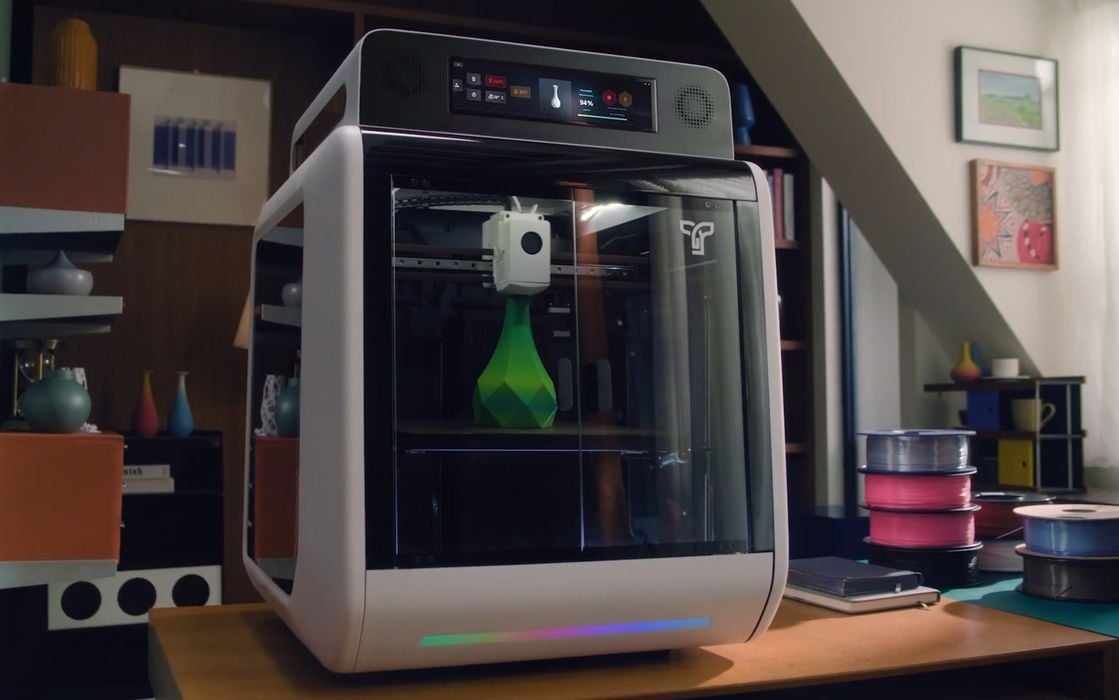
A new five-axis FFF 3D printer is set to appear on Kickstarter soon.
The device is the TOP.E R1, but which company produces it? It’s not at all clear from the company’s web page, and this is critical information for any Kickstarter campaign where you must have some trust in the manufacturer.
I did some digging and determined that this is all from High Energy Numerical Manufacturing (Xi’an) Technology Co., Ltd., usually branded as TOP.E (pronounced “tope-eee”). This is a company founded in 2021, but it focuses on solid-state battery production and dry electrode manufacturing equipment, not 3D printing.
It appears that they have decided to enter the 3D printing market with a new device using the TOP.E brand for a consumer 3D printer. So they are a well-established manufacturer, but not one that’s previously produced 3D printers.
But what about the TOP.E R1 3D printer? It turns out to be quite different from your typical FFF device.
The most glaring difference is that this is a 5-axis 3D printer.
Virtually all FFF devices are 3-axis systems, where the toolhead moves on the X, Y, and Z axes. This is how 3D printers have been made for decades. Unfortunately, a 3-axis approach makes it difficult to handle overhangs, and that’s why these systems require support structures: the toolhead cannot “reach underneath” overhangs.
That is not the case with 5-axis systems, where the toolhead can, sort of, reach around to perform extrusions that a 3-axis system cannot.
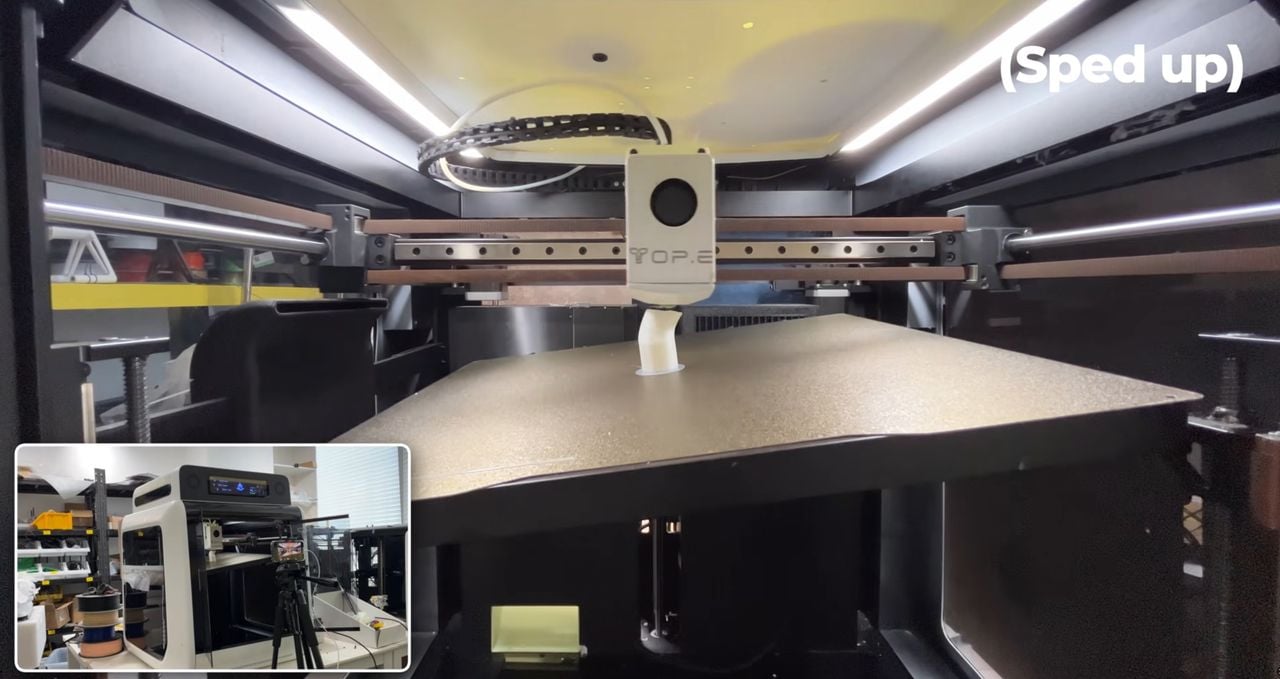
How does the R1 do this? They have an ingenious approach that involves mounting the build plate on three, not four, threaded rods. Each rod can independently move up and down. When they are not moving in sync, the build plate tips! This makes it a 3-axis machine: X and Y axes as normal, and three different Z axes, totalling five.
There’s a slight catch, however: the Z-axis approach can tip the plate only up to 17 degrees, which is not a lot. However, even this small amount will be enough to eliminate some overhangs, as you can see in the video above. They say it can handle 62-degree overhangs without any need for supports. This should reduce material use somewhat.
Aside from the 5-axis feature, there are plenty of other very useful features on the R1:
- Fully enclosed
- Actively build chamber heated up to 60C
- 350C hot end temperature
- Huge 350 x 340 x 320 mm build volume
- Print speeds up to 500mm/s (likely for 0.1mm layers)
- Dual on-board cameras
- Cloud-based slicer (not standalone software)
- Automated calibration
- Four-colour capability (filament swapping)
- HEPA air filtration
- Visible light bar indicating current machine status
- Optional 0.2, 0.6, 0.8mm nozzles
- Bed maximum temperature 100C
- Handles PLA, PETG, TPU, PVA, ABS, ASA, PC, PA, PET, PPA-CF/GF, PPS, PPS-CF/GF, BVOH
The other interesting feature is an integrated AI 3D model generation, a capability I believe will eventually appear on all consumer-facing 3D printers. It seems that TOP.E has partnered with “Leading AI Models”. They write:
“Powered by leading Al models, R1 turns ideas into high-quality printable designs. Describe what you want or upload an image and the system will provide multiple options to review and print, guiding you step-by-step.”
It’s not clear which AI model they are using, as I presume the machine would use only one at a time. However, they do mention some truly leading players such as Tencent HY, Tripo, Meshy, and “others”.
Also of interest is that they have published what appears to be actual videos of the machine in operation, which is something new Kickstarter 3D printers sometimes do not do. This lends some additional credibility to their campaign.
Now for the pricing. This interesting machine carries an MSRP of US$1699, but their Kickstarter campaign’s early bird backers will pay only US$999, a considerable saving. There is also a “VIP” price of US$899, which is obtainable through a US$30 deposit.
At US$1699, the TOP.E R1 is about the same price as a Bambu Lab H2S, and less than a Prusa CORE One L. In other words, it seems to have comparable or better pricing than enclosed systems with advanced features.
However, at US$999, it is a steal, assuming it works as advertised.
It’s not clear when they will activate their campaign, but it seems ready to go at any time.
Via Kickstarter and TOP.E
