
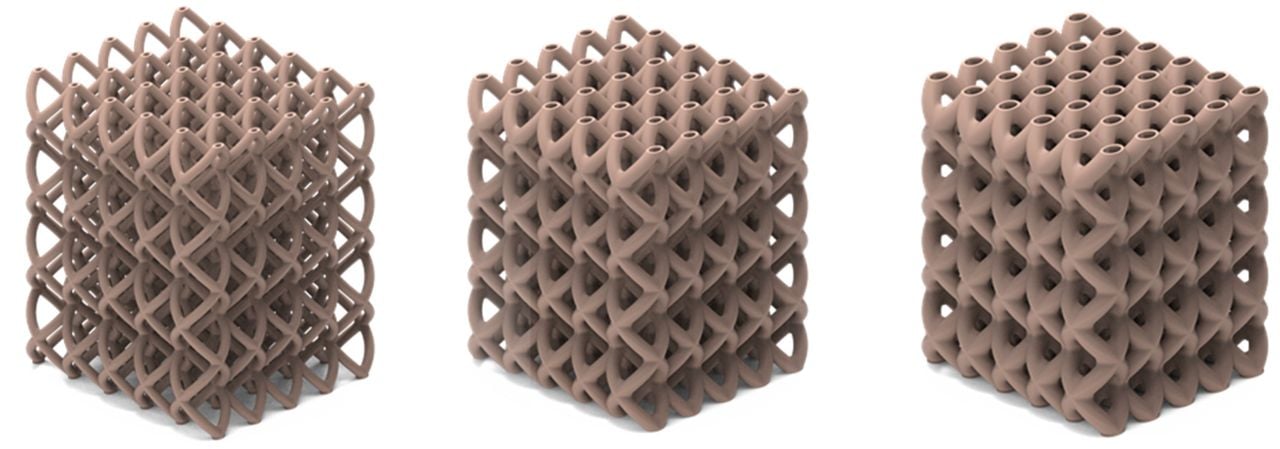
Researchers propose a hollow spiral lattice architecture that improves both heat transfer and load bearing, a combination AM operators need.
The study, entitled “Design of Hollow Spiral Lattice Architectures for Integrated Thermal and Mechanical Performance in Additive Manufacturing,” investigates the tradeoff between strength and heat transfer in 3D printed structures. Lattices like gyroids, Kelvin cells, and octets are proven for lightweight stiffness and energy absorption, while heat exchangers require maximum surface area and efficient flow — but bringing both goals into the same design is difficult.
The usual approach is to pick one or the other: open cell lattices tuned for stiffness-to-weight, or thin-walled microchannels tuned for convective cooling. Previous work on triply periodic minimal surfaces (TPMS) showed some promise for mixing mechanical and thermal functions, but designers still struggle with anisotropy, supportability, and pressure drops. The hollow spiral concept provides a geometry that is volumetric, continuous, and parameterizable, meaning it creates thermal and structural knobs that are easy to adjust.
From TPMS To Spirals: Why A New Geometry Helps
A hollow spiral lattice uses helical walls to form continuous internal channels while the overall scaffold design carries load. That configuration naturally increases surface area-to-volume ratio, aligns flow paths, and introduces rigidity that some strut-based lattices don’t have. Because the channels are hollow, the same architecture can provide convective cooling, thermal spreading, or even fluid routing, while the wall thickness and shape maintain the mechanical strength.
The paper describes tunable parameters — likely including spiral pitch, channel diameter, wall thickness, and unit orientation — that let designers set relative density, stiffness, and heat-transfer in the model. That is an ideal situation for those designing high performance AM printed parts.
Although the paper does not list processes or materials, this geometry seems well suited to Laser Powder Bed Fusion (LPBF) for metals, and possibly also for Selective Laser Sintering (SLS) or resin processes. The approach fits the increasing appearance of multifunctional 3D printed parts: brackets that are also heat sinks, motor mounts with internal coolant channels, and more.
The interesting part here is not just a new cell type but a design methodology that encourages co-optimization. That means engineers can select a required stiffness and at the same time also target thermal resistance within the lattice, rather than pasting together a structural lattice next to a heat exchanger.
However, I wonder about a few things with this design. When printing hollow channels in LPBF we might have troubles extracting loose powder after the build completes. This might require escape holes, careful build orientation, and other approaches. Overhangs are also possible trouble, especially if the orientation of the lattice varies in the print. None of these seem to be showstoppers, but they will have to be addressed before this can become commercially real.
The benefit here is fewer parts and less assembly. A single printed component that manages both heat and load can cut weight, reduce thermal interface materials, and eliminate joints or O-ring seals — all very attractive propositions in aerospace, drones, space, and motorsports.
I’m hoping this approach is further refined and then deployed into the design software tools used by part designers.
Via Aerospace
