
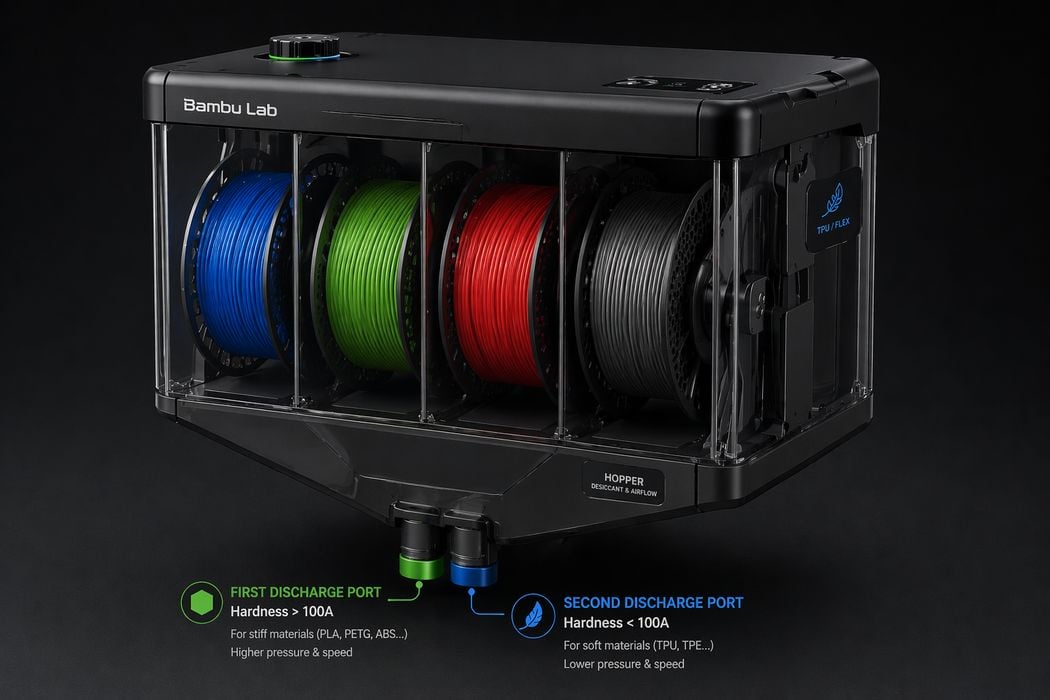
A very curious patent has been registered by Bambu Lab.
Patent CN-224130580-U just appeared on the WIPO database, titled “hoppers and 3D printers”. I’m afraid I have little information about this particular patent because it’s only a registration at WIPO and not the full patent itself. So we have to go with the title and abstract only to figure out what this is about.
The abstract is this, and yes, patent abstracts are usually pretty vague and hard to follow:
“This application belongs to the field of 3D printing equipment technology, and particularly relates to a material hopper and a 3D printer. This application provides a material hopper, including: a hopper body, a cover, a first discharge port, and a second discharge port. The cover is disposed on the upper surface of the hopper body, the first discharge port is disposed at the lower end of the hopper body, and the second discharge port is connected to a discharge opening on the upper surface of the hopper body or the cover. The first discharge port is used for discharging consumables with a hardness greater than 100A from the hopper body, and the second discharge port is used for discharging consumables with a hardness less than 100A from the hopper body. This application also provides a 3D printer including the above-mentioned material hopper. In the technical solution provided by this application, consumables with different hardness ranges are discharged separately through the first and second discharge ports. Corresponding discharge pressure and speed are matched according to different discharge ports, avoiding the problems of blockage in the discharge pipe and uneven discharge caused by the same discharge speed from the same discharge port.”
Whew, what does that all mean?
At first, I got quite excited because it’s talking about “hoppers”. A hopper is in 3D print terms referring to a basket of pellets that are then fed into a pellet extruder.
Wait, does this mean that Bambu Lab is going to release a pellet 3D printer? That’s something they have never done, and could suggest they are going after an industrial market they’ve never addressed.
Nope, that’s not it at all. It turns out that several of their patents refer to material feeding systems as “hoppers”. I presume this is a translation quirk.
So what is it really about? I suspect it is about filament feeding.
Bambu Lab (and most 3D printer manufacturers) currently have a serious problem: handling TPU. TPU is quite flexible and therefore does not work well with filament swapping systems that need to push the filament up long PTFE tubes. Because of this, machines have to be configured in awkward ways to handle the elusive flexible material. Separate ports, separate extruders, external spools, extra PTFE tubes, etc. It’s quite messy and not at all aligned with Bambu Lab’s quest to make life easy for 3D printer operators.
This patent might be part of the solution. It describes (in tedious patent language) what could be a new type of filament storage device that is able to handle flexible TPU filament. Today’s AMS units cannot handle flexible material at all, hence the need for using external spools.
The idea seems to be to have two different ports for the storage system, one for flexible, and the other for regular rigid filaments. We can tell this because it talks about filaments that are more or less than 100A. This no doubt is the Shore hardness rating, where 95A and lower are increasingly flexible.
The abstract says the two outlets allow different discharge pressure and speed so they can avoid blockage and uneven discharge. That is exactly the kind of problem you get when trying to push soft filament through the same path and with the same drive behavior as rigid filament.
At the top, we’ve made a concept image of what this might look like, should Bambu Lab proceed.
If this is indeed what the patent describes, it could change the TPU handling situation significantly. Instead of setting up special hardware, external spools, etc., when printing TPU, you would just drop the TPU spool into the “advanced” AMS unit. It would detect the TPU and subsequently route it through the special flexible port where it would make its way to the appropriate extruder.
This would essentially eliminate all the fuss when printing TPU, and as far as the operator is concerned, TPU would be “just another spool in the AMS”. TPU could be handled in the exact same way as any other spools.
If Bambu Lab were to actually implement this patent in a product, it would be a huge benefit to 3D printing. More people would be able to print TPU, especially the less techie consumer types they seem to be targeting. That would see people printing not only flexible objects, but objects with embedded flexible material.
