Charles R. Goulding takes readers inside IMTS 2026’s booming additive manufacturing section, where Nikon SLM, Renishaw and Farsoon demonstrate how 3D printing is moving from prototypes to sophisticated end-use production.
On the second day of IMTS 2026 in Chicago, I was able to head directly to the 3D printing section of the show—and it quickly became clear that additive manufacturing has become a major part of the overall manufacturing landscape.
The additive manufacturing section at McCormick Place is extensive enough to rival many standalone 3D printing trade shows. What was particularly interesting was the emphasis on finished production parts, rather than simply machines and technical demonstrations. Across the booths, manufacturers were showing how metal and polymer additive manufacturing is increasingly being applied to aerospace, automotive, medical, energy, defense and other demanding industries.
Three companies stood out during my visits: Nikon SLM Solutions, Renishaw and Farsoon.
Nikon SLM: From Cameras to Industrial Metal AM
I am actually writing this from the Nikon SLM booth, which has a particularly welcoming feature: seating. That may sound like a small detail at a trade show, but it creates an environment where visitors can stop, discuss applications and spend some time examining the technology.
Nikon’s transformation into an additive manufacturing company has been remarkable. We previously covered this evolution in Fabbaloo in From Snapshots to Space Parts: Nikon Reinvents Itself in Metal, which examined how Nikon’s acquisition of SLM Solutions helped establish the company as a significant force in industrial metal 3D printing.
At IMTS, that transformation is visible in the parts on display.
The booth featured end-use components produced in materials including copper and Inconel. These are particularly important materials because they demonstrate where industrial metal AM can move beyond conventional prototyping.
Copper’s thermal and electrical conductivity make it valuable for applications such as heat exchangers, cooling components and electrical systems, although its reflectivity and thermal properties make it challenging to process with laser-based AM. Nikon SLM has developed specialized copper parameters for complex geometries and thermal-management applications.
Inconel, meanwhile, is particularly useful for high-temperature and corrosive environments. Nikon SLM’s published applications include Inconel 625 clamp connectors and Inconel 718 rocket-engine components.
One example that illustrates the significance of this capability is Nikon SLM’s work on Inconel 718 liquid rocket-engine components. The company reports that additive manufacturing, combined with hot isostatic pressing and heat treatment, can dramatically reduce component complexity while producing parts suitable for demanding aerospace applications. (Nikon SLM Solutions)
That is a long way from the traditional perception of 3D printing as primarily a prototyping technology.
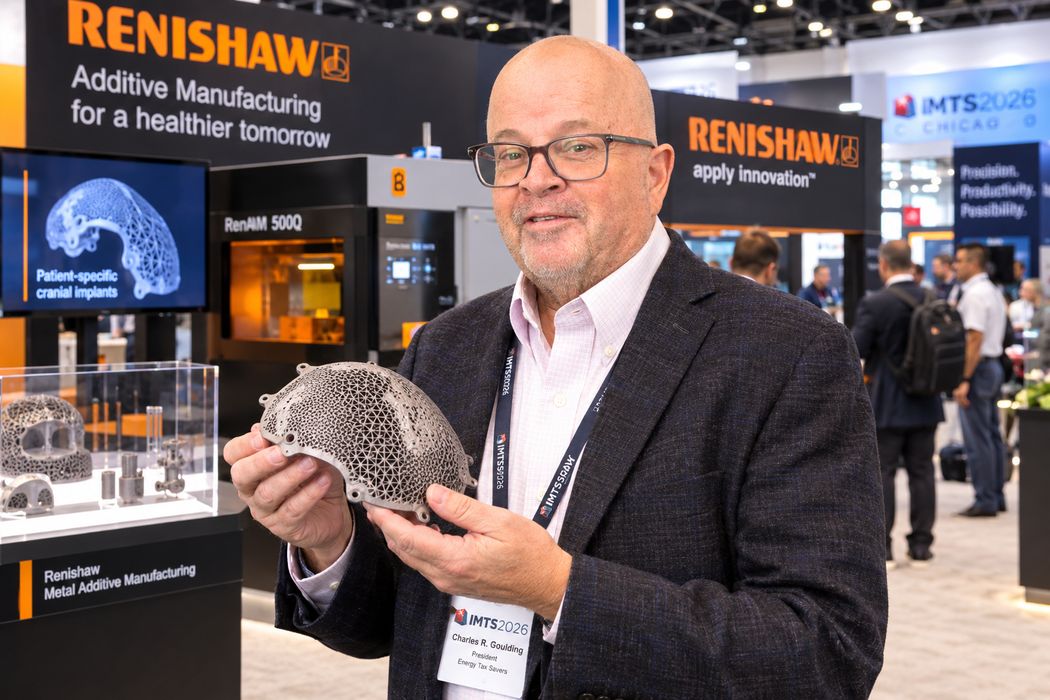
Renishaw Shows the Breadth of Metal 3D Printing
My next stop was the Renishaw booth. We previously covered the company’s additive manufacturing capabilities in Fabbaloo in Innovation in Motion: Renishaw’s Role in the Future of Additive Manufacturing.
The Illinois representative at the booth provided a useful overview of the finished products being displayed.
One notable feature of Renishaw at IMTS is that the company demonstrates two very different sides of its manufacturing expertise. Its additive manufacturing business has one booth, while its coordinated measurement machine business has a separate presence. That separation helps illustrate how the company participates in both making parts and measuring them.
The additive manufacturing applications on display demonstrated just how broad the potential market has become.
Among the examples were automotive components, medical implants and defense-related components. Renishaw’s medical work is particularly illustrative. Its metal AM systems are used to manufacture craniomaxillofacial implants, including patient-specific cranial implants. The technology allows complex lattice structures and customized geometries that would be difficult or impossible to manufacture economically through conventional methods.
Renishaw’s own documentation describes LaserImplants cranial implants as being additively manufactured on its metal 3D printing machines so that the implant can be customized for individual patients. (Renishaw)
The diversity of the parts at IMTS made an important point: the same fundamental metal AM technology can address radically different markets. A medical implant, an automotive component and a defense application may have very different design requirements, but all can benefit from the ability to manufacture intricate metal geometries without requiring conventional tooling.
Farsoon: Materials as a Competitive Advantage
My next visit was to Farsoon.
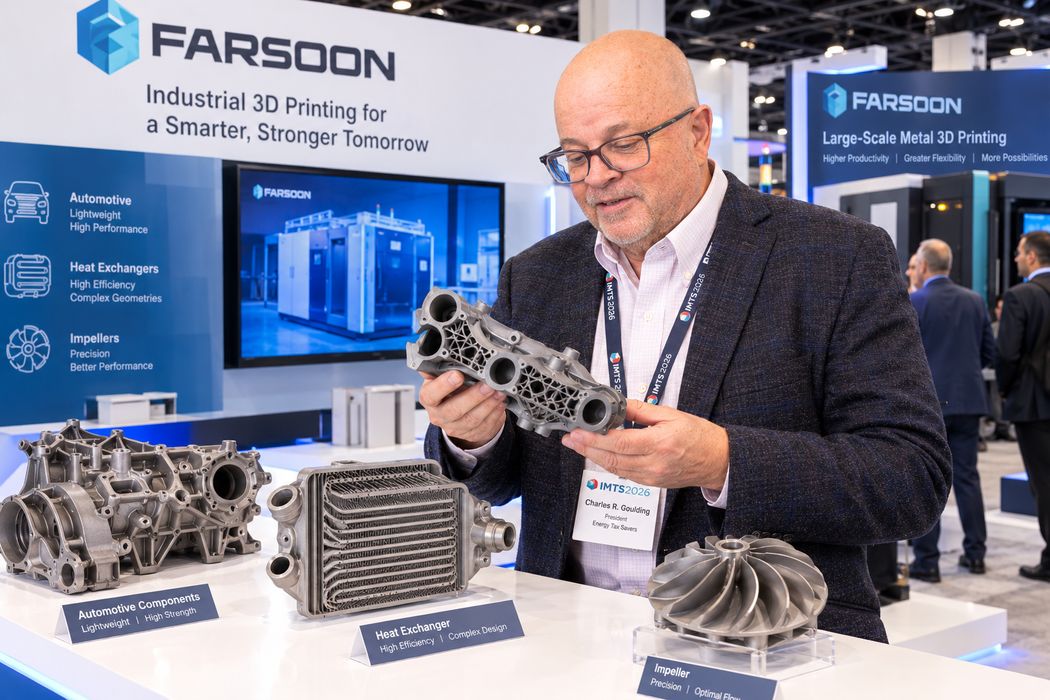
Four representatives at the booth did an excellent job explaining the company’s wide variety of applications, but what particularly stood out was the emphasis on materials expertise.
That is an increasingly important part of the industrial 3D printing conversation. A manufacturing company purchasing an AM system isn’t simply buying a machine. It is buying access to a combination of machine parameters, materials, software, process knowledge and application expertise.
Farsoon currently describes its metal portfolio as including more than 16 alloys and more than 68 validated processing parameters. Its materials include titanium, aluminum, nickel-based alloys, stainless steels and copper-based alloys. (Farsoon Technologies)
At the IMTS booth, I looked at automobile components, a heat exchanger, an impeller and a variety of fluid-transfer components.
The heat exchanger was especially interesting because thermal-management applications are an area where additive manufacturing can offer significant design freedom. Farsoon has previously demonstrated a 3D printed pure copper heat exchanger featuring a complex spiral geometry and very thin walls. The component was manufactured as a single piece, eliminating assembly associated with a traditionally manufactured design.
Farsoon has continued to develop this area. Its more recent work with copper-alloy additive manufacturing focuses on advanced liquid cooling, including cold plates, micro-fin arrays and complex thermal structures.
The company’s automotive portfolio also illustrates the production focus of its technology. Farsoon reports applications involving functional automotive parts, small-batch production and customized components, with both metal and polymer platforms available. (Farsoon Technologies)
Stratasys
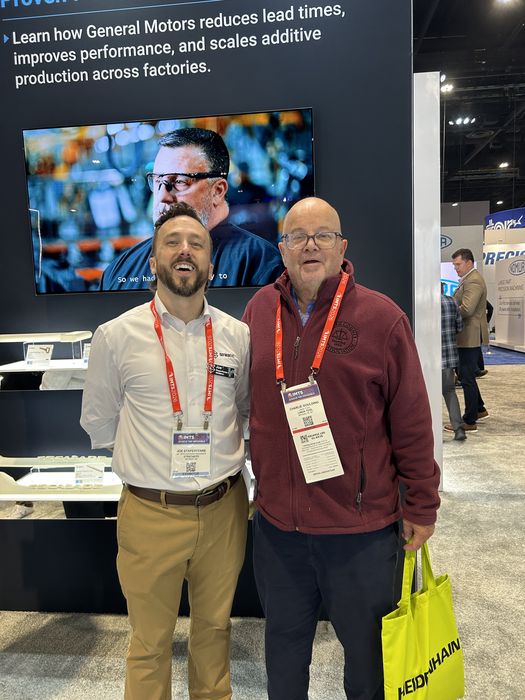
In a separate Fabbaloo article related to IMTS 2026, we covered Stratasys, including their automotive expansion into 20 GM plants. Below is a picture of me with the Stratasys representative.
IRC §41 R&D Credit Support from Additive Manufacturing Developments
The additive manufacturing developments provide strong fact patterns for supporting IRC §41 research credit claims when mapped to specific business components and project records. IRC §41 applies the qualified research tests separately to each business component, including products, processes, software, techniques, formulas, or inventions, and expressly treats production processes, machinery, or techniques as separate business components. Here, business components may include specialized copper additive manufacturing parameters for complex geometries and thermal-management applications, Inconel 625 clamp connectors and Inconel 718 rocket-engine components, validated materials/process parameters across more than 16 alloys and 68 processing parameters, copper heat exchangers and liquid-cooling structures, and patient-specific cranial implants with lattice structures.
These facts support technological uncertainty and qualified purpose where taxpayers evaluated alternative designs, materials, build parameters, heat treatments, or software settings to improve function, performance, reliability, or quality. The process-of-experimentation standard requires identifying uncertainty, alternatives, and systematic evaluation through testing, modeling, simulation, or trial and error. The article’s shift from prototypes to finished production parts and integration of machine, materials, software, process knowledge, and application expertise also help substantiate nexus, provided records retain usable detail on activities and costs.
Below is a table that presents the R&D investments Renishaw has made in recent years in comparison to its human capital.
Renishaw plc — R&D Expense per Employee by Reporting Year
| Company | Reporting year | R&D book expense (USD $ millions) | Employee / human capital | R&D expense per employee (USD $) |
| Renishaw plc | 2025 | 90.906 | 5,342 | 17,017.98 |
| Renishaw plc | 2024 | 90.822 | 5,256 | 17,279.64 |
| Renishaw plc | 2023 | 90.190 | 5,136 | 17,560.36 |
| Renishaw plc | 2022 | 73.502 | 4,931 | 14,906.77 |
R&D Tax Savers has been helping companies navigate the complexities of the R&D tax credit since it was introduced into law in 1981.
IMTS Makes the Production Story Visible
The biggest takeaway from the second day was not any single machine.
It was the sheer breadth of production applications.
Nikon SLM demonstrated sophisticated metal applications involving copper and Inconel. Renishaw showed how additive manufacturing can extend from automotive and defense applications into highly customized medical implants. Farsoon emphasized the connection between machines, materials and real-world production requirements.
This is an important evolution for IMTS and for additive manufacturing generally.
The 3D printing industry is increasingly being integrated into the larger manufacturing ecosystem rather than operating as a separate technology category. At IMTS, additive manufacturing is appearing alongside machining, metrology, robotics, automation and other production technologies.
And that may be the most significant observation from Day Two: 3D printing is no longer simply something manufacturers come to see. It is increasingly something they come to see working in production.