
A new machine learning approach has designed metal alloys and their laser printing parameters at the same time.
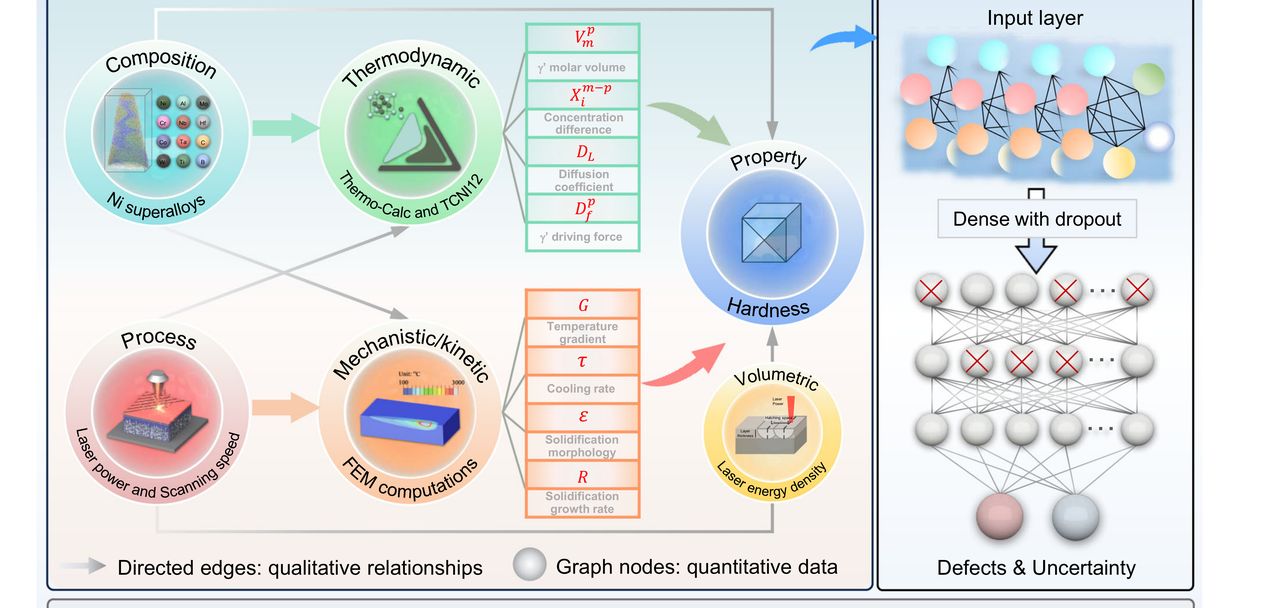
Researchers led by Northeastern University in China developed a framework called UQ-KGAT, short for Uncertainty Quantified Knowledge Informed Graph Attention Network. The work targets a frequently encountered metal AM problem: an alloy can look excellent on paper but crack or form pores when subjected to the rapid heating and cooling of a laser process.
Most alloys were originally formulated for casting, forging or other conventional methods. Laser powder bed fusion and laser directed energy deposition impose very different thermal conditions, so simply feeding an existing alloy into a 3D printer often forces operators into narrow processing windows or produces defects.
Teaching AI Metallurgy
The researchers did something more interesting than feeding a large spreadsheet into a neural network.
They built a knowledge graph describing known relationships between composition, processing conditions, solidification behavior, thermodynamics and material properties. In other words, the AI was given a map of which variables are known to influence others, rather than being asked to discover every relationship from a limited dataset.
The system also estimates uncertainty. That is useful here because pores and cracks are not distributed perfectly evenly through a printed sample. A microscopy image taken from one location may therefore give a somewhat different answer from another.
For the nickel superalloy work, the team began with only 142 samples from five alloys produced by laser directed energy deposition. The model then worked with a genetic optimization algorithm to search alloy chemistry and printing conditions together, seeking low defect levels without wandering into regions where its predictions were uncertain.
The result was a new nickel based material called KG-AMS.
Two Alloys, Two Processes
KG-AMS was actually produced and tested, which makes this considerably more interesting than a purely computational alloy proposal. Using optimized L-DED conditions around 1500W and 10mm/s, printed samples showed defect area fractions from 0.037 to 0.133%. X-ray CT measured 0.038% porosity in the best specimen.
The alloy also reached 391 to 417 HV hardness. Tensile testing produced 1307 MPa ultimate tensile strength with 22.2% elongation at room temperature, while testing at 900C produced 655 MPa strength and 7.5% elongation.
The model also helped the researchers investigate why the alloy behaved well. Their analysis pointed toward stable gamma prime precipitates, and subsequent atom probe tomography and neutron diffraction experiments supported that explanation. The alloy appears less sensitive to the repeated thermal cycling that can destabilize some nickel superalloys during printing.
Then they tried the same framework on aluminum.
Using a separate dataset of 163 literature derived samples, the system produced an alloy called KG-AMAA for laser powder bed fusion. Experimental samples reached 99.96% relative density and 128.3 HV hardness, with the best tested processing condition producing only 0.03% defects.
That aluminum result may be more important. A machine learning method that works once might just be well matched to one specific dataset. Here, the same basic framework generated printable candidates for TWO quite different alloy families and TWO different laser AM processes. It seems that it might be a general solution that is reusable on other alloys.
If this approach is scaled up, future metal AM materials may increasingly appear as a matched package: alloy chemistry plus the processing parameters needed to reliably print it.
