
Researchers at Lawrence Livermore National Laboratory appear to have found an unusual way to 3D print multiple materials with a two-photon system: change the light instead of changing the resin.
The concept appears in recently published patent application US20260249547A1, assigned to Lawrence Livermore National Security, LLC.
The idea is to use two different laser wavelengths, both pointed at essentially the same microscopic print location. If the resin chemistry is arranged appropriately, one wavelength could trigger one material while the other wavelength triggers another.
That could make multimaterial two-photon polymerization considerably more practical.
Two Lasers, One Print Point
Two-photon polymerization, or 2PP, is quite different from the resin 3D printing processes most readers will be familiar with.
Instead of exposing an entire layer, a highly focused laser beam polymerizes an incredibly small volume of resin at a time. By moving that focal point through the material, it’s possible to produce extremely tiny and detailed structures.
The trouble comes when you want more than one material.
One approach would be to swap materials during the build, but that becomes quite challenging when you’re dealing with microscopic structures. Lawrence Livermore’s approach is very different.
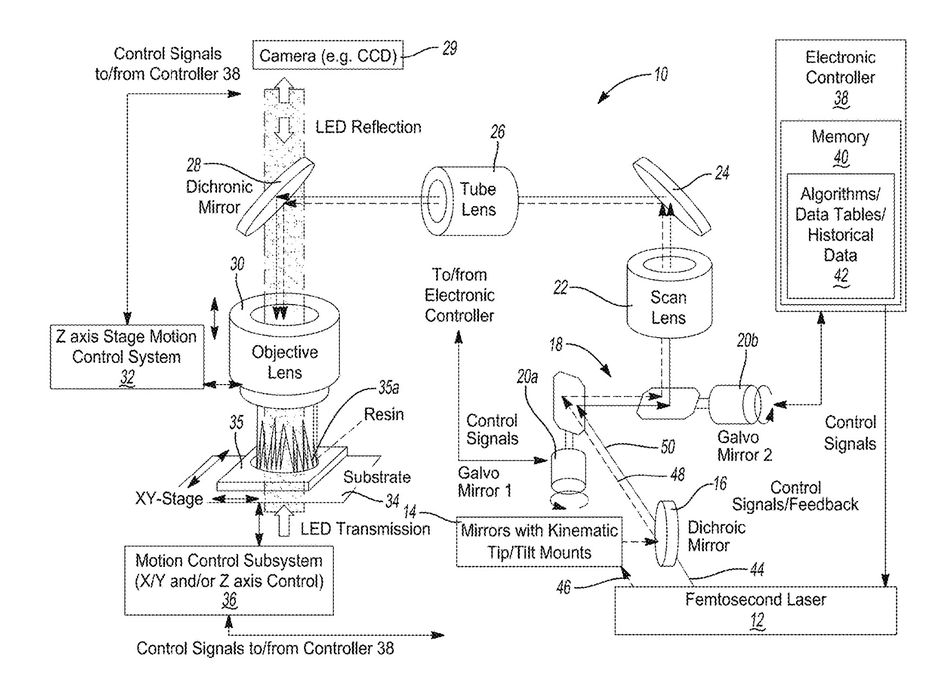
The proposed system generates two laser beams and combines them using a dichroic mirror so that they ultimately travel along the same optical path.
One of the lasers could operate at around 1045nm, while the second can be tuned from approximately 680nm to 1300nm.
Why do this?
The resin could contain different chemistries that respond to different wavelengths. The printer might therefore hit one coordinate with the first wavelength to cure Material A, then use the other wavelength elsewhere to cure Material B.
In some versions of the concept, the second wavelength could even cure both materials.
This is the part I find particularly interesting. From the printer’s point of view, switching materials could become almost like changing an exposure parameter in the toolpath. There’s no nozzle change, resin vat swap or other mechanical operation involved.
The patent suggests this could produce microscopic structures having different stiffness, refractive index, density, porosity or electrical characteristics in different regions.
There are also some more exotic possibilities described, including overlapping voxels and STED-style beam arrangements that could potentially squeeze the polymerization region down even further.
Of Course, The Optics Get Complicated
This sounds simple when described as “use two colors of light”, but getting both beams to arrive at precisely the same microscopic point is another matter entirely.
The patent spends considerable effort describing how this could be accomplished.
There are alignment pinholes, tip-tilt mirror mounts and a camera system to verify that the two beams actually overlap. Galvanometer mirrors steer the beams, while telecentric optics attempt to keep everything behaving properly as the focal point moves around the print area.
One disclosed configuration provides a print field of around 500 x 500 micrometers, although this would vary depending on the objective being used.
There’s another interesting wrinkle in the patent.
Conventional 2PP systems can be limited by the very short working distance between the microscope objective and the material. That puts a practical limit on how tall a structure can become.
Lawrence Livermore proposes placing a refractive-index-matched medium between the objective and a cover glass above the resin. One example described in the application could accommodate a resin depth of as much as 8mm.
That doesn’t sound like much by ordinary 3D printing standards, but in the world of two-photon printing, 8mm is enormous.
Larger structures would presumably be produced by shifting the sample stage and stitching multiple microscopic build regions together.
There are several potential applications mentioned, including optical devices, medical structures and specialized components for inertial-confinement-fusion work.
There are some obvious challenges.
The resin chemistry would have to be extremely well behaved. Each material has to react when desired without the other material unintentionally polymerizing. Meanwhile, the two laser paths must remain precisely aligned through a fairly elaborate collection of mirrors, lenses and scanning hardware.
That sounds like a calibration adventure.
Instead of physically changing materials during printing, Lawrence Livermore’s concept attempts to make the material choice optically. If that can be made reliable, a future 2PP machine might simply select “Material A” or “Material B” for each microscopic region of the model and let the lasers take care of the rest.
Via Espacenet
