
Researchers unveiled an LPBF aluminum alloy that stays strong and creep resistant up to 400C with no heat treatment.
Aluminum remains the default lightweight metal for AM, but most printable Al grades soften quickly above 250C and struggle with creep effects around 300–400C. The normal approaches to counteract this phenomenon use costly elements like Sc, Ag or complex heat treatments, and even then strength reduces at operating temperatures. Prior LPBF work on AlSi10Mg and Al–Ce/Mn showed better thermal stability, but tradeoffs in ductility and creep often persisted.
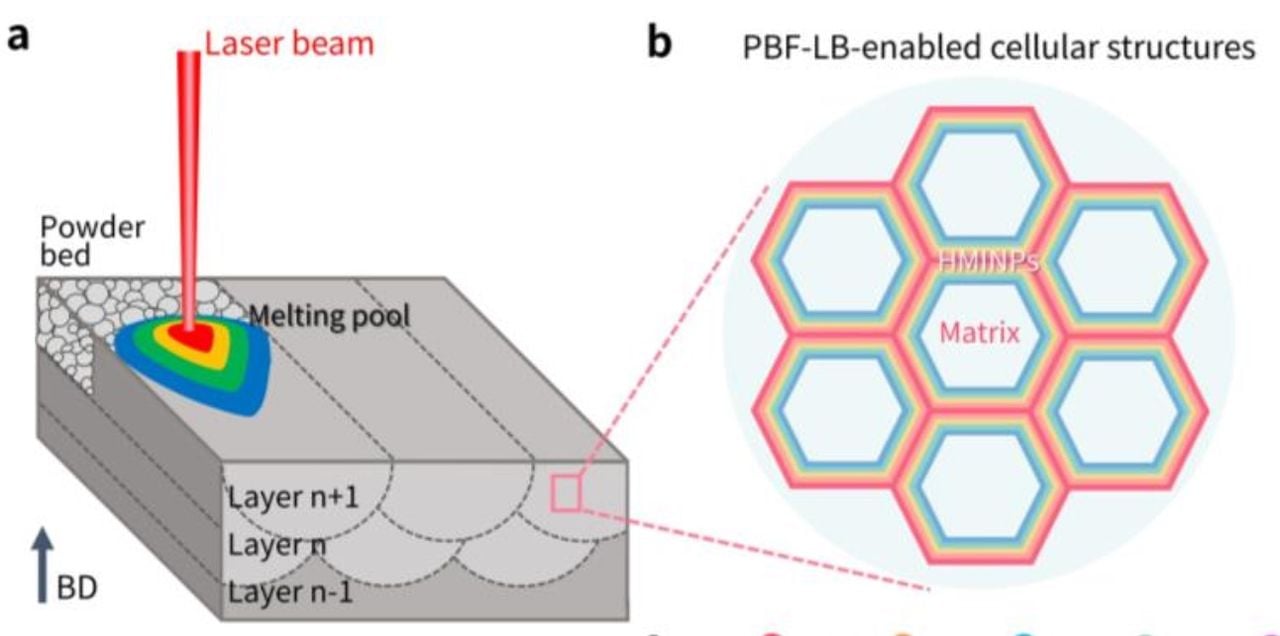
A new paper in Nature Communications describes a different approach: exploit the LPBF thermal field to build a thermally stable nanoprecipitate network directly during solidification. The researchers targeted the cell boundaries that naturally form in Laser Powder Bed Fusion (LPBF), enriching them to resist coarsening and keep dislocations from occuring.
Heat-Resistant Aluminum Without Rare Earths
The alloy uses readily available elements and leverages high-solubility silicon and slow-diffusing transition elements. During LPBF, these separate to the cell walls and form heat-resistant multicomponent intermetallic nanophases (HMINPs). The LPBF printed microstructure shows 300–400 nm aluminum cells enclosed by a continuous HMINP network about 60 nm thick.
The cell-boundary network notably raises part performance, confirmed by long heat exposure: after 168 hours at 400C, the HMINP skeleton remained intact, in contrast to the silicon network in AlSi10Mg, which breaks up and coarsens. Importantly, all of these structures form naturally during the LPBF build — no post-processing or aging required, and no rare or expensive elements are used.
Mechanically, the new 3D printed alloy reaches a room-temperature yield strength near 440 MPa with ultimate tensile strength around 582 MPa and about 7 percent elongation, comparable to normal levels but achieved straight off the build plate.
Elevated temperature performance is where this material really stands out: about 263 MPa UTS at 300C and roughly 114 MPa at 400C. Creep tests at 400C under 25–40 MPa show low steady-state creep rates relative to reported AM and cast Al benchmarks. The researchers also report reduced anisotropy versus typical LPBF Al.
The team printed on an SLM Solutions 280 using 370 W laser power, 1300 mm/s scan speed, 30 μm layers, and verified near-full density at 99.99 percent. Notably, the powder reflectivity at 1070 nm was measured at 33.7 percent — lower than many aluminum powders — which likely improves melt (energy) efficiency.
The immediate beneficiaries of this new material could be any sectors producing hot, lightweight hardware, including aerospace management, marine propulsion housings, or underhood automotive brackets — where LPBF’s design freedom plus creep resistance can leverage lightweighting for increased function to weight ratios. The researchers note early commercialization in marine and aerospace, with complex parts demonstrating high surface quality, although they didn’t mention specifics about the cost per kg of this wonder material.
There are still some open questions about this material, but it appears so promising that it is certain these questions will be soon answered. At that point we may see many more high temperature aluminum parts being 3D printed.
