
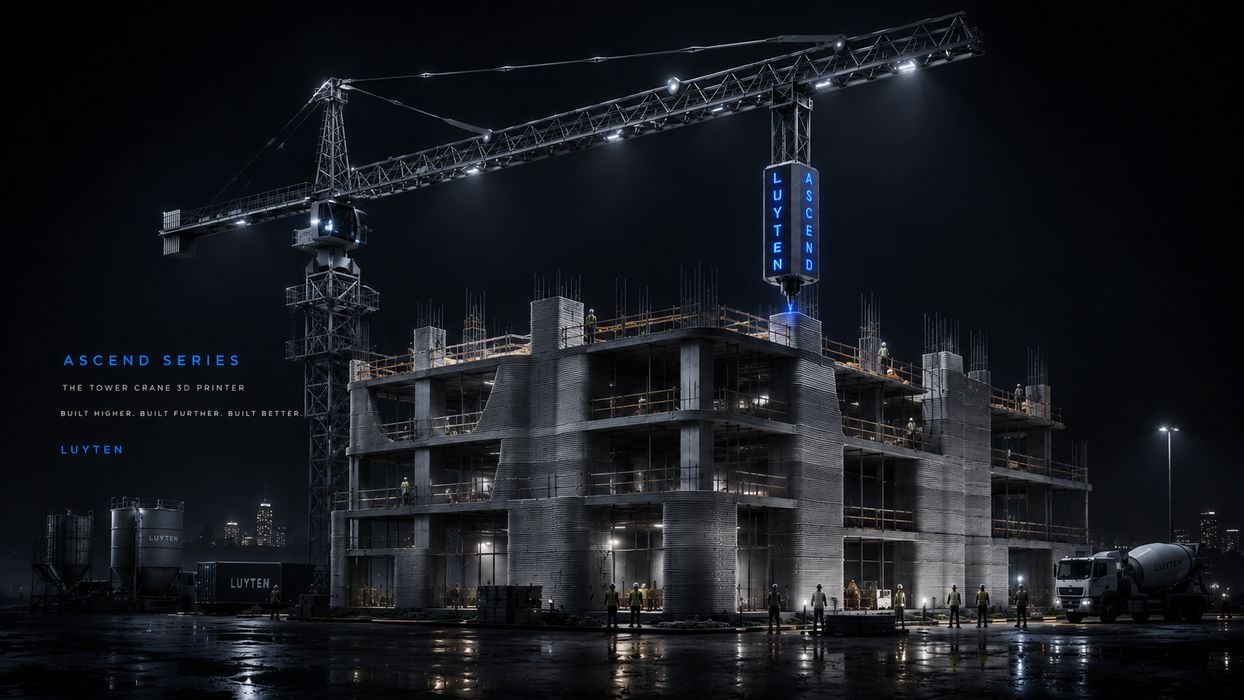
Luyten has produced a most unusual 3DCP printer.
3DCP systems tend to be of two forms: a gantry that surrounds the build site; and a robotic arm that reaches into the build volume. Sometimes these can be mounted on rails to extend the effective build volume on the X and Y axes.
Australia-based Luyten, a global construction company, has developed a very different format for a 3DCP device: a tower crane.
Tower cranes are something everyone in an urban environment is familiar with: they are those extremely tall cranes that lift components upwards when constructing skyscrapers. Most large city skylines will have at least a few visible at all times.
Here, however, Luyten has done something quite unique: they’ve used a tower crane as a motion system for the 3DCP process. That is their ASCEND SERIES A27 system.
Hold on, how could this work? Based on their imagery, the following seems to be true:
- The tower crane appears to be a typical system.
- The tower system can be set up in “1-2 days”.
- The crane holds a suspended 3DCP unit.
- The 3DCP unit holds not only the extruder, but also the material.
- No material pumping seems to be present.
- The tower crane provides the motion to move the extruder head as required.
Luyten said the A27 is able to construct 3DCP structures as tall as 100m (that’s 328 feet). In addition, the “sweep” of the tower crane yields an XY radius of 45m. This is easily the largest build volume I’ve ever heard of in 3D printing history: a cylindrical build volume of diameter 90m and height of 100m. That’s almost 640,000 cubic meters!
Meanwhile, competing 3DCP printers boast of being able to print up to three storeys of a building. What Luyten is providing is vastly beyond that capability.
But does it really work? My immediate concern would be the position accuracy of the system. Remember, the 3DCP extrusion unit is hanging under the crane’s arm, where it could potentially wobble. It is likely their print speed is quite slow to prevent momentum swings that would affect extrusion position. The extrusion unit would be incredibly heavy, but I have no doubt that the crane could lift it. The question is how difficult it is to move it precisely.
However, tower cranes are a well-understood technology, and it is quite possible that the required accuracy could be achieved, perhaps through the use of advanced positioning systems and AI-based motion control algorithms.
This is a very interesting development, since it opens up a whole new set of 3DCP possibilities. Up to now, we’ve been limited to short structures, but the A27 could, if it works and is financially feasible, allow for absolutely massive 3D-printed concrete structures.
We would also see competing tower crane 3DCP systems quickly emerge.
The future is looking up.
Via Luyten
