
A new review examines how magnesium containing materials and additive processes could turn patient specific, resorbable bone repairs into reality.
The article documents progress across magnesium alloys, magnesium doped bioceramics and polymer composites made by multiple additive manufacturing (AM) methods. For readers who follow implant materials, magnesium sits between titanium and PEEK: lighter than both, mechanically closer to bone than titanium, and intended to harmlessly degrade as the defect heals, potentially eliminating follow up removal surgery.
That degradability is the attraction and the headache. Pure magnesium can corrode too fast in vivo, evolving hydrogen gas and losing strength before tissue consolidation. The review walks through the levers available to AM developers — alloying strategy, lattice architecture, surface treatment and process parameters — to dial degradation toward a clinically acceptable window while maintaining throughput and repeatability.
Why These Processes Matter
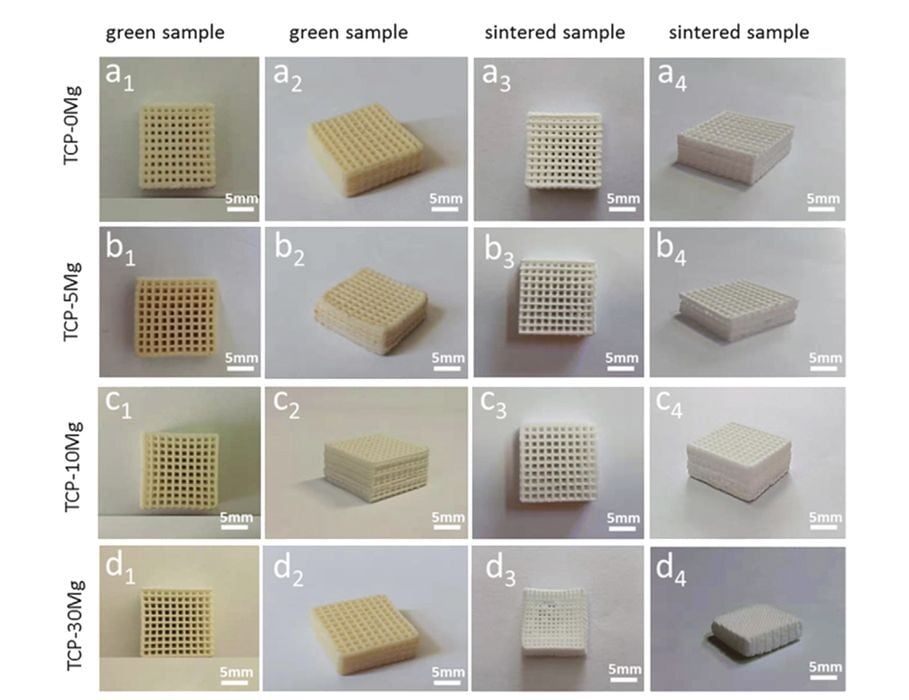
For metallic implants, Laser Powder Bed Fusion (LPBF) dominates the discussion. LPBF enables fine feature lattices, graded porosity and tight patient specific geometries, all useful for matching stiffness and encouraging bone growth. The paper also notes activity in binder jetting followed by sintering and infiltration, though sintering magnesium safely and to high density is nontrivial. On the nonmetal side, Digital Light Processing (DLP) of magnesium silicate or magnesium doped calcium phosphate resins, and extrusion based printing of polymer matrices filled with magnesium particles, give designers bioactive scaffolds without handling reactive metal powders.
Each route has constraints. LPBF of magnesium demands aggressive inerting, strict powder handling protocols and careful energy density control to avoid evaporation, porosity and ignition risk; very few OEMs publish validated parameter sets. Binder jetting and FFF composites trade structural performance for safer handling and easier shaping, but typically require sintering or have limited load bearing capability. DLP ceramics can hit intricate shapes, yet post cure and high temperature sintering add cost and can distort features.
Tuning Degradation Without Losing Strength
The review’s most practical contribution is a playbook for balancing corrosion and mechanics. Alloying magnesium with biocompatible elements such as zinc or calcium, refining grain size via process parameters or post build heat treatment, and applying surface treatments like calcium phosphate coatings or polymer barriers can slow early corrosion. AM specific design — for example, using thicker struts in high stress regions and finer lattices elsewhere — adjusts surface area and local pH exposure, further moderating the degradation rate.
What is still lacking are head to head data sets that match process recipes to in vivo outcomes. Reported corrosion rates, fatigue behavior and hydrogen evolution vary widely across studies, often with small animal models and short follow up. The authors highlight the need for standardized tests that correlate accelerated in vitro corrosion with clinical timelines for load bearing sites such as long bones versus lower load craniofacial indications.
Economics, Safety And The Path To Clinics
On economics, the paper does not provide build volume or cycle time benchmarks, and the cost of safe powder handling for magnesium in LPBF is rarely disclosed. Service bureaus and hospitals considering point of care manufacturing will need clear guidance on powder reusability, inert gas consumption, and post processing steps like support removal, heat treatment and surface finishing. Regulatory acceptance will lean on process monitoring, lot traceability and demonstrated repeatability — areas where AM has tools, but not yet a magnesium specific playbook.
The good news is application fit looks strong. Resorbable screws, plates and lattice scaffolds are the near term targets, with patient matched geometries playing to AM’s strengths. Dental and trauma indications could move first, where implant lifetimes are measured in months and the benefit of avoiding a second surgery is compelling.
Readers should watch for multi center preclinical studies using common test protocols, fatigue data under physiological loading, and demonstration of closed loop process control on reactive powders. When those appear alongside clear sterilization, packaging and shelf life guidance, magnesium AM will have a credible route to first approvals.
