
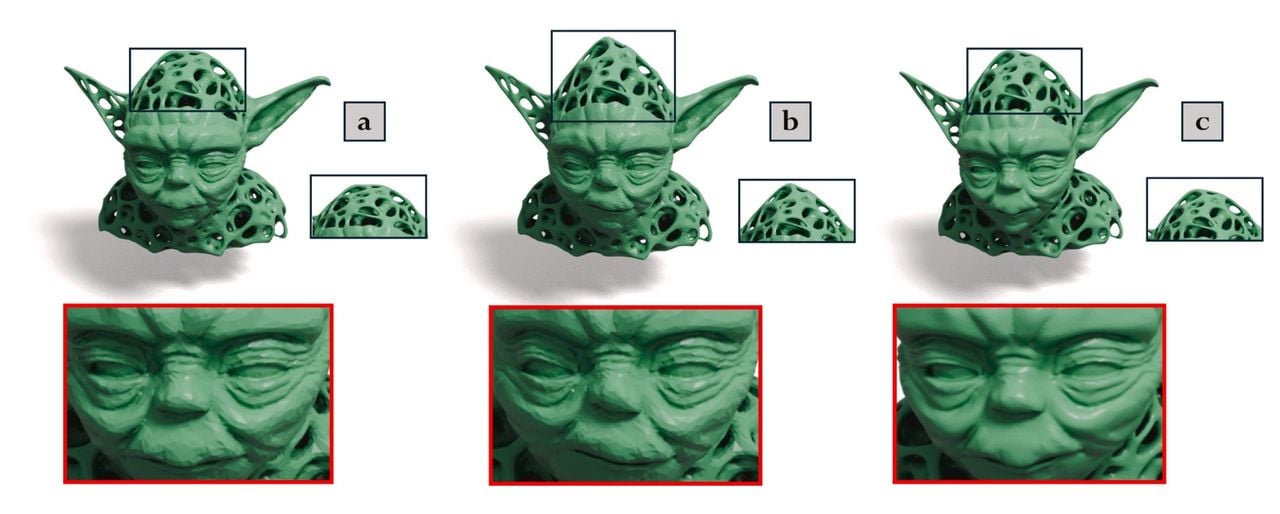
A new neural field-based optimization method aims to reshape parts to reduce overhangs and, in turn, minimize the need for 3D printing support structures.
If you have ever tuned a print only to discover that supports ate your time, material, and surface finish, you already understand the stakes. Supports are often the hidden cost in polymer processes like FFF and vat photopolymerization, and they can be even more painful in metal powder bed fusion where removal can turn into manual labor and risk. The dream is not “better supports”, but fewer situations where supports are needed at all.
The paper, titled “Neural field-based shape optimization for manufacturability-aware support structure minimisation”, proposes a method that targets the geometry itself. Rather than only deciding where to place supports under an existing design, the approach tries to slightly alter the part so that it becomes more self-supporting while still meeting design intent.
This sits in a growing category of “design for additive” automation that lives between CAD and the slicer. We have seen topology optimization for stiffness and weight, lattice generation for energy absorption, and simulation-driven compensation for warping. Support minimization has largely remained a slicing task, with incremental improvements like tree supports, better contact settings, and smarter orientation tools. The research here proposes support reduction upstream into shape optimization, potentially reducing the need for trial-and-error slicing.
What The Neural Field Adds
The core idea is to represent a 3D shape using a neural field, a continuous function that describes whether any point in space is inside or outside the object. With that representation, the algorithm can make smooth, localized changes to the surface while evaluating manufacturing constraints tied to overhang behavior. It is a way to “nudge” the model toward printable angles and transitions without the jagged artifacts you can get from voxel-based edits.
Because the optimization is “manufacturability-aware”, it is not just chasing an abstract mathematical objective. It is explicitly trying to reduce regions that would trigger supports for a given process model of overhang limitations. Conceptually, think of it as automatically adding subtle chamfers, fillets, and gentle curvature where a designer might otherwise add them by hand after seeing a support preview.
Designers already know these manual tricks. They add ribs, split parts, change angles, or reorient. But those steps can take hours, and they often conflict with aesthetic or functional surfaces. An optimizer that can explore many small changes quickly could reduce that iteration load, especially when the starting design comes from topology optimization or generative design and is already “busy”.
Where It Helps, And Where It Might Not
This is not a magic “supports are gone” button, and the paper’s promise should really be minimization, not elimination. Some geometries require support unless you change the design in a way that breaks the requirement. A horizontal internal ceiling, for example, may need either supports, a redesign into an arch, or a multi-part assembly. If the optimizer is constrained to preserve certain interfaces or internal cavities, it may have limited freedom to improve things.
It also matters which process you care about. Overhang rules for FFF are different than for resin printing, and both differ from powder bed fusion where heat management and support anchoring are part of the story. A shape that prints without supports is not automatically a shape that prints accurately.
Another open question is workflow. Most production shops do not want a black-box geometry modifier that changes the model without traceability. To get adoption, the output needs to be explainable and controllable: preserve datum surfaces, keep hole sizes within tolerance, respect “do not touch” regions, and export clean CAD or mesh that downstream software trusts. If the method stays in research tooling and cannot round-trip into mainstream CAD and slicing pipelines, its impact will remain limited.
That said, even partial wins could matter. If a tool can reliably shave off 20 to 40 percent of support volume on common brackets, ducts, housings, or figurative resin models, it could reduce material use and cleanup time while improving surfaces that would otherwise be scarred by support contact. For service bureaus, that means less labor per part. For engineers, it means fewer design iterations that are really just “support debugging”.
The fastest support removal is the support you never had to print.
Via ScienceDirect
