
Researchers have developed a process to embed continuous carbon fiber into resin 3D prints.
Revealed in a recently awarded patent to the University of Colorado, the patent describes a new process that enables resin printing of very strong parts using continuous fiber.
Continuous carbon fiber FFF 3D printers have been around for a while, although they typically have been expensive. The concept is to lay down strands of (say) carbon fiber in each layer of the print. Carbon fiber is stronger than steel, so the parts are extremely rigid. In some cases these lightweight parts can replace metal parts, as long as the environment isn’t too hot.
But continuous fiber has only been achievable in FFF 3D printing — until now.
The new patent, WO-2025217022-A1, entitled “Continuous fiber reinforced photo sensitive polymer 3D printing”, describes a method of doing the same thing in a resin 3D printer.
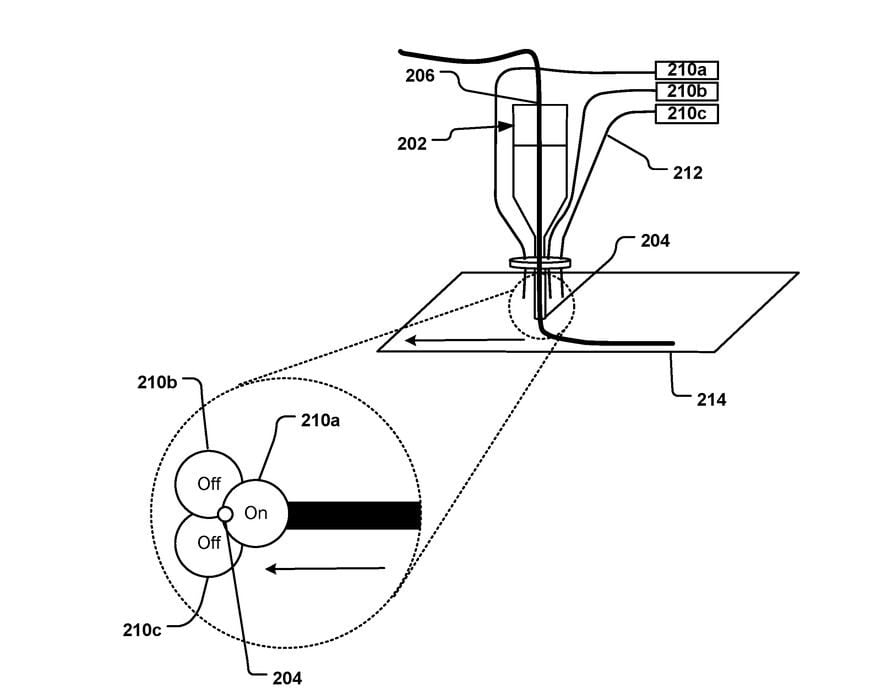
The approach is relatively straightforward: add a second toolhead to lay down the fiber as each layer is produced. The normal UV curing cycle will freeze the fiber into the layer, adding strength.
That sounds simple, but it’s actually a bit more complex, particularly the curing cycle. Here’s how it works:
- A layer îs cured in the normal manner — the whole layer is solidified with a UV light bath
- The fiber is laid down in specific areas on the layer
- As the fiber is laid down, a UV light source on the deposition nozzle tacks the fiber down
- The layer is then flooded again with resin
- A full layer UV cure finishes the layer
You might be wondering about the “tacking” process, which keeps the fiber in place while curing occurs. How is this done? It’s possible because the fiber is pre-treated with a sheath surrounding it.
The sheath is produced by wetting the filament with resin ahead of time, and then partially curing it to “gel” state. A second resin bath fills any gaps, and a pass through a shaping die ensures it’s round. This leaves a filament that has a coating that can be cured as it is laid down during printing.
This method effectively creates an entirely new category of 3D printing — photopolymer continuous fiber reinforcement. It should be able to produce extremely strong parts in resin that leverage all the many properties of today’s resin materials.
For example, there are resins that can produce objects that offer significant heat resistance, unlike the thermoplastics produced by the FFF process. If these parts suddenly became much stronger due to fiber reinforcement, they could be used in countless mechanical applications, particularly aerospace.
If the fibres are conductive, it might be possible to embed electrical traces directly into resin 3D prints. This could vastly simplify the production of certain electronic products.
There are many possibilities. However, this appears to be just a patent at this point, and there are no devices you can purchase using this tech. It’s very likely this technology will soon be commercialized in the future, if it isn’t already underway.
Via Google Patents
