
Researchers have developed a method of using digital twins to significantly improve resin 3D printing results, but there’s some challenges in doing so.
Vat photopolymerization (VPP) — including stereolithography (SLA), MSLA and DLP — has long used relatively simplified optics and curing systems. There are standard formulas for predicting cure depth and setting exposure. Those formulas work for plain photopolymer resins and coarse settings, but they have problems once you add pigments, fillers, oxygen inhibition layers, thermal effects, grayscale anti-aliasing, or other complications.
The paper looks at decades of work on light transport, resin rheology, kinetics, thermal rise, shrinkage, and stress — then connects these to today’s control requirements. It also looks at process variants such as continuous printing (CLIP-like dead zones), micro-SLA, two-photon polymerization, and emerging volumetric concepts. For readers operating SLA and DLP fleets in dental, hearing aids, jewelry, and engineering prototyping, this is a decent survey of what matters inside the resin vat and how to predict what happens.
The researchers used digital twins — these are digital models that can absorb printer settings and sensor data and predict the resulting cure state, and then adapt exposures on the fly. That means combining an optics model, cure kinetics, and a thermal module, sometimes with oxygen transport at the interface. If supplied with layer images and instrumented by cameras, photodiodes, or temperature probes, the digital twin can forecast overcure, undercure, and heat spikes, and even compensate with parameter changes.
Metal AM has previously explored this approach with melt pool monitoring and closed-loop laser control. VPP could see similar benefits: fewer blowouts on microfeatures, reduced print-to-print drift as LEDs age, and better z-resolution without brute-force overexposure. The review achieved demonstrations of pixel-level compensation, predictive anti-bleed algorithms, and exposure scheduling that manages heat buildup to keep viscosity stable and limit curl.
However, resin variability is a big factor, since proprietary formulations hide kinetic constants, and filled systems scatter light in ways that simple formulas cannot deal with. The paper discusses the lack of standardized calibration parts and open datasets linking illumination to final mechanical properties. Printer APIs are also a problem — many resin 3D printers still do not expose sufficient hooks for closed-loop control, preventing the use of digital twins.
Why Multiwavelength Exposure Matters
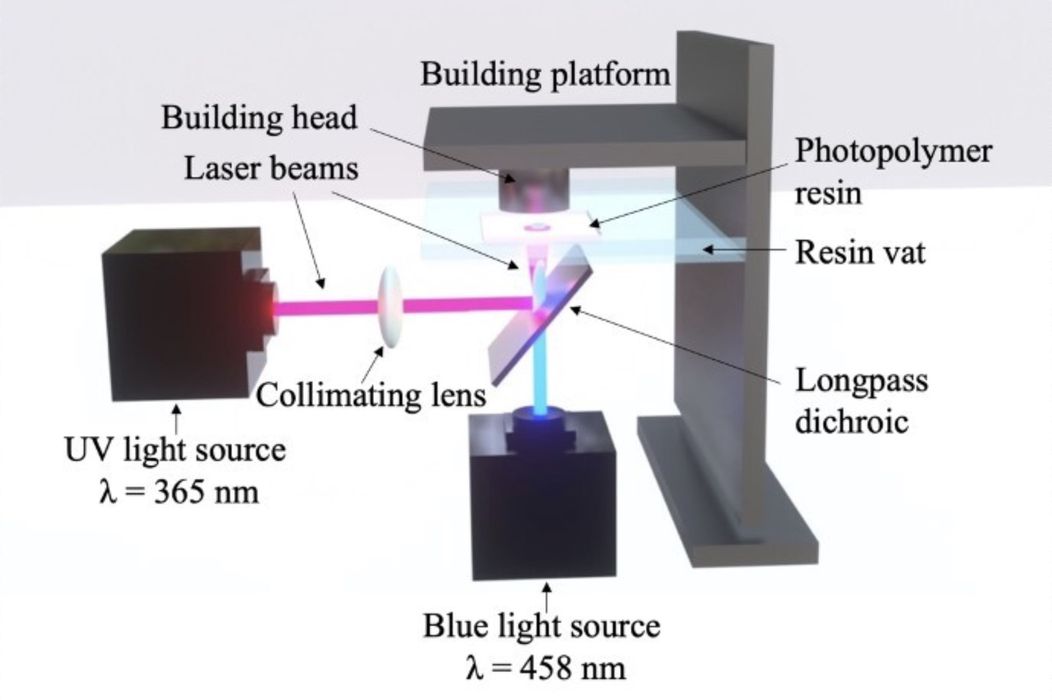
The second major thread in the paper is multiwavelength processing, where two or more narrow bands coordinate exposures. The paper discusses strategies ranging from photo-inhibited polymerization — using a secondary color to hold reactions in check until a trigger light arrives — to orthogonal chemistries that enable multi-material or functionally graded parts in one vat.
Implementing multiwavelength control is nontrivial. Typical DLP engines are optimized for a single band, so hardware may require additional LEDs and dichroic optics, plus per-pixel color calibration to avoid spatial artifacts. Resin design becomes more complex, balancing absorbers, photosensitizers, and initiators without sacrificing strength or long-term stability. The paper argues that a digital twin is the natural companion here, since it can schedule color channels and predict cross-talk.
For service bureaus and regulated segments like dental, the potential payoff is could be important: tighter tolerances, lower rework, and higher throughput. Adoption could start with controlled, single-application workflows where material, optics, and software can be co-tuned, then expand as 3D printer manufacturers open interfaces and share calibration methods.
The researchers call for benchmark parts that stress optics and kinetics together, shared repositories of resin optical and kinetic parameters, and side-by-side studies across multiple printers. It would help to see field results where a twin reduces scrap rates or print times by a defined percentage on production parts.
This research could open up quite a few new avenues for improvement of resin 3D printing, and I’m hoping some of the manufacturers will pick up these new approaches.
