
A new US patent application proposes a heat-aided abrasion method to speed finishing of additively manufactured thermoset parts.
Surface finishing has long been a pain point for photopolymer resins and other thermosets. Vapor smoothing works well for many thermoplastics, but cross-linked resins resist traditional solvent-based reflow, leaving users with manual sanding, media tumbling, or coatings to erase layer lines and roughness. Automated systems from AMT, DyeMansion and others focus on thermoplastics; resin users still spend significant human time to hit cosmetic or sealing targets.
US20260001275A1 addresses that gap by defining a thermal preconditioning step that temporarily softens only the outer skin of a resin or elastomer part without melting the bulk. The approach targets vat photopolymerization parts as a primary use, but the filing also calls out applicability to highly resistant thermoplastics such as PAEK, including Polyether Ether Ketone (PEEK) and Polyether Ketone Ketone (PEKK).
The concept is simple: raise the surface temperature above the material’s heat distortion temperature but below its thermal degradation temperature, then abrade while the skin is more compliant. After cooling, the part returns to a hardened state with a smoother finish.
Heating Just Below Degradation To Soften The Skin
The patent specifies surface temperatures typically in the 200C to 300C range, with examples at 220C, 240C, 250C, 260C and 280C depending on material. Heating is preferably done by submerging the part in a liquid bath whose boiling point meets or exceeds the heat distortion temperature and whose flash point exceeds 80C for safety. Suggested liquids include bio-derived solvents and oils: gamma-valerolactone, Cyrene, Methyl 5-(dimethylamino)-2-methyl-5-oxopentanoate, and even vegetable, olive or sunflower oils. Exposure is short — often five to ten seconds — to limit thermal risk and keep the effect near the surface.
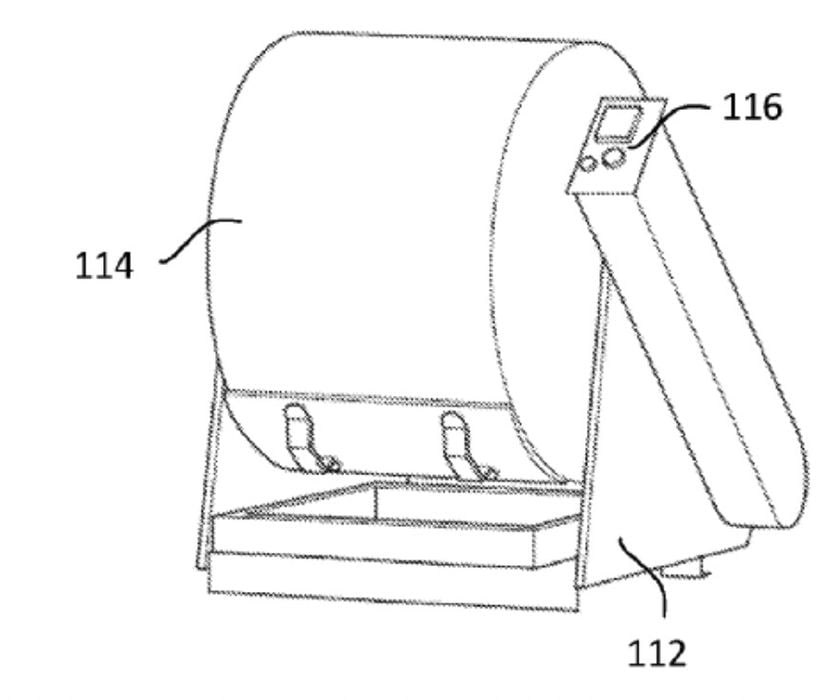
After the dip, the part is abraded mechanically. The filing describes several routes: a rotary or vibratory tumbler with soft polymeric media (acrylic or nylon), textile or foam media, or blasting with plastic, ceramic or glass media at 1 to 9 bar. Media sizes of 106 to 212 microns and hardness around 5 Mohs are noted as effective. An integrated apparatus concept combines a heated liquid receptacle with a vibratory bowl to streamline the workflow and maintain temperature uniformity, a known factor for consistent results.
The claimed impact is substantial: the authors report removing defects in about five minutes with the heat prep, compared to multiple hours of sanding at ambient conditions. Example runs show resin elastomer parts dipped in 240C solvent or 260C oils for a few seconds, then rubbed with flexible polyurethane foam, and epoxy or PEEK parts dipped at 280C followed by brief 400-grit sanding.
Implications For Resin, Elastomer And PAEK Parts
If validated, this creates a resin-side analogue to vapor smoothing for thermoplastics. Service bureaus handling large volumes of vat photopolymerization parts could reduce human touch time, improve throughput, and achieve more consistent Ra without resorting to heavy coatings. Elastomeric thermosets — often the most stubborn to deburr — appear to respond well in the examples.
The PAEK angle is notable. Polyaryletherketone parts printed by FFF or laser-based systems are famously resistant to solvents and slow to finish. The filing suggests a short thermal dip plus light abrasion can accelerate smoothing even here, potentially improving economics for aerospace, medical and industrial users who need clean surfaces on PEEK or PEKK components.
There are constraints. Working at 240C to 280C with liquids raises equipment compatibility, fume management and EHS questions; the patent steers toward bio-solvents and high flash points, but real-world safety engineering and ventilation are non-trivial. Dimensional change, edge retention and property effects are not quantified. The authors do not provide standardized surface roughness data, bulk mechanical retention after cycles, or long-term aging results for photopolymers, which are sensitive to heat and chemistry.
Watch for independent benchmarks with Ra/Rz data before and after, part-to-part repeatability on complex geometries, and comparisons against dry media finishing or spray coatings. A commercial system that integrates a controlled hot-bath stage, sealed handling, and automated tumbling could drive adoption, especially if it documents material compatibility matrices across epoxy, polyurethane and elastomer resins, plus PAEK.
If these results hold, a short dip in hot bio-solvent or oil might become resin finishing’s equivalent of vapor smoothing — more heat than hype.
Via Google Patents
