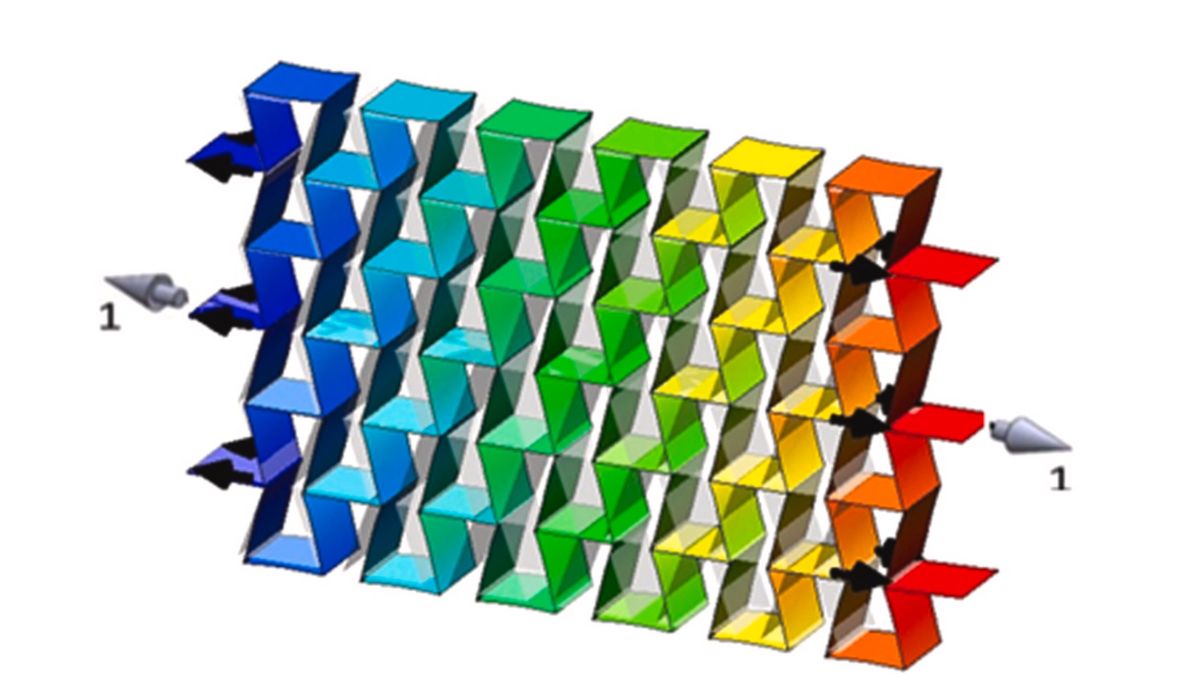
Equal density does not mean equal behavior.
That is the idea in a new study of PETG cellular structures. The researchers held density constant, then examined how different cellular geometries behaved. Their focus was stiffness, but also something more interesting: how the structures actually broke.
Cellular structures are the repeating lattices and patterned walls increasingly used in 3D printed parts, particularly when generating 3D models. They can reduce weight, absorb energy, or tune flexibility without changing the outside shape of a component, all with a single material. But their mechanical behavior is usually very dependent on direction.
Print or load a structure one way and it can feel quite rigid. Turn it 90 degrees and it may become noticeably more flexy. That is anisotropy.
The paper’s title lists a second source of directional behavior. Geometry can introduce anisotropy on its own, while the way a cellular structure is oriented and loaded introduces another. The authors call this combined behavior “double anisotropy.”
We tend to talk about anisotropy as a result of the process: layer interfaces, extrusion direction, layer bonding, and build orientation. Yet a lattice may already have its own preferred direction.
If both effects are present, a part designer cannot assume that selecting a stronger print orientation will automatically produce a stronger part. The geometry and the direction of the expected load have to be considered together.
Why Equal Density Is A Useful Control
The “iso-density” part is particularly important. Cellular designs are frequently compared at different relative densities, which means one sample may simply contain more polymer than another. That can hide whether a stiffness advantage comes from a fancy geometry or from just using more material.
By comparing structures at equal density, the study attempts to isolate the effect of form. If one PETG structure is stiffer, more compliant, or fails differently than another, the explanation is less likely to be merely that it had a thicker or heavier framework.
The auxetic side of the comparison is especially interesting. Auxetic structures have a negative Poisson’s ratio: stretch them in one direction and they expand sideways rather than narrowing. Conventional materials do the opposite.
That unusual motion can be very useful for energy absorption, conformal components, and parts that must deform in a controlled way. But it also creates joints, hinges, and stress concentrations that may fracture differently from a conventional cellular pattern.
The researchers examined a transition in fractures across those two regimes. That suggests the issue is not just whether one design survives a larger load. The structure may fail through a different physical sequence as the geometry moves from conventional behavior toward auxetic behavior.
A stiff lattice that suddenly snaps at a few highly stressed junctions is a very different engineering scenario from one that progressively breaks through several cells.
The notion of treating lattice geometry and print-related directionality as a combined design problem seems like a very good idea. Engineers should choose designs for the way they deform and fail, not only for the amount of material they save.