
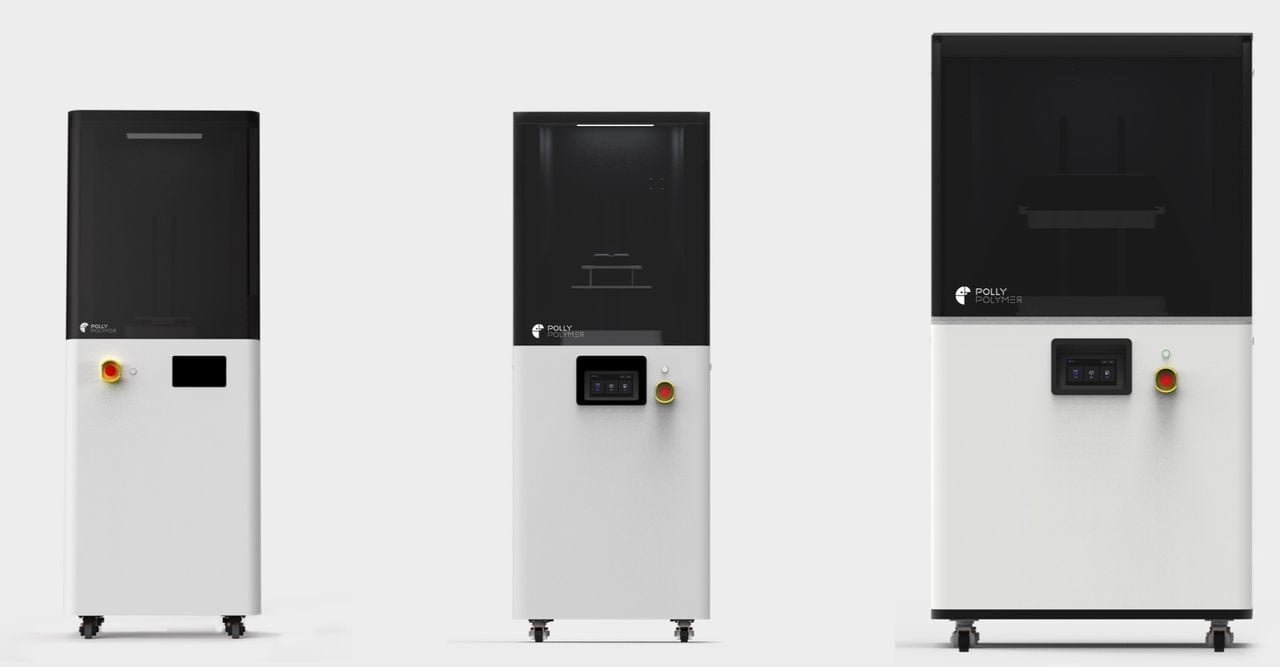
The West may face a new competitor in 3D printing, PollyPolymer.
You may not have heard of PollyPolymer, and that’s because they were founded only in 2017. However, they’ve experienced very rapid growth, mostly in domestic Chinese business.
A report in the South China Morning Post provides some details on the new company, which produces both industrial polymers and 3D printers.
Their business has several branches, including the development of apparently 10,000 unique polymer materials, which are used by industry.
In addition to the materials, they also produce a line of industrial 3D printers, the TAPS machines. The largest model in the TAPS line has a huge build volume of 995 x 745 x 2102 mm, one of the larger resin systems on the planet.
These devices use a resin 3D printing technology PollyPolymer has named Hindered Asynchronous Light Synthesis (HALS), which apparently provides higher speed printing at lower costs.
They don’t really describe HALS in any detail, but it is listed as a “separation technology”. The imagery shows a resin process quite similar to common bottom-up MSLA or DLP systems, which typically suffer slower speeds due to separation problems. That’s when fresh layers need to be peeled carefully off the bottom of the resin tank.
There are a number of 3D printer manufacturers that have found ways around that problem, and it seems that PollyPolymer has another one in their HALS technology.
In addition to the materials and hardware, PollyPolymer also provides “Super Designer Lattice Software” that enables clients to easily design foam-like structures for their products. They explain:
“Super Designer is an advanced lattice design software that enables the creation of multi-zone lattices, providing varied performance across different areas of a part.”
They also offer a “smart factory” equipped with TAPS 3D printers to produce quantities of production parts on demand.
With all these products and services, they seem to be focused on the footwear market, as they, like others, believe there will be a huge demand for custom 3D printed footwear in the near future.
At this point in the story I realized that PollyPolymer appears to be using the same playbook as California-based Carbon:
- Strong focus on materials
- Working directly with product manufacturers
- Creating custom materials for specific applications
- Offering print services as well as printers
- Offering easy-to-use lattice generation tools
- Significant effort in the footwear industry
- Separation technology to speed up resin 3D printing
Carbon’s key innovation was their development of an ingenious oxygen-based chemical barrier that prevents layers from sticking on the print vat. This enabled their systems to print more or less continuously, greatly speeding up printing and increasing part throughput for production deployments.
We don’t know exactly how HALS achieves separation, but it is unlikely to be the same as Carbon’s. However, functionally it could be the same, and that’s really what matters in business competition.
Today the two companies are quite far apart in terms of market reach, but as both are growing, it could be they may collide in coming years.
Via SCMP and PollyPolymer
