
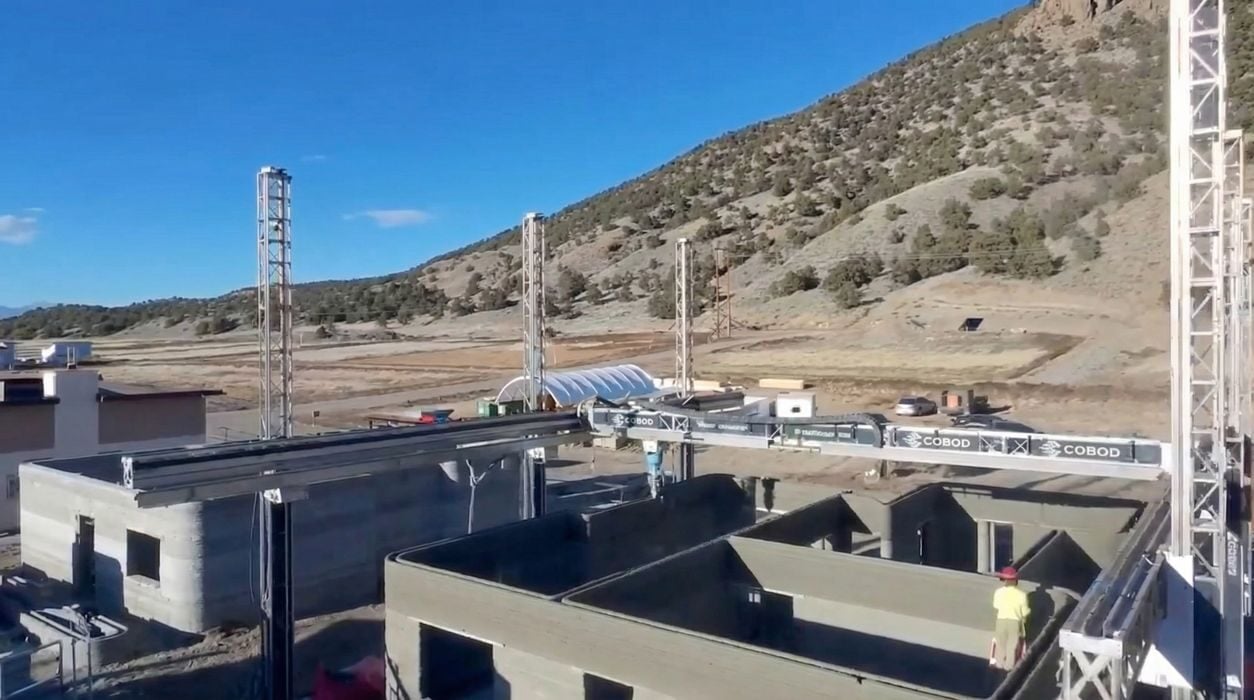
Hints at the true cost of 3DCP have been published by COBOD.
COBOD, based in Denmark, is one of the world’s leading producers of large 3DCP equipment. Their concrete printers are able to print multi-storey structures, and have been used worldwide on quite a number of projects.
In a LinkedIn post, COBOD CEO Henrik Lund-Nielsen described a project undertaken by one of their partners, VeroTouch of Colorado. (This is COBOD’s business model: they make the 3D printers, and construction companies like VeroTouch use them on projects.) The project was to build a set of 31 homes in Salida, Colorado.
Nielsen reports that the process of building the foundation and walls — both made of extruded concrete — took less time and cost than traditional approaches. He writes:
“VeroTouch, with the help of our technology managed to print the walls and the foundation of a 140 m2 (1540 sq ft.) single-family house in Salida, Colorado in just 6 working days over 9 calendar days.
The 6 working days were divided into 2 days for the foundation and 4 days for the walls (20 printing hours), starting the wall printing on a Monday morning and finishing the same week.”
VeroTouch explained that they were able to build the walls and foundation at a lower cost than building just the foundation alone using regular methods. They said that the time required for the build was 50% less, and the cost was 30% less.
This is information we’ve been looking for: what does it really cost to do one of these projects.
Early on this type of data was very rarely seen, and the suspicion was that the projects were really just experiments to prove the technology, and not something that was financially feasible. “It works, but not something we’d actually use day to day.”
Here we have a different story, as the costs and time required apparently were less expensive than traditional methods, and substantially so.
If these results are practical in other projects, it could mark a turning point for 3DCP technology. Construction companies face highly competitive markets, and costs are critically important. Having a way to lower those costs — and speed up delivery — could be quite attractive. And it doesn’t hurt that the resulting structures are quite unusual in geometry.
However, changing a company’s methods is always extremely difficult. Construction companies are by definition focused on their construction work and will be reluctant to switch technologies: why risk change when we know what we can do with older tech right now? That’s a fair point, and many conservative construction companies will take that line.
The same effect occurred in other areas that encountered 3D printing. The only way to persuade companies to try the technology was to make an overwhelmingly positive business case, so enormous that it could overcome the conservative nature of the business.
Is a 30% saving on building walls and foundations enough to tip the scales toward 3DCP?
I’m not sure, because a company might still feel the risk of failure would cancel out any potential savings. If it were possible to make, say, 80% savings, then the risk could be more worth the effort.
We’re not there yet, but the 30% saving might convince another layer of more adventurous construction companies to take on the new technology of 3DCP.
Via LinkedIn
