
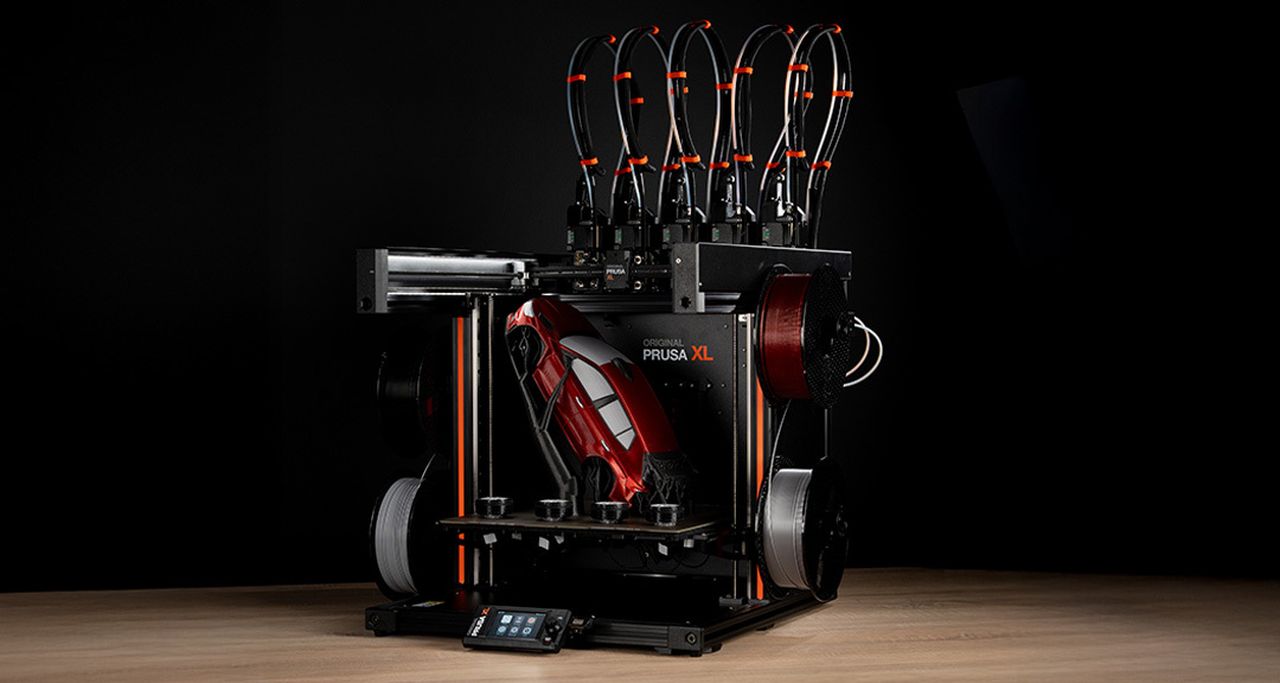
Prusa Research is positioning the Original Prusa XL for a bigger 2026 by comparing it with the newer INDX system and teasing new, non-FFF toolheads.
The immediate takeaway for XL owners and would-be buyers is that Prusa says the platform is still their “ultimate” multi-material toolchanger, and it is now selling at the lowest price the company has offered so far. At the same time, Prusa is clearly making room for INDX, its newer multi-material approach designed for the CORE One+ and CORE One L machines.
This matters because low waste solutions are splitting into two approaches. Most consumer multi-material solutions rely on a single nozzle with purging, wipe towers, and waste. Prusa’s toolchanging approach aims to avoid that, but XL and INDX do it in very different ways, with different tradeoffs around mass, heating, changeover time, and how far beyond plastics the machine can go.
Active Vs Passive Toolchanging
Prusa describes the XL as an active toolchanger: each toolhead is a complete print head with its own hotend and nozzle. The machine’s mechanism physically swaps entire toolheads, and Prusa says those heads can remain heated and ready, then power down automatically when not needed. The XL currently supports up to five toolheads.
INDX is a passive toolchanger. In that system, one active print head picks up passive “tools” that each hold filament and a nozzle. The tool gets docked, heated, used, and then swapped. Prusa likes INDX for its low moving mass, cost efficiency, and support for up to eight materials, but it also acknowledges that heating strategy changes the print speed.
On toolchange time, Prusa avoids publishing a single number and argues it is hard to compare fairly. The company explains why it expects XL to stay faster in pure toolchange terms: the XL’s nozzles are already close to target temperature, while INDX heats each newly selected nozzle from scratch, even if it does so quickly using induction.
Then there is build volume. Prusa reiterates that XL’s 360 x 360 x 360 mm capacity is over three times the CORE One+ volume, and about 50% more than CORE One L. That can turn a complex assembly into a single print job, which is one of the few advantages that cannot be replicated by clever multi-material plumbing.
Why XL Is Being Framed As A Platform
The more interesting part of Prusa’s update is that it is leaning into the XL as a modular platform, not just a five-material printer. The core idea is simple: once you can swap an entire toolhead, you can swap in something that is NOT a plastic extruder at all. Prusa says it plans to expand the XL with brand-new toolheads in 2026.
One headline addition, announced earlier, is a plug-and-play toolhead for printing liquid materials such as heat-resistant silicone. Prusa says the silicone toolhead was co-developed with Filament2 and makes applications like custom gaskets, insertions, or durable hinges possible on a desktop system. Notably, Prusa does not provide ship dates or pricing details here, beyond positioning it as a step down from historically “industrial” solutions.
Another toolhead in development is a Pick & Place concept, aimed at automatically inserting off-the-shelf components like magnets, threaded inserts, or bearings during a print. Prusa says it is co-developing this with Zurich University of Applied Sciences (ZHAW), and is targeting late 2026 for implementation. If it works as intended, it could reduce manual pauses and improve placement repeatability, especially for jigs, fixtures, and functional assemblies. This feature could be a game-changer for printing functional products.
Prusa also points to the community as evidence that XL is unusually adaptable. It highlights Proper Printing’s “Proper Extruder” project, where all five stock toolheads were replaced with belt-driven extruders better suited for very soft materials like TPU 60A. While that is not a stock configuration, it reinforces their message that XL’s toolhead interface is the real product.
On day-to-day operation, Prusa calls out several “hidden gems”: zero-waste multi-material printing that avoids prime towers, a segmented heatbed with sixteen independently controlled tiles, and the ability to run mixed nozzle sizes across toolheads. That combination targets a certain kind of user: someone printing long jobs, functional materials, and varied geometries, where reliability and reduced waste matter as much as raw speed.
The final practical update is pricing. Prusa says production refinements allow it to sell the Assembled five-toolhead XL for roughly US$200 less than before, depending on region and currency, and it notes that the Semi-Assembled version was discontinued at the end of 2025. What to watch next is whether Prusa can ship the promised toolheads on time, and whether XL owners see meaningful upgrade paths that feel proportional to the machine’s premium positioning.
In other words, XL’s future may depend less on how fast it swaps plastic, and more on whether it becomes the first widely used “toolchanging workstation” on a desktop. The toolchanging “feature” is now a toolchanging “strategy”.
Via Prusa Research
