
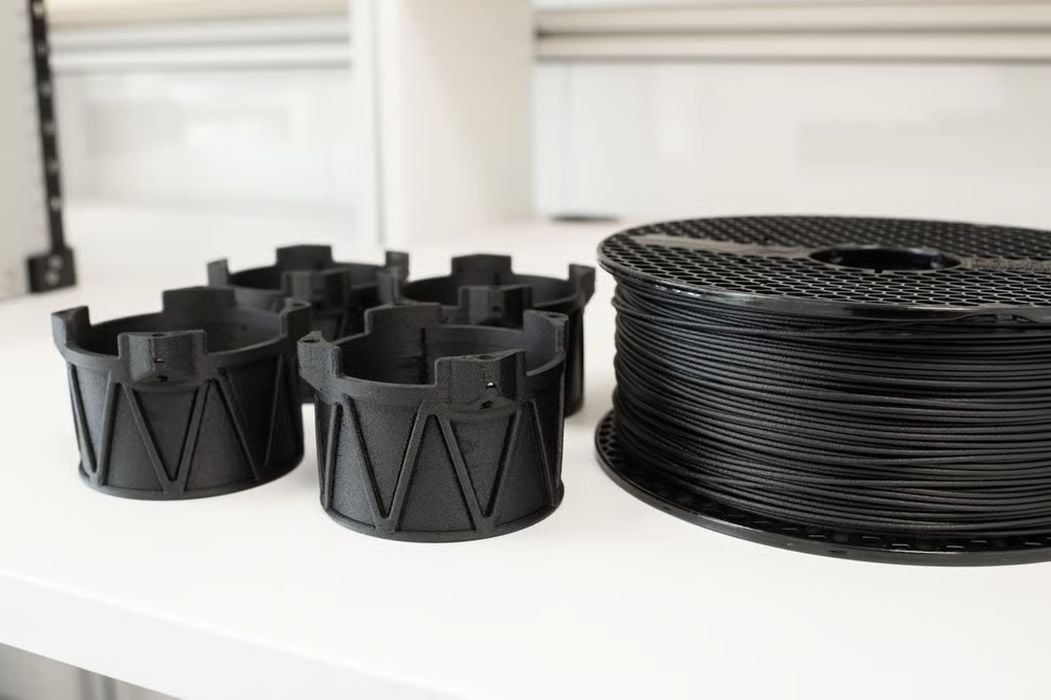
Prusa Research has just released a new filament product designed for use in space.
The new Prusament PC Space Grade Black is a very unusual material, one that I’ve never seen previously. The design goal of Prusament PC Space Grade Black is to enable successful 3D printing of parts destined for outer space, which is a very different environment.
While Prusament PC Space Grade Black is in fact a variant of the company’s normal PC material, made by mixing in unspecified “carbon additives”. These additives change the properties to meet the requirements.
But what those requirements might be? It turns out that the new material was actually a joint development project with nearby Czech company TRL Space. TRL Space is a one-stop shop for anyone wishing to build satellites, from tiny CubeSats to large deep space craft. Evidently, TRL Space required this type of material for upcoming projects.
You might be wondering what makes the space environment different than ground-based applications, and there are a few key differences. One is the lack of gravity, which in this case doesn’t affect the material properties — that’s more of a printer thing. There are two properties of interest here.
Electrostatic Discharge
One is ESD, electrostatic discharge. This is the effect that occurs when static electricity builds up on a surface and is suddenly discharged. That might not matter much for some 3D prints, but if your print is a housing for electronics, it can be rather critical. A sudden discharge might fry delicate electronics.
This is aggravated in space applications because the distance means you cannot easily replace the damaged electronics. Instead, you must prevent the ESD from occurring in the first place. That’s why you need ESD-safe materials.
The new Prusament PC Space Grade Black offers excellent ESD-safe properties, with measured dissipation being quite exceptional.
Outgassing
The other property of interest is outgassing. That’s the slow emission of gases from a material that happens naturally over time. You’ve definitely experienced this if you’ve ever smelled a new car: that’s the fresh plastic outgassing.
This is another critical property in space applications because parts might be used inside the enclosed environment of a space station. The emissions can pollute the small station’s air and potentially mess up experimental measurements. This is particularly evident if the 3D printed part is the housing of a sensor.
Even outside a space station, the black vacuum of space, outgassing can be a problem: outgassing effectively removes some amount of material from the part, lost to space. This could change the mechanical properties of the part, possibly compromising its function.
You just don’t want your parts off-gassing in space.
Here, Prusament PC Space Grade Black has extremely low off-gassing, as measured by the company.
Space Applications
This means that Prusament PC Space Grade Black is ideal for space applications: no ESD, no off-gassing, lightweight and with all the normal properties of PC material.
It’s relatively accessible, as well: it can be 3D printed on common desktop FFF 3D printers with easily used print parameters.
The cost of the material is quite a bit more than regular PC at US$250 per 850g (US$295/kg). However, this price is far less than other high-temperature materials typically used for this type of application. For those that need this kind of material, it’s a good price.
It’s interesting that Prusa Research is offering this material to the public. Evidently created as part of a joint project, that arrangement apparently allows the company to market it to others.
That should be good for the company as it establishes a path to a new set of applications in the space environment.
Via Prusa Research
