
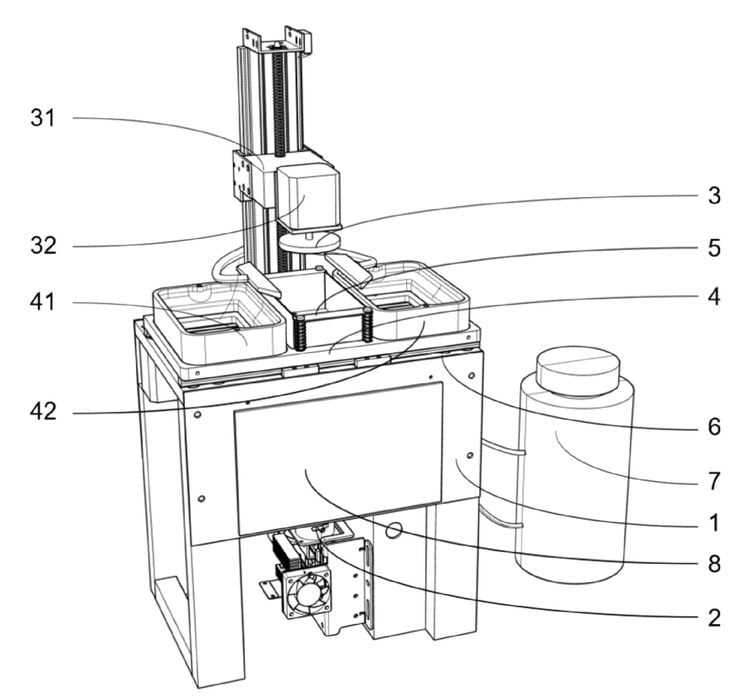
Shanghai JIZHI Zongheng Technology has patented a compact approach to dual-material resin 3D printing.
The patent, CN-224224532-U, describes “a dual-material projection photopolymerization additive manufacturing equipment.” In normal 3D print language, this appears to be a DLP-style resin 3D printer designed to switch between two different photopolymer materials during a print.
That is not a trivial problem, as you might imagine.
Resin 3D printing is superb for generating fine features, smooth surfaces, and relatively high-resolution parts. DLP, or digital light processing, uses a projected image to cure an entire layer at once, rather than tracing with a laser. It is a very useful process for dental, jewellery, microfluidic, engineering, and small-batch production applications.
But today’s DLP systems print one resin at a time. Changing materials mid-print is difficult because liquid resin tends to go everywhere it should not. A part emerging from one resin vat carries uncured material with it — the print is wet. Move that part into another vat too quickly, and the first resin contaminates the second.
That is the core issue Shanghai JIZHI seems to be solving with this patent.
A Different Take From PolySynth
This patent is especially interesting because it appeared almost at the same time as the new PolySynth 1, a resin 3D printer claiming multimaterial capability.
PolySynth’s approach is quite different. That system uses multiple circular resin tanks on a rotating platform, with the build plate moving between vats as required. It reportedly can handle up to eight resins, and the company says multiple materials on the same layer are possible by rotating vats without changing the Z level. The listed price is US$4999, and the machine is currently offered for pre-order.
https://www.fabbaloo.com/news/new-resin-3d-printer-can-print-in-multiple-materials
Shanghai JIZHI’s patent appears more modest, but possibly more controlled. Instead of up to eight vats, it describes two independent resin tanks, a DLP projection optical engine, a height-adjustable and rotatable printing platform, a resin tank assembly, a cleaning tank assembly, and a linear guide rail.
Both the resin tank assembly and cleaning tank assembly are mounted on the guide rail. That suggests the system automatically switches between workstations: resin one, cleaning, resin two, and presumably back again as required.
In other words, PolySynth seems to focus on expanding the number of available resins through a rotating vat carousel, while Shanghai JIZHI’s utility model focuses on a compact two-material workflow with a dedicated cleaning station.
PolySynth’s clever trick is spin drying the build plate so excess resin flies back into the original vat. Shanghai JIZHI also uses platform rotation, but adds jet drying through compressed air input, multi-directional air nozzles, and a cleaning fluid recovery pipe. That implies a more elaborate cleaning operation between material changes.
The goal is the same in both cases: prevent cross-contamination. The mechanism is not identical, and therefore the patent should be valid.
The Catch Is Resin Management
Dual-material resin printing would be most useful when the two materials are notably different. One might be rigid and the other flexible. One might be transparent and the other opaque. One could be conductive. Another could be a sacrificial support material. Dental appliances could use multiple hardness levels. Research labs could build high-precision heterogeneous structures with material placement that actually matters.
But the hard part is not simply having more vats. It is keeping the process clean, repeatable, and fast enough to be useful.
Shanghai JIZHI’s cleaning tank may provide a more deliberate way to remove resin before material changes. That could reduce contamination more effectively than spin drying alone, especially on geometries that trap liquid resin in cavities. On the other hand, it could also add operator complexity, consumables, maintenance, and cycle time.
PolySynth’s approach looks simpler and more ambitious with eight materials. Shanghai JIZHI’s looks more conservative and possibly more industrial in its cleaning logic.
Neither approach escapes the same questions. How much resin remains on the part after drying? How long does each material transition take? What happens to delicate features under spinning or air jets? Which resin combinations are actually compatible? Does repeated cleaning affect adhesion between materials?
Those findings will determine whether this is a practical manufacturing workflow.
There is also the usual patent caveat: CN-224224532-U is a utility model, not a product announcement. It suggests what Shanghai JIZHI is thinking about, but it does not prove the company has a commercial dual-material DLP machine ready for buyers.
Still, the timing is notable. PolySynth shows that startups are actively trying to make desktop multimaterial resin printing real. Shanghai JIZHI’s patent suggests others are circling around the same problem from a more contained, two-material direction.
My suspicion is that multimaterial resin printing will not be won by whoever has the most vats. It will be won by whoever can manage resin contamination, alignment, cleaning, and slicing without making the user babysit the machine.
The proof will be in the mess.
Via Espacenet
https://worldwide.espacenet.com/patent/search/family/099709953/publication/CN224224532U?q=CN224224532U
