
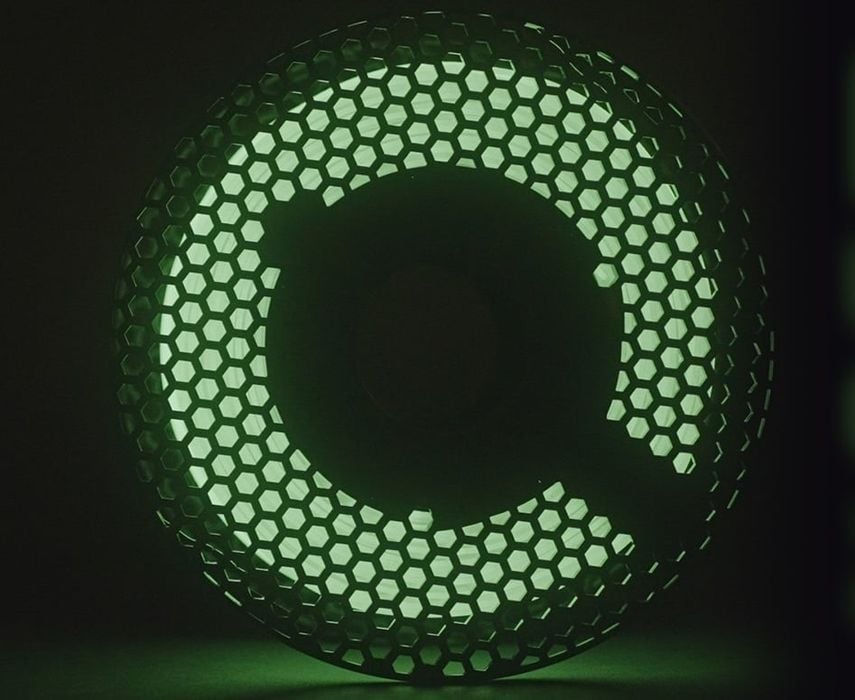
Prusa has introduced Prusament PETG Ultraglow Green, a glow filament it claims is the brightest on the market — with a major concern for wear on hardware.
Why This Glow Filament Is Different
Glow-in-the-dark filaments are hardly new, and most 3D printer operators have tried at least one “glow” PLA that looks great right after charging and then fades quickly. Prusa’s pitch in this release is that it did not try to make a “normal” glow material. Instead, the company says it packed clear Prusament PETG with as much glow powder as it possibly could, while still keeping the material reliably printable.
The glow effect comes from strontium aluminate, a phosphorescent pigment commonly used in signage and other consumer products. Prusa fortunately points out that it is completely non-toxic, non-radioactive, and stable around water and typical household chemicals. Like other glow materials, it needs to be “charged” under a bright light source, and UV light is the most effective, according to the company.
Using PETG instead of PLA is an interesting choice by Prusa Research. PETG is generally tougher than PLA and also more temperature resistant, which means the company is aiming beyond simple toys and decorative prints. The idea here is to make functional parts where glowing features are actually useful: a handle, a switch locator, a pointer, or a safety marker that can be found quickly in low light.
Brightness, Price, And That Hidden Cost
To support its brightness claim, Prusa says it bought competing branded glow filaments (which they did not name) and ran a simple comparison: identical #3DBenchy prints, charged for 20 minutes with a 405nm UV source (its own CW1S unit), and then photographed for glow intensity. Prusa also published a luminance-over-time plot for the new Ultraglow Green, although long-duration comparisons against the other samples were not provided.
The filament is currently offered in green, with additional colors “on the way.” Pricing is unambiguously premium: an 800g spool is listed at US$83 (import duties included) or €70 (VAT included), quite a bit more than a spool of plain PLA. Prusa did not indicate whether lower-cost, lower-loading variants will follow, but their strategy here suggests this material is intended as a flagship specialty material rather than a commodity filament.
The bigger issue for many users will be abrasion. Strontium aluminate is an extremely hard material, and Prusa calls this the most abrasive material it has ever produced, comparing it to “liquid sandpaper.” A hardened nozzle is absolutely mandatory, as brass nozzles would wear out rapidly. Prusa also warns that high-volume printing can accelerate wear on PTFE tubes and other hardened components, including hardened steel nozzles and Nextruder gears, even if occasional printing is unlikely to be a problem.
Print settings matter too. Prusa recommends a 0.6 mm nozzle to reduce clogging risk, though it provides 0.4 mm profiles. Somewhat counterintuitively, it also says standard (non-high-flow) nozzles work better for this material. For those wanting maximum durability, Prusa Research points at E3D’s DiamondBack nozzle as an option that should resist the abrasive pigment.
Another unknown is compatibility with filament swapping accessories. Would this abrasive wear down the components and tubes in, say, a Bambu Lab AMS? Most of these units say not to run carbon fiber filaments in them, so it is likely the new glow PETG would suffer the same fate.
This material looks best suited for workshops and makers already accustomed to abrasive filaments like carbon-filled nylons, where hardened nozzles and routine consumable replacement are part of the normal workflow. For casual users, the filament may be most sensible as an accent material: print most of the part in standard PETG, then add small glowing sections for wayfinding and status indication.
What to watch next is independent confirmation over longer glow intervals and real-world wear rates. “Brightest” can be true in the first minutes after charging, yet still disappoint over half an hour in a dark hallway. If Prusa or users publish standardized tests across longer time spans, and if the community shares nozzle-life data, we will have a clearer picture of the true operating cost.
Glow is fun, but the most interesting glow filament is the one you can afford — and the one that does not quietly eat your hotend.
