
Snapmaker has filed a patent that tries to make multicolor FFF printing less wasteful without slowing the job to a crawl.
Multicolor FFF today typically falls into two approaches.
The first is single nozzle systems that swap filaments through a shared hot end, as seen in popular filament changer approaches. Those setups can produce impressive results, but they pay for every color change with purge volume, prime towers, and time spent waiting for the next filament to load and stabilize.
The second approaches uses multiple toolheads or dual extrusion, ranging from fixed dual nozzle designs to Independent Dual Extruder (IDEX) machines and full toolchangers, which can reduce contamination and waste but raise mechanical complexity and cost.
The patent, titled “Multi Color 3D Printing System and 3D Printing Method,” positions itself in the middle: keep multiple material paths ready, but focus on reducing “human touch time” and minimizing purge driven waste.
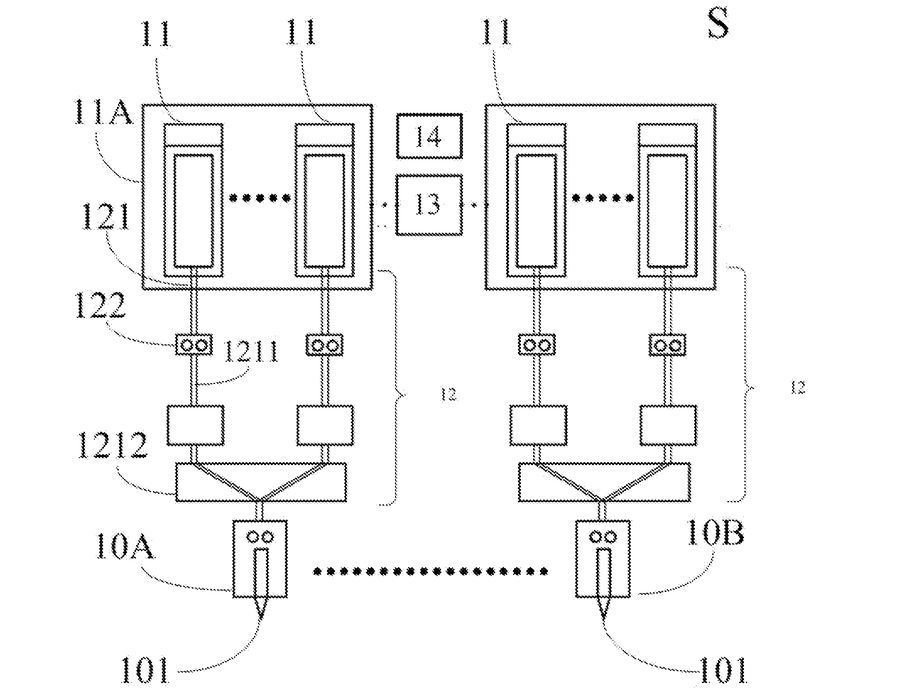
In the patent’s system, the 3D printer has at least two print heads, each with an extruder, plus one or more filament storage bins. The key hardware detail is a material channel near the storage side that splits into multiple parallel passages, each paired with its own feed and retract mechanism. Those parallel passages merge near the print head side into a multi in one channel that delivers filament to the extruder.
That configuration enables two different changeover modes. In the first, when both the current filament sequence and the next filament sequence are routed to the same print head, the system performs a swap: It retracts the current filament, feeds the next filament through one of the parallel paths, and uses the incoming filament to push the remaining molten material out of the extruder before heating the new filament to a ready state.
This could be an attempt to make single nozzle style swapping simpler and more deterministic by managing the feed path selection and timing, rather than relying on a single shared tube and a lot of purge.
The more interesting mode is the parallel change. If the control unit decides the next filament is connected to a different print head, it can pre feed that next filament into the second head while the first head continues printing: swapping WHILE PRINTING!
The patent then has the system heat the second head’s filament to a molten ready state, park the first head, and immediately resume printing with the second head. The “next color” tool can be staged during productive printing time, which can cut the dead time that dominates frequent color jobs.
There is also a software chain angle. A material management unit tracks which bin holds the current sequence and which bin holds the next sequence, and the control unit can pull the next color from slicing software to decide what to stage next. That hints at tighter integration between slicer instructions and hardware readiness, similar in spirit to what toolchangers already do, but focusing on routing and preheating logic rather than elaborate docking mechanisms.
Snapmaker does not provide numbers in the provided text for swap time, purge reduction, or throughput, and the patent leaves material compatibility broad. The approach also raises some potential problems: multiple feed and retract mechanisms add parts that can drift in calibration and keeping a standby tool hot long enough to be “ready” risks polymer degradation and drips unless temperatures are managed carefully. However, if Snapmaker can make filament staging reliable, the payoff could be exactly what annoys users of single nozzle filament swappers: waste and long swap times.
If this concept is implemented into Snapmaker’s current strategy, their competitive positioning may change. Systems like Bambu Lab’s AMS minimize user effort but still burn filament on purges, while toolchangers like Prusa XL reduce contamination but demand precise mechanics and cost. A dual head, pre feed strategy could create out a middle ground if it delivers predictable switching with less waste at a consumer friendly price. Not quite a VORTEK or INDX, but something inbetween.
We’ll have to see Snapmaker’s measured swap times with real multicolor print jobs, how often the staged head really needs recovery purges, and whether the parallel channel design can survive long print jobs.
This is a fascinating development that might enable Snapmaker to produce a desktop 3D printer that is low waste, but not as high priced as the competition.
Via WIPO Patentscope
