
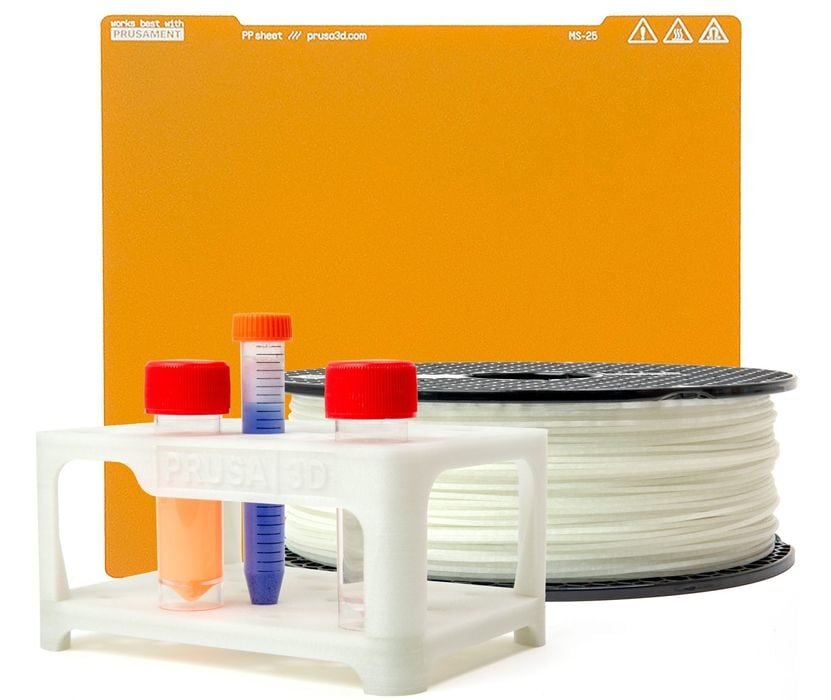
Prusa Research launched two new materials last week, and they’re both quite interesting.
One material is a filament, Prusament PP Glass Fiber. This is the company’s polypropylene material, but mixed with a ratio of chopped glass fibre. The fibre provides quite a bit of rigidity to the material.
PP is a terrific material as it has high thermal and chemical resistance. That’s why it’s often used in many commercial applications. However, it is a bit flexible, meaning it can’t always be used for applications where rigidity is required.
The addition of glass fibre changes all that, producing a very strong material that can be used to print highly durable mechanical parts. Prusa Research describes some potential applications:
“Due to its lightweight properties and extreme heat and chemical resistance, the Prusament PP Glass Fiber is suitable for demanding applications in the automotive and aerospace industries. It can serve its purpose in laboratories for custom equipment, such as vial racks. And finally, hobbyists may find this filament useful for printing drone parts and other components that require outstanding mechanical properties.”
The really interesting part is the material’s chemical resistance. Prusa Research published a chart of the material’s reaction to a range of nasty substances, which shows that it is immune to most of them. The exceptions are chloroform, hydrochloric acid, hydrogen peroxide, and nitric acid. If you’re not exposing the part to any of these corrosive fluids, it’s going to be just fine.
PP is notoriously challenging to print as it does not properly adhere to standard PEI print plates. For this reason, Prusa Research also provides specialized PP print plates that are chemically ready for the material. They can also be used for certain other 3D print materials.
Prusa Research also markets a PP-CF product, but the difference here is that PP-GF is white, rather than the black caused by the carbon fibre. This means that it would be possible to dye PP-GF prints in desired colours.
The other material introduced was Prusament Resin Impact65. This is a photopolymer resin that is designed to provide higher impact resistance.
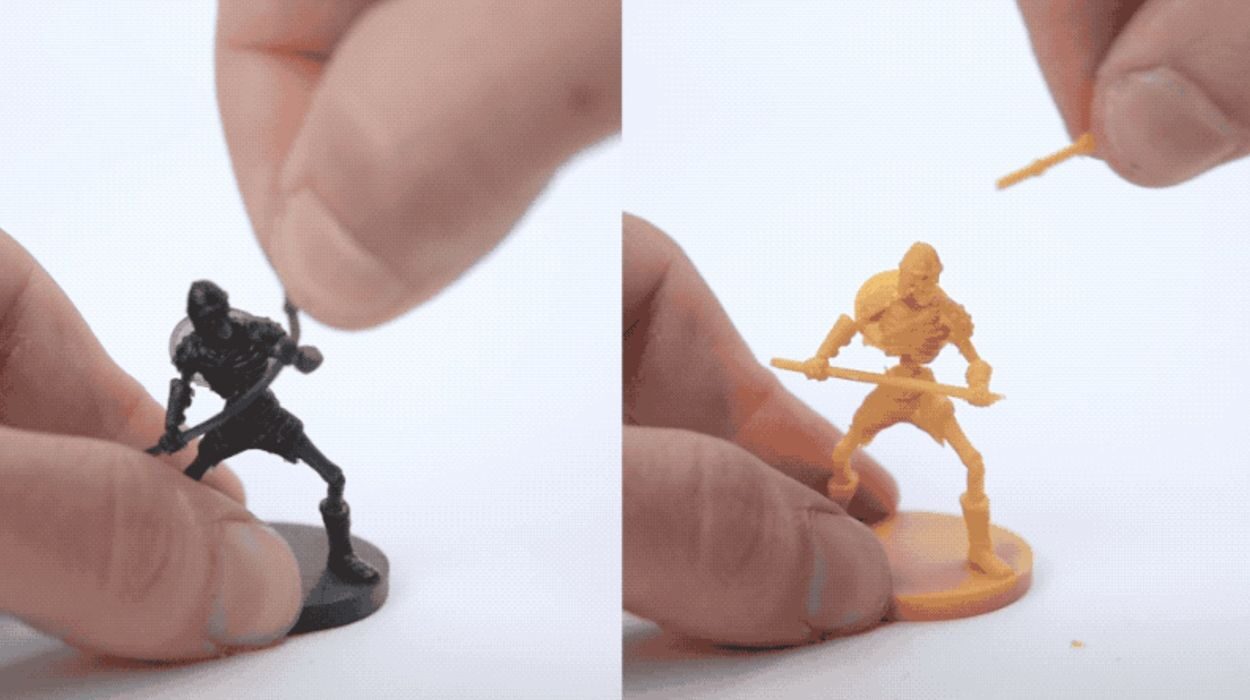
Impact resistance is a common problem with most resin 3D prints. The prints may be quite detailed, but they are typically quite brittle. This makes it challenging to print highly detailed models because removing supports risks breaking spindly parts of the model. And of course, handling the brittle parts afterwards often causes breakage.
The new material’s engineering properties include:
- Izod impact strength 65 kJ/m2
- Tensile strength 25 MPa
- Elongation up to 30%
If you’re reading carefully, you’ll note that this makes Prusament Resin Impact65 somewhat close to TPU in that it’s slightly flexible.
This makes prints much more durable when faced with bending or impact forces. For anyone printing highly detailed 3D models in resin, this material could be extremely attractive.
Even better, Prusa Research has done their best to ensure this resin has the “lowest possible toxicity”.
Prusament PP Glass Fiber Natural (850g spool) is available now for US$70 (US$82/kg), and a 1kg bottle of Prusament Resin Impact65 goes for US$69.
Via Prusa Research
