
Prusa Research seems to be taking a step away from traditional open source principles.
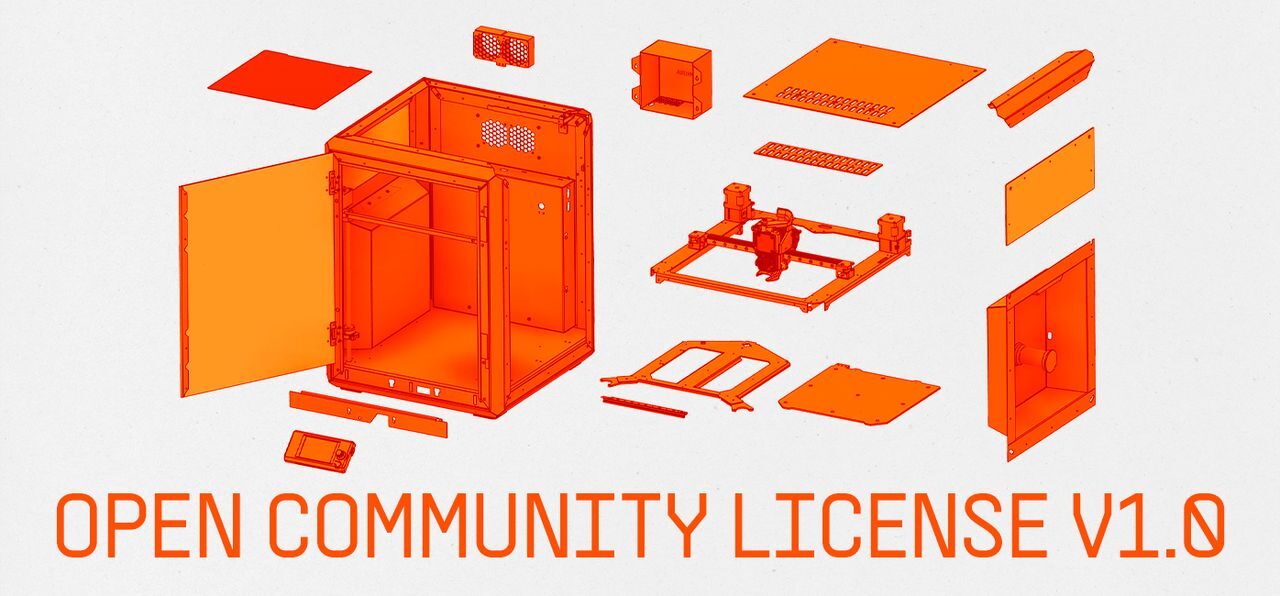
The company has long championed open source projects, and up to now, has largely provided their system designs in open source form. Now, however, they have released the CAD files for their latest device, the Core ONE, with a brand new license, the “Open Community License”. This license is not a true open source license, as it includes some restrictions not present on traditional open source licenses.
Open Source and 3D Printing
How did we get here? Open source first appeared in the software world as a means to encourage community involvement in shared development projects. The basic idea was this: feel free to invent new features to be added to the system, use the system in any way you like, and maintain that same license going forward. This has been quite successful in the software world, leading to the enormous success of many of today’s free software tools, such as Linux, Blender, and many others.
The hardware community wanted the same outcome, and began using the same licenses. The open principles allowed open hardware users to understand exactly what they are using/building, repair the equipment, design and pass on interesting modifications, etc. Through this activity evolved large DIY communities that follow specific hardware projects.
Problems with Open Source Licenses
However, it turns out there is a massive difference between the software and hardware worlds. The licenses really apply only to the digital artifacts, like software code. In the case of open source hardware, the digital artifact is the design.
To use a software license you simply run the software on a computer. Anyone can run software equally on their equipment.
To use the digital design files for open source hardware you must physically manufacture the device. But that’s where things differ. The cost of manufacturing is wildly different depending on location.
Some regions (Asia, specifically) are able to manufacture products vastly cheaper than in the West. This difference allowed Asian companies to mass produce the same designs at far lower cost, often undercutting the original Western designer.
Legal? Yes, the open source licenses of the time permitted such use — that’s literally how the licenses were designed — anyone can use them. Ethical? Perhaps not, as the original designers often lost out in the commercial market because competitors’ products cost less.
This is the dilemma facing every Western product manufacturer that intends on carrying forward open source principles. If the design is sufficiently popular, it could be replicated by someone that can manufacture it at lower cost and potentially put the designer out of business.
In the 3D print world this scenario first appeared with MakerBot, which began with fully open source principles. Later, they found their designs being legally marketed by Chinese manufacturers at far lower cost, about half, if I recall. This would have put MakerBot out of business, so they took the drastic step of transforming into a closed source company. That effectively destroyed their open source community support, and to this day still carries bad vibes.
Prusa Research is facing the same dilemma today. As the leading Western 3D printer manufacturer, they are quite large and still adhere to open source principles.
It might be noble to support open source principles to the death, but then they see how other companies disappeared by doing so. They also saw how MakerBot lost virtually all of their support by going closed source. Neither option is good.
Open Community License
This week Prusa Research is trying something new: a completely different license. It isn’t quite open source, nor is it closed source. It’s something in-between.
The short, easy-to-read “OCL” allows the usual open source permissions and carry forward obligations, but with some new restrictions. The main one is that you cannot “Sell complete machines or remixes based on these files.”
This allows makers to tinker with their machines, and business operators to make changes to internally used equipment. You just can’t sell any machines, or, it seems, modifications. You can share the modifications, however.
The idea here is that Prusa Research is attempting to block those who might copy their design and manufacture it at lower cost. They write:
“We have seen it happen too many times: A talented community member designs a brilliant extruder or hotend mod. A commercial entity sees it, mass-produces it, and sells it without giving a cent (or sometimes even credit) back to the creator.”
This is true, and the OCL may indeed help some hardware designers who also make use of it with their designs.
But this is really about backstopping Prusa Research’s designs from being adopted via traditional open source licenses. In a very real way, the OCL is not an open source license in the traditional definition. It’s a kind of hybrid between open and closed usage: it’s open, except when it’s closed.
Time will tell whether this approach works for Prusa Research. It certainly puts up new barriers that Asian manufacturers must deal with.
It may not matter in the end, however. Certain Chinese 3D printer manufacturers have recently obtained massive new funding from several very large investors, making them far more capable than they have been. It seems to me that these few companies will likely overtake all other Chinese 3D printer manufacturers within a few years, and it will be extremely challenging for any company, Western or not, to compete.
Via Prusa Research and GitHub
