
Announced last week, Recreus has proposed a dramatic change to filament standards.
Recreus is a Spanish company that specializes in the production of flexible TPU filament under their brand name, FilaFlex. Their products are quite popular, and are available in a range of shore hardness, from 95A down to 60A. They also sell a range of other filament products in PLA, PETG and PP.
TPU is a highly desired print material because you can produce flexible objects with it. These might include hinges, coatings, gaskets, grips and more.
The problem is that it is quite difficult to print due to its very flexibility. Pretend you are an extruder and magine trying to push a flexible filament down a long PTFE tube. It just doesn’t work because the flexible filament bends and cramps up in the tube.
Similarly, the wiggly nature of flexible filaments can cause havoc inside the toolhead’s extruder. It can mistakenly wrap around the extruder gears, or get lost on its way to the hot end — unlike rigid filaments that proceed on a straight path. Successful printing usually requires very slow print speeds to avoid bends and twists in the floppy material.
The problem has been aggravated recently with the introduction of many filament swapping systems, like Bambu Lab’s AMS. These units hold typically four spools of filament and sit well outside the 3D printer. The filaments are pushed and pulled to and from the 3D printer’s hot end via lengthy PTFE tubes. It works very well.
But not for TPU.
In all cases, you will find that TPU is “incompatible” with the AMS/CFS/ACE Pro/etc.
In rare cases TPU can be printed, but the shore hardness is so high that it’s rigid enough to be properly pushed. However, that hardness is not nearly the softness you will usually need for your flexible print job.
To solve the problem, most 3D printer manufacturers these days set up special configurations to handle flexible filaments. For example, Bambu Lab’s H2D has two extruders, but you can only use one of them for printing TPU, and the TPU must be mounted on the external spool, not the AMS.
It works, but it’s really quite a pain.
Last week Recreus proposed a solution to all this with their new “FilaFlex 2.20 System”.
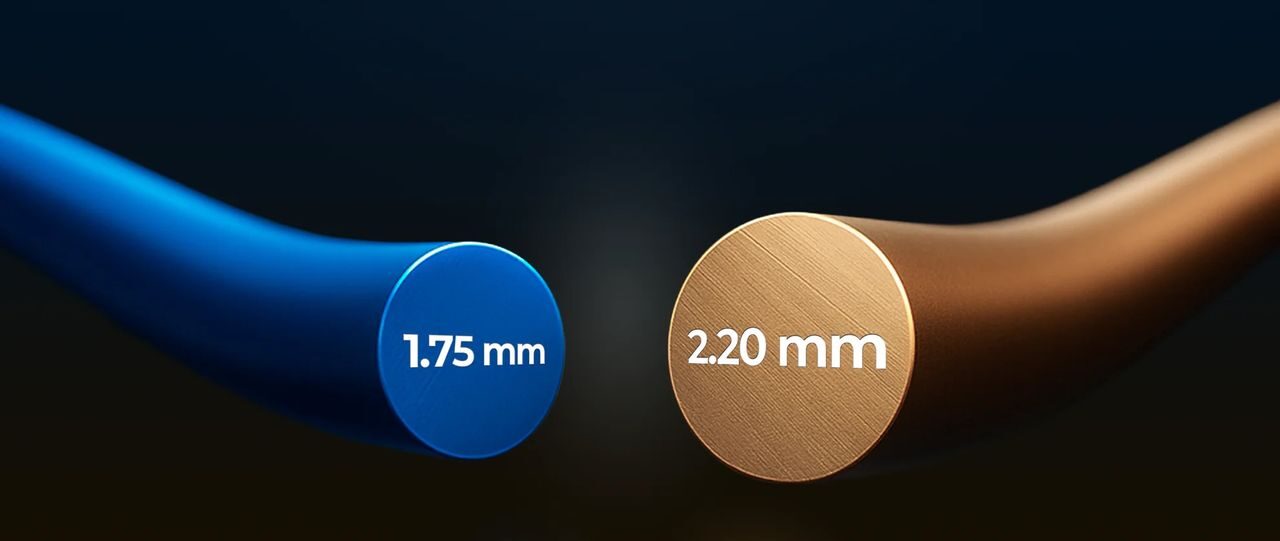
What is it? Well, simply put they want to increase the diameter of the flexible filament from 1.75mm to 2.20mm. This makes it thicker and therefore a bit more rigid, sufficient to be handled by filament swappers.
The company performed considerable research and testing to determine that 2.20mm was the ideal diameter to provide just enough rigidity to enable reliable and faster 3D printing. Their statistics show print speeds increasing by 2-4X, depending on the specifics of the situation.
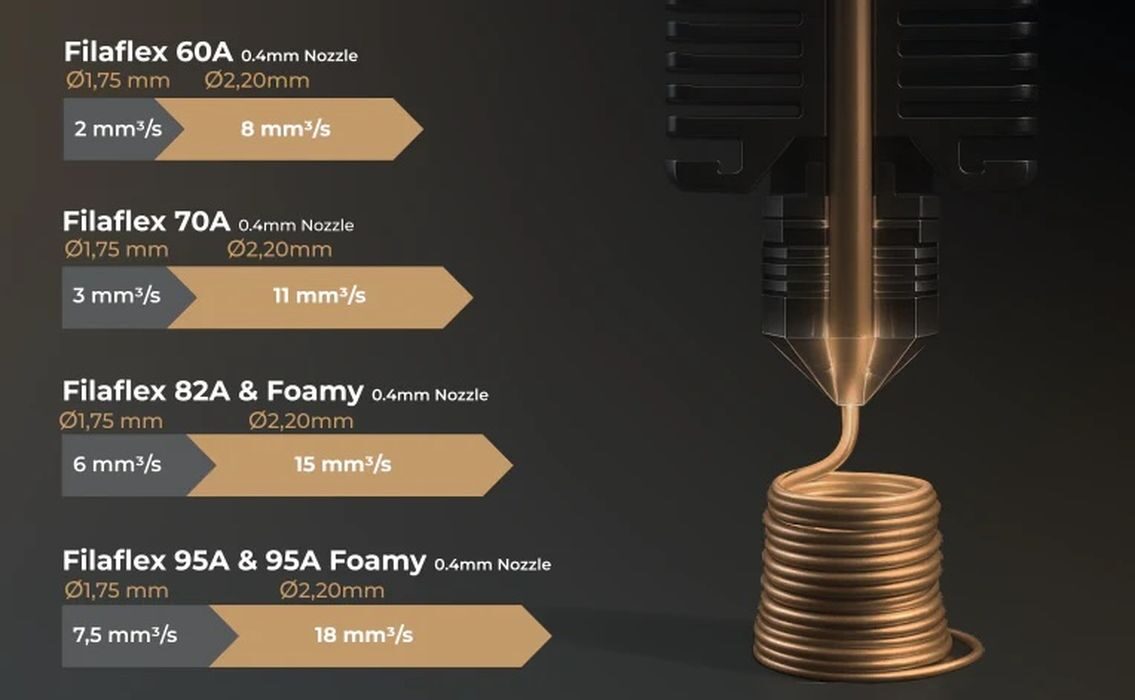
Hold on, how does this work? Aren’t 3D printers designed to use 1.75mm? Yes indeed they are. But this is how Recreus proposes it will work:
- Mount a new 2.20mm FilaFlex spool on the spool holder
- Edit the filament profile’s diameter to be 2.20mm
- Swap the hot end on the 3D printer with one of Recreus’ new special 2.20mm hot ends
- Slice and print
They say they are already compatible with some Prusa and Bambu Lab machines, with more options to come. Basically they have to design a hot end that is compatible with the target machine’s mounting system, so this shouldn’t be too difficult.
This should actually work; the thicker diameter will clearly reduce all kinds of extrusion issues with flexible TPU, and result in far more reliable and faster printing.
But will this succeed as a business venture? That, I am not so sure. Anything that requires user action will automatically knock of many potential users, and this requires not only the purchase of different materials, but also different hardware.
Could this be used with the filament swapping systems? I suspect not, because they all use 1.75mm diameter PTFE tubes to lead to the 3D printer, and a 2.20mm filament would not fit. Will these tubes be retrofitted or changed by the manufacturers? Not likely.
The 1.75mm diameter standard has been around for over 15 years, and it is so deeply incorporated into the 3D print ecosystem that it will be impossible to replace, so that is not happening. The Recreus 2.20mm system will therefore always be a niche product, the exception to the rule.
What Recreus needs here is an endorsement and action from one of the leading 3D printer manufacturers, and I am not certain they will get it. That’s because they all have already developed methods to print TPU, albeit slowly. In other words, this should really only of interest to those who are printing huge amounts of TPU that require throughput increases. If you can print the occasional TPU object overnight, who cares if you can get it done faster?
In retrospect, someone back in 2010 should have decided the standard would be 2.20mm instead of 1.75mm, and then none of us would be having this discussion today.
Via Recreus
